
EN 301 549 vs Section 508: the rows a 508 ACR does not have
 By David LoPresti August 4, 2026
 A European buyer has asked for EN 301 549 conformance evidence. You hold an Accessibility Conformance Report built on the VPAT 508 edition, every row in it is populated, and the position that costs nothing to hold internally is that the two documents are the same requirements with different covers.
Here is the fastest way to settle it. Open the Revised Section 508 Standards at Chapter 4 and read provision 412.5. The heading and one word are the whole provision:
“Real-Time Text Functionality. [Reserved].”
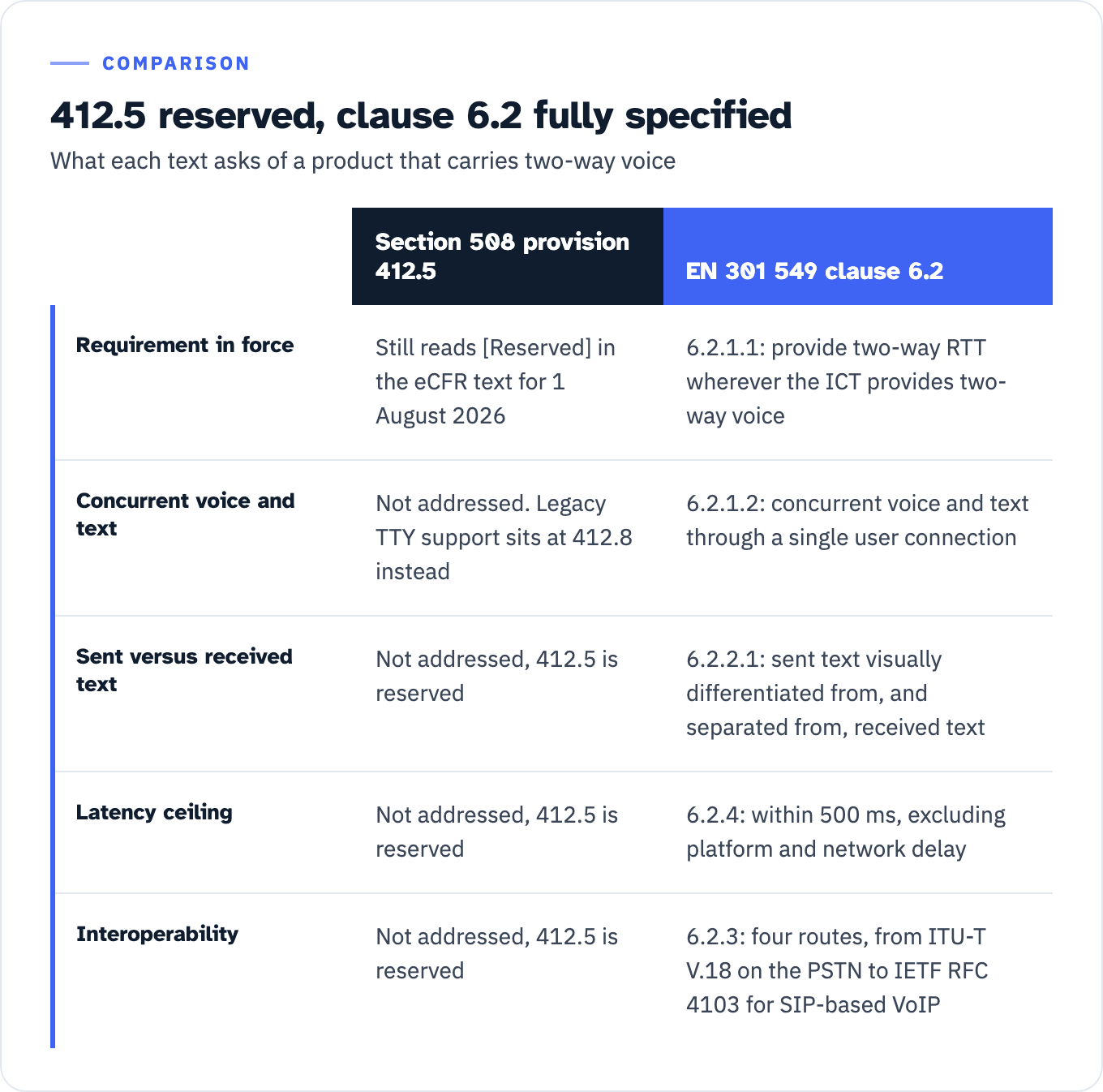
That text sits in 36 CFR part 1194, Appendix C, and it is what the eCFR returned for 1 August 2026. The provision is numbered, it sits between 412.4 Digital Encoding of Speech and 412.6 Caller ID, and it imposes nothing. EN 301 549 V3.2.1 spends four subclauses and a 500 millisecond ceiling on the same subject.
Then open the template you reported in. ITI’s VPAT 2.5Rev 508 edition does carry a 412.5 row, and both of its response cells arrive pre-filled with “Reserved for future”. A supplier who populated every row populated nothing there and had no prompt to notice. The EN 301 549 edition of the same template carries eight rows under clause 6.2, from 6.2.1.1 RTT communication through 6.2.4 RTT responsiveness, and a tester has to answer every one.
That is what a clause gap looks like once it reaches a report: not a weak answer, but no place to put one. What follows is the rest of the delta, read out of both texts and against the Access Board’s own comparison where it made the call. Mapping it before testing starts is part of our VPAT and ACR work.
The Access Board compared the two, then refused the equivalence
A crosswalk exists, and it is narrower than its heading suggests. The Access Board put a discussion headed “Comparison of Final Rule With EN 301 549” into the preamble of the 2017 final rule, 82 FR 5790, reproduced on the Access Board’s ICT page. The table under that heading is Table 2, captioned “Formatting Differences Between the Final Rule and EN 301 549”, and the Board scopes it in the sentence directly above: “Organizationally, the documents differ in several respects. These general differences are outlined in Table 2 below”. Four of its cells go past formatting and decide substance, and those four are the ones used here.
The prose around the table carries more weight than the table does. On what harmonization means:
“Harmonization, however, does not necessarily mean that the technical requirements for accessibility are exactly the same as between the final rule and EN 301 549. Rather, harmonization exists when the two sets of technical specifications are complimentary [sic], in the sense that compliance with each can be achieved simultaneously without conflict.”
On what the review found:
“The Access Board evaluated EN 301 549 on a provision-by-provision [sic] and has determined that there are no conflicts between the technical requirements in the final rule and those specified in EN 301 549. However, we also concluded that, in some situations, EN 301 549 does not provide sufficient accessibility.”
And on what the Board did with that finding:
“For the foregoing reasons, the Access Board declines to reference EN 301 549 in the Revised 508 Standards or otherwise state that conformance with EN 301 549 equates to compliance with the final rule.”
No conflict is a statement about contradiction: you can satisfy both at once. It says nothing about coverage. The Board called the divergence deliberate, “because it finds that other technical requirements provide better accessibility”, and a deliberate divergence still leaves a report row unanswered.
One warning before you take Table 2 to a customer. It was written against EN 301 549 V1.1.2, and the clause numbers have moved. Its row reading “Section 8.3.2 Clear floor or ground space” is clause 8.3.4 in V3.2.1, where 8.3.2 is now Forward reach. Cite the table by content and name the version you are quoting, or a buyer who opens 8.3.2 in the current standard lands somewhere else and concludes your analysis is wrong.
Three assumptions worth retiring first
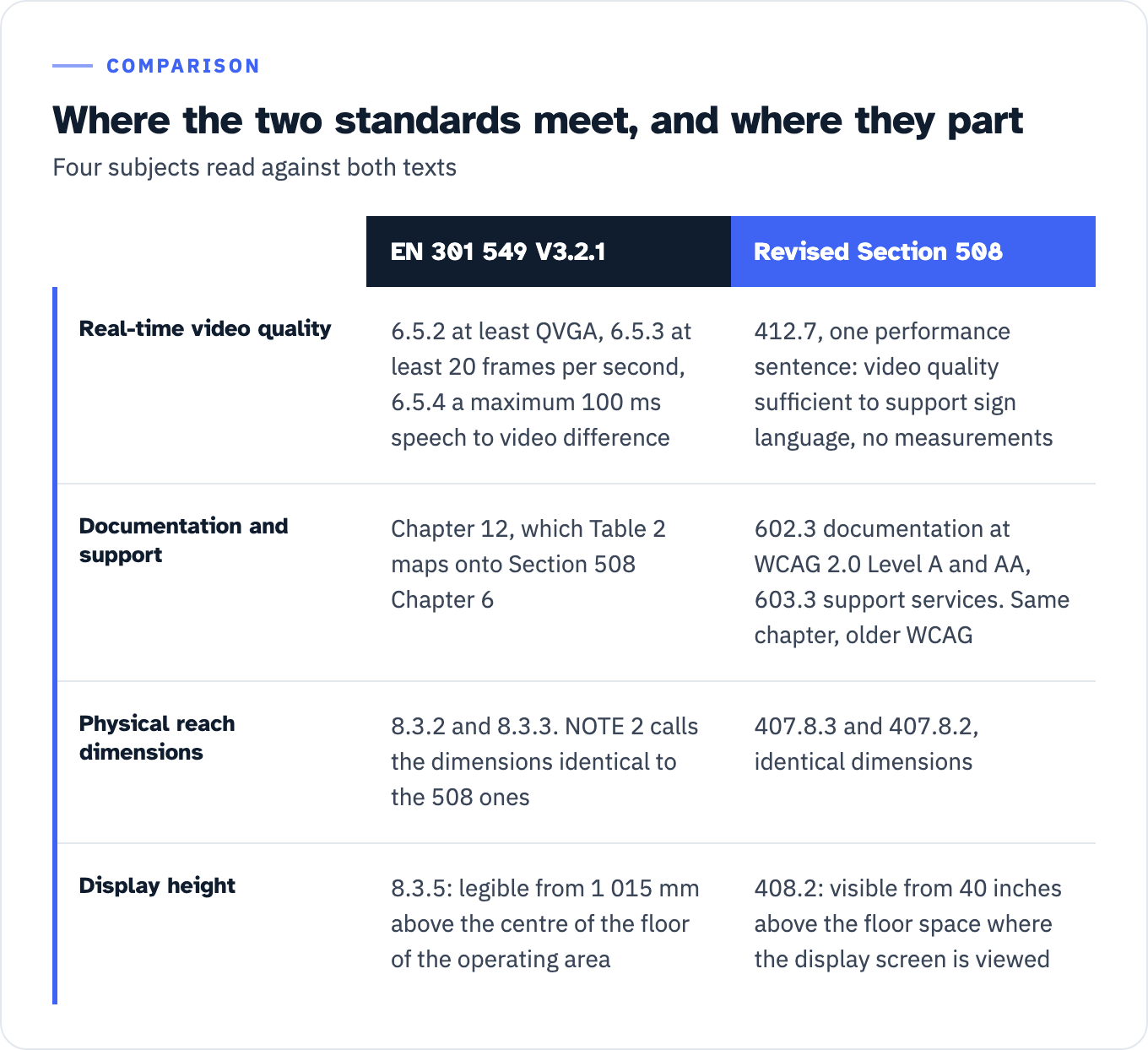
Two-way voice is not the gap. Two things inside it are. Section 508 Chapter 4 carries provision 412, ICT With Two-Way Voice Communication: eight top-level provisions, 412.1 through 412.8, eighteen counting subprovisions. Real-time text is the empty one. Video is the thin one. Provision 412.7 reaches video in a single performance sentence, “Where ICT provides real-time video functionality, the quality of the video shall be sufficient to support communication using sign language”, and the Board flags the mismatch in Table 2: “Their 6.5 is a prescriptive standard while our 412.7 is a performance standard.” EN 6.5.2 requires at least QVGA resolution, 6.5.3 at least 20 frames per second, 6.5.4 “a maximum time difference of 100 ms between the speech and video presented to the user”, 6.5.5 a visual indicator of audio activity and 6.5.6 speaker identification. A 508 record for 412.7 carries none of those measurements. The EN template gives each one its own row.
Documentation and support is a whole chapter, not a gap. Table 2 maps EN Chapter 12 onto Section 508 Chapter 6, Support Documentation and Services, where 602.3 requires that electronic documentation “conform to Level A and Level AA Success Criteria and Conformance Requirements in WCAG 2.0” and 603.3 requires support services to “accommodate the communication needs of individuals with disabilities.” The difference here is the WCAG version, not the chapter.
Physical reach dimensions match, and EN says so. NOTE 2 under clause 8.3.1 of EN 301 549 V3.2.1 states:
“The dimensions set out in clauses 407.8.3 and 407.8.2 of Section 508 of the Rehabilitation Act, as published in January 2017 [i.25], are identical to those given in clauses 8.3.2 and 8.3.3 of the present document.”
Display height is close but not identical. Section 508 provision 408.2 asks that a screen be “visible from a point located 40 inches (1015 mm) above the floor space where the display screen is viewed”. EN 8.3.5 asks that “the information on the screen is legible from a point located 1 015 mm (40 inches) above the centre of the floor of the operating area”. The dimension matches; the verb does not, and legible is a harder test than visible, taken from a differently defined point.
View the data as a table
| EN 301 549 V3.2.1 | Revised Section 508 | |
|---|---|---|
| Real-time video quality | 6.5.2 at least QVGA, 6.5.3 at least 20 frames per second, 6.5.4 a maximum 100 ms speech to video difference | 412.7, one performance sentence: video quality sufficient to support sign language, no measurements |
| Documentation and support | Chapter 12, which Table 2 maps onto Section 508 Chapter 6 | 602.3 documentation at WCAG 2.0 Level A and AA, 603.3 support services. Same chapter, older WCAG |
| Physical reach dimensions | 8.3.2 and 8.3.3. NOTE 2 calls the dimensions identical to the 508 ones | 407.8.3 and 407.8.2, identical dimensions |
| Display height | 8.3.5: legible from 1 015 mm above the centre of the floor of the operating area | 408.2: visible from 40 inches above the floor space where the display screen is viewed |
The clause groups a 508-edition ACR has no row for
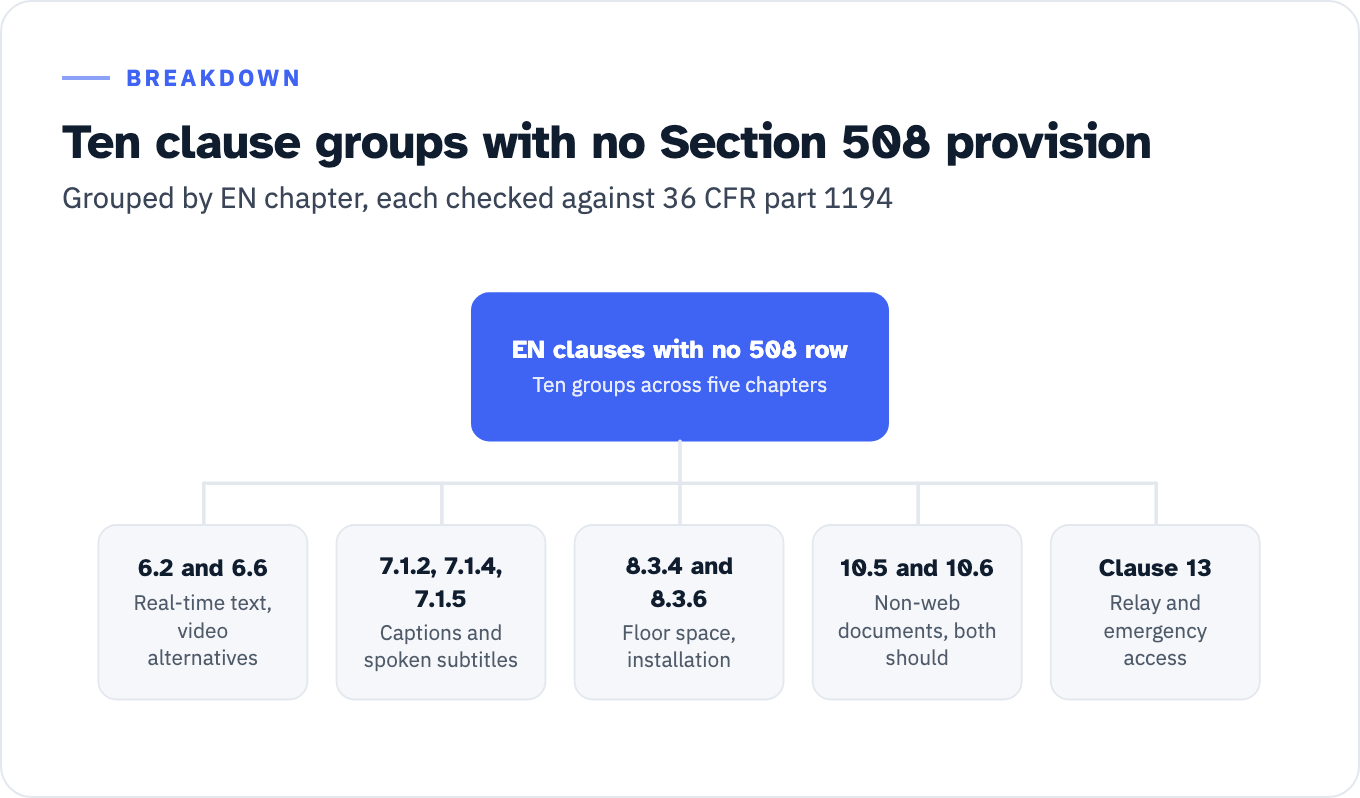
The groups below are the ones this article could find no provision for in 36 CFR part 1194, reading Chapters 3 through 7 of the Revised 508 Standards against EN clauses 4 through 13. Each was confirmed against the Section 508 text rather than inferred, and each can be checked a second way in about a minute: download ITI’s 2.5Rev 508 edition template and none of these subjects appears in it, while every one of them has its own row in the EN 301 549 edition.
- 6.2 Real-Time Text (RTT) functionality, four subclauses, and eight rows in the EN edition of the template. Provision 412.5 is reserved.
- 6.6 Alternatives to video-based services. No Section 508 provision. The EN modal verb is “should”.
- 7.1.2 Captioning synchronization. EN requires captions “within 100 ms of the time stamp of the caption” for recorded material, and the same tolerance against availability for live captions. The string “100 ms” does not appear in part 1194.
- 7.1.4 Captions characteristics, the user’s ability to adapt how captions are displayed. No Section 508 provision.
- 7.1.5 Spoken subtitles, a mode that speaks the available captions aloud. No Section 508 provision.
- 8.3.4 Clear floor or ground space, three subclauses, including a ramp “no steeper than 1:48” and a clear floor area of “760 mm (30 inches) by 1 220 mm (48 inches)”. Table 2 marks the row “Not within the scope of Section 508 or Section 255” and points to the 2010 ADA Standards for Accessible Design instead.
- 8.3.6 Installation instructions, guidance on installing stationary ICT in a way that respects built-environment accessibility. The string “installation instruc” does not appear in part 1194.
- 10.5 Caption positioning, for non-web documents. No Section 508 provision, and EN states it as “should”.
- 10.6 Audio description timing, likewise for non-web documents, likewise “should”.
- 13 ICT providing relay or emergency service access, seven normative clauses plus an informative general clause. Table 2 is blunt here, and the phrase is the Board’s own: “No comparable chapter.”
Two more belong in a partial column rather than an absent one, and it is worth saying so before a buyer says it for you. EN 6.4 requires that voice mail, auto-attendant and interactive voice response facilities “offer users a means to access the information and carry out the tasks provided by the ICT without the use of hearing or speech”. Section 508 reaches the same equipment at 412.8.4, through one technology only: “Where provided, voice mail, autoattendant, interactive voice response, and caller identification systems shall be usable with a TTY.” EN 6.5.2 to 6.5.6 sit under the single performance sentence at 412.7, as above.
Two functional performance statements also sit outside the Section 508 list. EN clause 4.2 runs 4.2.1 through 4.2.11; Section 508 Chapter 3 runs 302.1 through 302.9. The two with no numbered Section 508 criterion are 4.2.9, minimize photosensitive seizure triggers, and 4.2.11, privacy. Privacy reaches Section 508 in one place only, hardware provision 405.1. Photosensitivity reaches it twice: hardware provision 408.3 caps flashes at “no more than three flashes in any one-second period”, and WCAG 2.0 SC 2.3.1 arrives through the incorporation by reference at E205.4 and E207.2. Neither appears as a numbered criterion in Section 508 Chapter 3, which is where an EN reviewer goes looking for the functional performance answer.
View the data as a list
EN clauses with no 508 row: Ten groups across five chapters
- 6.2 and 6.6: Real-time text, video alternatives
- 7.1.2, 7.1.4, 7.1.5: Captions and spoken subtitles
- 8.3.4 and 8.3.6: Floor space, installation
- 10.5 and 10.6: Non-web documents, both should
- Clause 13: Relay and emergency access
Clause 13 changes the conversation
If your product carries two-way communication of any kind, read clause 13 first. It is the only chapter of requirements the Board labeled “No comparable chapter”; the phrase appears twice more in Table 2, both times against informative annexes. Two of its requirements are written as prohibitions on interference rather than as feature lists:
“Where ICT systems support two-way communication, and the system is specified for use with relay services, access to those relay services shall not be prevented for outgoing and incoming calls involving: voice, RTT, or video, either individually or in combinations supported by both the relay service and the ICT system.”
Clause 13.3 repeats that sentence for emergency services. Clause 13.1.2 adds that a text relay service “shall enable text users and speech users to interact by providing conversion between the two modes of communication.”
For a product with no communication features, Not Applicable is the right answer. For a meetings product, a contact center platform, a softphone or anything embedding a calling stack, it is a live question with no Section 508 test evidence behind it, because Section 508 never asked. The words “relay” and “emergency” appear nowhere in the 508 template; the EN template carries rows for 13.1.2 through 13.3.
Real-time text: a numbered provision holding nothing
The reservation at 412.5 was a decision, and the preamble says why. In April 2016 the FCC published a notice of proposed rulemaking on replacing TTY support rules with real-time text rules, and the Board wrote:
“As the FCC had issued a notice of its intent to regulate in this area, the Board determined that it would reserve the issue of RTT in the final rule to be addressed in a future rulemaking.”
The Board added that it “continues to monitor these proceedings and will update the 508 Standards and 255 Guidelines as appropriate.” What Section 508 kept instead is legacy TTY support at 412.8, restored by a direct final rule published on 22 January 2018 at 83 FR 2912.
Search the CFR for real-time text and you will find it, which is worth knowing before a buyer finds it first. Part 1194 defines the term at E103.4 and again at C103.4: “Communications using the transmission of text by which characters are transmitted by a terminal as they are typed.” A definition with no requirement behind it is exactly what 412.5 leaves you holding.
EN 301 549 went the other way. Clause 6.2.1.1 requires that “Where ICT is in a mode that provides a means for two-way voice communication, the ICT shall provide a means for two-way RTT communication, except where this would require design changes to add input or output hardware to the ICT.” Clause 6.2.1.2 requires concurrent voice and text “through a single user connection”, 6.2.2.1 requires sent text to be “visually differentiated from, and separated from, received text”, 6.2.4 caps latency at “within 500 ms” excluding platform and network delay, and 6.2.3 lists four interoperability routes, from ITU-T V.18 on the PSTN to IETF RFC 4103 for SIP-based VoIP.
Nothing retrieved for this article shows 412.5 filled: the eCFR text for 1 August 2026 still reads “[Reserved]”. Whether the FCC’s own real-time text rules reach a particular federal procurement is a separate question, and not one this article answers.
View the data as a table
| Section 508 provision 412.5 | EN 301 549 clause 6.2 | |
|---|---|---|
| Requirement in force | Still reads [Reserved] in the eCFR text for 1 August 2026 | 6.2.1.1: provide two-way RTT wherever the ICT provides two-way voice |
| Concurrent voice and text | Not addressed. Legacy TTY support sits at 412.8 instead | 6.2.1.2: concurrent voice and text through a single user connection |
| Sent versus received text | Not addressed, 412.5 is reserved | 6.2.2.1: sent text visually differentiated from, and separated from, received text |
| Latency ceiling | Not addressed, 412.5 is reserved | 6.2.4: within 500 ms, excluding platform and network delay |
| Interoperability | Not addressed, 412.5 is reserved | 6.2.3: four routes, from ITU-T V.18 on the PSTN to IETF RFC 4103 for SIP-based VoIP |
The WCAG version gap is a different kind of blank
Clause 9 does have Section 508 rows. They are the wrong-version rows.
Section 508 incorporates WCAG 2.0 by reference: scoping provision E205.4 requires that “Electronic content shall conform to Level A and Level AA Success Criteria and Conformance Requirements in WCAG 2.0”, and E207.2 says the same for software. EN 301 549 states its own relationship to both WCAG versions in clause 9.0. That clause is headed “General (informative)”, and Annex C confirms that “Clause 9.0 is informative only and contains no requirements requiring test”, but both inputs to the arithmetic below are printed there and the clauses they name are normative:
“Conformance with W3C Web Content Accessibility Guidelines (WCAG 2.0) Level AA is equivalent to conforming with clauses 9.1.1, 9.1.2, 9.1.3.1 to 9.1.3.3, 9.1.4.1 to 9.1.4.5, 9.2.1.1, 9.2.1.2, 9.2.2, 9.2.3, 9.2.4, 9.3, 9.4.1.1, 9.4.1.2 and the conformance requirements of clause 9.6 of the present document.”
“Conformance with W3C Web Content Accessibility Guidelines (WCAG 2.1) [5] Level AA is equivalent to conforming with all of clauses 9.1 to 9.4 and the conformance requirements of clause 9.6 of the present document.”
Subtract the first list from the second and twelve EN clauses fall outside a WCAG 2.0 conformance claim: 9.1.3.4, 9.1.3.5, 9.1.4.10, 9.1.4.11, 9.1.4.12, 9.1.4.13, 9.2.1.4, 9.2.5.1, 9.2.5.2, 9.2.5.3, 9.2.5.4 and 9.4.1.3. In WCAG 2.1 names: Orientation, Identify input purpose, Reflow, Non-text contrast, Text spacing, Content on hover or focus, Character key shortcuts, Pointer gestures, Pointer cancellation, Label in name, Motion actuation and Status messages. Both inputs are printed in the standard, so the arithmetic is checkable.
Clause 9.6 adds a second version-shaped difference, and the scopes have to be lined up carefully. EN 9.6 governs web pages, and requires one to “satisfy all the following five WCAG 2.1 conformance requirements at Level AA”. Section 508’s parallel obligation for non-web software drops one of those five, Complete Processes, at E207.2 Exception 3, then restores it by another route at E207.3. Which EN clause your reviewer opens depends on what you ship: clause 9 for a web page, clause 11 for non-web software. For the US side of this, we have mapped which WCAG version each US rule requires.
Which VPAT edition answers which buyer
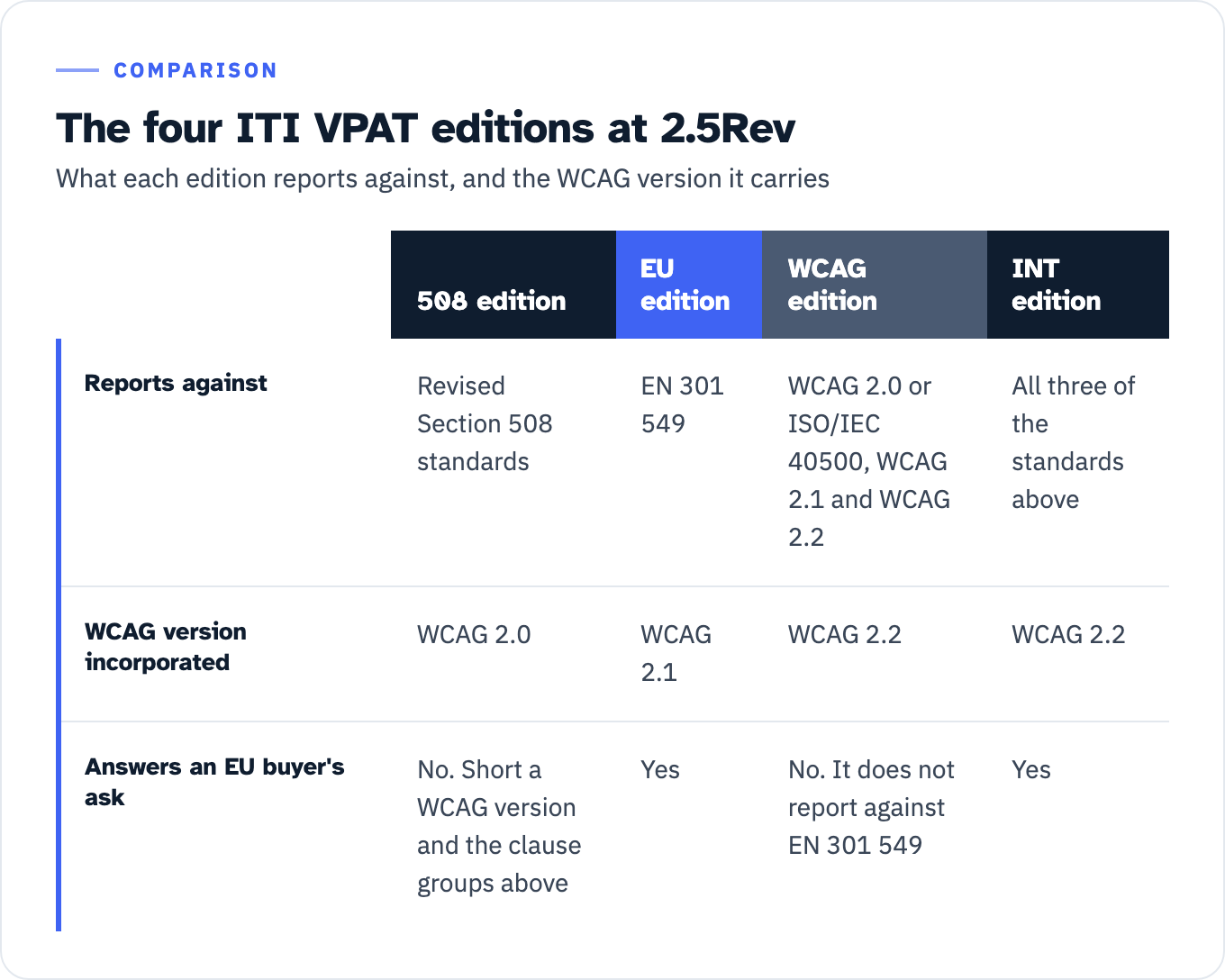
ITI publishes four VPAT editions, currently at version 2.5Rev (April 2025), and choosing one is a scoping decision made before testing, not a formatting decision made after. In ITI’s own descriptions, the 508 edition reports against “Revised Section 508 standards”, which ITI glosses as the U.S. Federal accessibility standard; the EU edition against “EN 301 549”; the WCAG edition covers “WCAG 2.0 or ISO/IEC 40500 (equivalent to WCAG 2.0), WCAG2.1, and WCAG 2.2”; and the INT edition, per ITI, incorporates all three of the above standards.
The WCAG version travels with the edition, which ITI also states plainly: “WCAG 2.0 is incorporated into the 508 edition”, “WCAG 2.1 is incorporated into the EU edition”, “WCAG 2.2 is incorporated into the WCAG and INT editions”. An EU buyer’s ask is answered by the EU or INT edition, and a supplier holding only the 508 edition is short both a WCAG version and the clause groups listed above. For a software business selling into both markets that belongs at the front of the test plan, which is where we put it in our SaaS and software accessibility work.
Two facts from the same page belong next to that choice. A blank template is not a report: “A version of the VPAT which has been completed for a specific product is an ACR.” And nobody blesses the result: “No, ITI does not review or approve VPATs”, and “There is no certification for VPAT.” Your buyer is reading your evidence, not somebody’s seal, which is why the rows have to survive a reader who checks them, the way you would when you score a vendor ACR.
View the data as a table
| 508 edition | EU edition | WCAG edition | INT edition | |
|---|---|---|---|---|
| Reports against | Revised Section 508 standards | EN 301 549 | WCAG 2.0 or ISO/IEC 40500, WCAG 2.1 and WCAG 2.2 | All three of the standards above |
| WCAG version incorporated | WCAG 2.0 | WCAG 2.1 | WCAG 2.2 | WCAG 2.2 |
| Answers an EU buyer’s ask | No. Short a WCAG version and the clause groups above | Yes | No. It does not report against EN 301 549 | Yes |
What EN 301 549 conformance does not tell an EU buyer
Two limits, both of which a careful buyer already knows.
First, V3.2.1 is harmonized under the Web Accessibility Directive, not the European Accessibility Act. Commission Implementing Decision (EU) 2021/1339 made V3.2.1 a harmonized standard under Directive (EU) 2016/2102. Article 15(1) of the European Accessibility Act grants the presumption of conformity to standards “the references of which have been published in the Official Journal of the European Union”, and a citation under one directive is not a citation under another. The standards bodies read it the same way: the Foreword to the V4.1.0 final draft states the presumption in the conditional, “Once the present document is cited in the Official Journal of the European Union under that Directive”. Conforming to V3.2.1 is strong technical evidence. It is not an automatic EAA presumption of conformity, and putting that claim in a cover letter invites a correction from the buyer’s counsel.
Second, the obligation your buyer is under is national. EAA Article 31 required member states to “adopt and publish, by 28 June 2022” the measures necessary to comply with the directive, and to “apply those measures from 28 June 2025”. What binds a supplier is the transposing national measure where the service is offered, and this article did not enumerate those country by country. Which ones reach your company is a question for counsel in that member state. Our work stops at the standard, the report and the test evidence behind it. The European Accessibility Act timeline covers the dates.
What the research for this article did not find
The Access Board wrote in 2017 that it “anticipates providing technical assistance materials on its Web site to assist product manufacturers with mapping EN 301 549 requirements to the Revised 508 Standards and vice versa.” No such mapping appears in the Additional Resources list on the Board’s ICT page today, which names two WCAG 2.0 crosswalks among its entries and nothing for EN 301 549.
No published decision, enforcement action or dispute turning on an EN 301 549 gap in a US supplier’s 508-edition ACR turned up in the research for this article. No source verified here publishes a count of ACRs that leave EN rows blank, or of EU procurements that have asked a US supplier for EN 301 549 evidence. Neither standard states a total requirement count, and neither uses a conformance score or grade.
And nothing tells a supplier how to report a “should” clause. EN 6.6, 10.5 and 10.6 are recommendations rather than requirements, and a buyer reading a blank row for a “should” is in a different position from one reading a blank row for a “shall”. That distinction deserves a sentence in your report notes, since no template supplies it.
V4.1.0 changes two answers at once, and it is not in force
The final draft of EN 301 549 V4.1.0, dated June 2026, states its status in its Foreword: it “is now submitted for the Vote phase of the ETSI Standardisation Request deliverable Approval Procedure (SRdAP)”. No published V4.1.0 sits in the ETSI directory, and no citation for it has appeared in the Official Journal. Do not test against it and do not report against it.
Two of its listed changes matter to everything above. The Foreword says “the requirements related to Real-Time Text (RTT) in clause 6.2 have been significantly revised and extended to include total conversation”, and that “the requirements of clauses 9, 10 and 11 have all been updated to align with the WCAG 2.2 recommendation”. Know both facts, act on neither yet.
Your next step
Open the ACR you would send to that European buyer tomorrow and check three things.
The header first: which VPAT edition, which standards table, which WCAG version. If the answer is 508 edition and WCAG 2.0, the report cannot speak to clause 9 at WCAG 2.1, and twelve EN clauses sit outside anything it claims.
Then the communication stack. If your product carries voice, video or messaging between users, clauses 6.2 and 13 are the rows a European reviewer will look for, and a 508 test package holds no evidence for either.
Then hardware, if you ship any. Reach dimensions you already have from 407.8, unchanged. Display height you have at the same measurement against a softer verb. Clear floor space, change in level and installation instructions you do not have at all.
If you want the crossing mapped against your own report rather than a generic table, send us the ACR and the buyer’s request language. What comes back first is the list of EN clauses your current evidence does not reach, with the test scope each one adds.