

VPATs Are Now a Top Requirement in B2G Contracts


.svg)

Introduction
Accessibility Documentation Moves from Optional to Operational
In 2025, accessibility compliance stopped being an internal checklist item and became a front-line business requirement. The latest Gartner Market Guide for Digital Accessibility calls the Voluntary Product Accessibility Template® (VPAT®) a “procurement readiness factor” for vendors competing in both government and enterprise markets.
Meanwhile, the Forrester Wave™: Digital Accessibility Platforms, Q4 2025 notes that accessibility governance has “evolved from compliance to competitiveness”. The accessibility conformance report is now influencing vendor selection cycles.
Together, these independent analyses confirm what accessibility professionals have long predicted: VPATs are a prerequisite for business-to-government (B2G) contracts.
Unsure if your product should have a VPAT? Schedule a quick consultation to understand VPAT requirements.
The Policy Shift: EPA’s 2025 Section 508 Directive
In February 2025, the U.S. Environmental Protection Agency (EPA) issued a new Section 508 Policy (IT/IM Directive CIO 2130.4). This policy enforces accessibility across all information and communication technology (ICT) procurement and internal systems.
According to this update, federal agencies must request a VPAT report for each digital product or service.
This directive echoes the broader U.S. Section 508 framework administered by the General Services Administration (GSA). It has steadily expanded enforcement guidance since 2023. Federal contracts now require vendors to provide the latest VPATs that follow WCAG 2.2 standards.
Key takeaway: The EPA policy formalized what the market already knew. The VPAT ACR is now integral to federal procurement validation.
Learn More: What Is a VPAT and How to Write One
A strong VPAT can make the difference between compliance confidence and procurement delays.
Read our detailed VPAT/ACR guide to learn:
What’s inside a VPAT and how it relates to Section 508
How WCAG 2.2 standards are used in ACRs
Simple tips to write a VPAT that meets buyer expectations
Read the Full Guide Here: What Is a VPAT and How to Write It
Why are VPATs now mandatory for government contracts?
Because federal agencies under Section 508 and the 2025 EPA directive require ACRs. These reports act as proof of WCAG 2.2 compliance before awarding contracts.
VPAT Market Implications
Both Gartner and Forrester emphasize that VPAT compliance testing and reporting directly influence procurement timelines and vendor scoring.
According to aggregated analyst observations, a current VPAT can accelerate deal closure by up to 30% in SaaS, education, and cloud infrastructure sectors.
Federal buyers are no longer content with self-attestations or marketing claims of accessibility. They require evidence-based VPAT assessment validated by third-party audits. For vendors, this means accessibility is a sales enablement tool.
A VPAT does this by clearly showing accessibility test results against WCAG and Section 508 standards in an organized format.
If your organization is preparing for government or enterprise procurement, your VPAT should accurately reflect WCAG 2.2 and Section 508 alignment and stand up to buyer review.
Schedule a free VPAT consultation with ADACP to:
• Assess your current accessibility documentation readiness
• Identify compliance issues before procurement cycles begin
• Receive expert recommendations for drafting the VPAT template
The Procurement Landscape in 2025
The U.S. government spends over $100 billion annually on digital products and services. Accessibility compliance has moved into the earliest stages of vendor evaluation because B2G digital transformation has accelerated.
Key factors driving this:
Federal mandates
Section 508 and EPA directives now tie funding eligibility to accessibility compliance.
Procurement modernization
New RFP templates on SAM.gov and section508.gov include VPAT submission fields.
Market accountability
Analyst firms highlight that vendors with updated VPATs show transparency and governance maturity.
Gartner (2025): “Accessibility conformance documentation is now a visible indicator of vendor governance quality.”

Which standards do VPATs follow in 2025?
VPATs align with WCAG 2.2, Section 508 (Revised 2017), and EN 301 549 for international conformance.
How Accessibility Policies Shape the Vendor Ecosystem
Federal buyers have standardized the VPAT documentation. The ripple effect can be seen as state agencies, universities, and private enterprises follow similar compliance requirements. In this cascading compliance environment, accessibility conformance is the expected default.
The EPA’s 2025 directive explicitly states that “ICT procurements must include accessibility evaluation at the solicitation, selection, and post-award stages.” That wording effectively brings accessibility into the procurement lifecycle. Vendors who fail to demonstrate accessibility compliance risk immediate disqualification.
Accessibility Governance and Investor Confidence
Accessibility documentation has also emerged as an ESG (Environmental, Social, Governance) signal. Digital inclusion is a measure of ethical and operational governance for institutional buyers and investors.
Vendors that maintain updated VPATs position themselves as low-risk partners in public accountability terms.
According to Forrester (Q4 2025), organizations with structured accessibility programs experience “reduced compliance volatility and improved vendor-client trust metrics.”
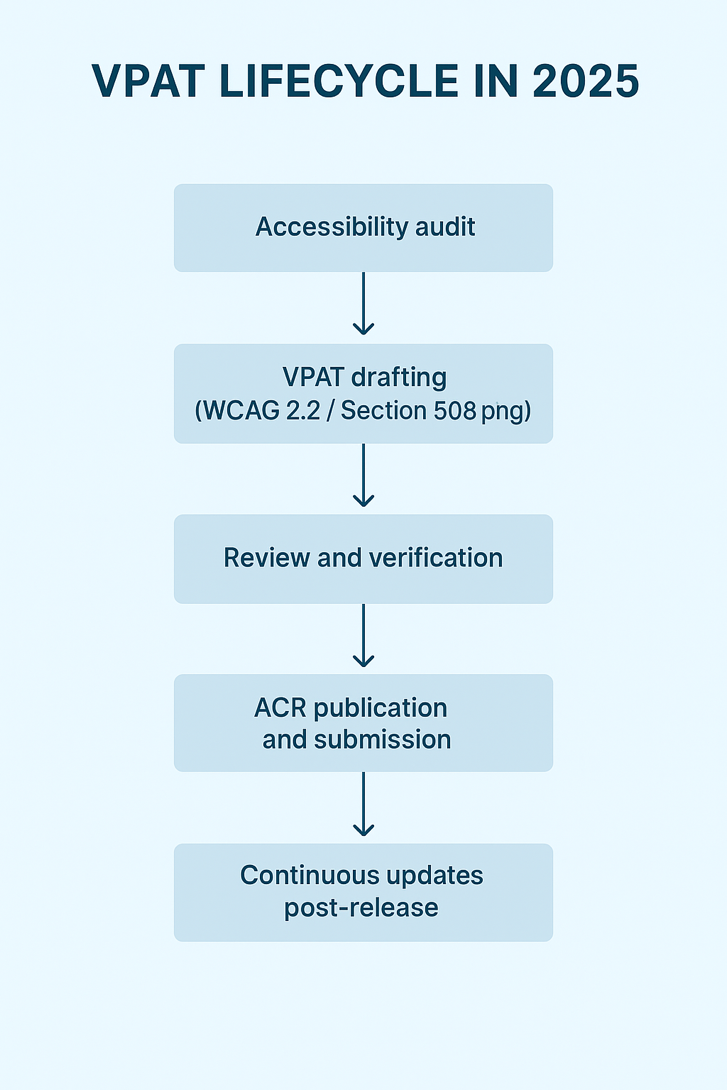
VPAT Lifecycle in 2025
What Vendors Should Do Now
Follow this simple 10-step process to stay procurement-ready in 2025:
1. Audit for WCAG 2.2 compliance.
2. Identify barriers early and address them systematically.
3. Develop or update your VPAT.
4. Use the latest Section 508 Edition or WCAG 2.2 Edition templates.
5. Validate through independent review.
6. Third-party evaluation for more credibility.
7. Publish your Accessibility Conformance Report (ACR).
8. Make it discoverable on your website or contract portal.
9. Maintain continuous accessibility governance.
10. Update documentation whenever product versions change.
How do VPATs help vendors close deals faster?
Analyst research indicates that vendors with ready-to-submit VPATs accelerate procurement cycles by up to 30%. They get a competitive edge by reducing compliance verification delays.
Conclusion
Accessibility compliance is becoming procurement currency. Federal agencies like the EPA and GSA are urging Section 508 policies firmly. Market leaders are calling accessibility documentation a competitive edge.
The message is clear: government buyers now favor vendors who treat VPAT accessibility as a long-term strategy.
If your organization is preparing for large scale B2G contracts, then choose ADACP for accessibility documentation.
ADACP helps vendors audit, document, and publish accurate VPATs that meet federal expectations and align with WCAG 2.2 standards.
Schedule a VPAT consultation with ADACP before your next proposal.
References
Environmental Protection Agency. (2025). Section 508 Policy (IT/IM Directive CIO 2130.4). U.S. EPA. https://www.epa.gov/system/files/documents/2025-02/section-508-policy.pdf
Gartner. (2025). Market Guide for Digital Accessibility. Gartner Research.
Forrester. (2025). The Forrester Wave™: Digital Accessibility Platforms, Q4 2025. Forrester Research Inc.
Introduction
Accessibility Documentation Moves from Optional to Operational
In 2025, accessibility compliance stopped being an internal checklist item and became a front-line business requirement. The latest Gartner Market Guide for Digital Accessibility calls the Voluntary Product Accessibility Template® (VPAT®) a “procurement readiness factor” for vendors competing in both government and enterprise markets.
Meanwhile, the Forrester Wave™: Digital Accessibility Platforms, Q4 2025 notes that accessibility governance has “evolved from compliance to competitiveness”. The accessibility conformance report is now influencing vendor selection cycles.
Together, these independent analyses confirm what accessibility professionals have long predicted: VPATs are a prerequisite for business-to-government (B2G) contracts.
Unsure if your product should have a VPAT? Schedule a quick consultation to understand VPAT requirements.
The Policy Shift: EPA’s 2025 Section 508 Directive
In February 2025, the U.S. Environmental Protection Agency (EPA) issued a new Section 508 Policy (IT/IM Directive CIO 2130.4). This policy enforces accessibility across all information and communication technology (ICT) procurement and internal systems.
According to this update, federal agencies must request a VPAT report for each digital product or service.
This directive echoes the broader U.S. Section 508 framework administered by the General Services Administration (GSA). It has steadily expanded enforcement guidance since 2023. Federal contracts now require vendors to provide the latest VPATs that follow WCAG 2.2 standards.
Key takeaway: The EPA policy formalized what the market already knew. The VPAT ACR is now integral to federal procurement validation.
Learn More: What Is a VPAT and How to Write One
A strong VPAT can make the difference between compliance confidence and procurement delays.
Read our detailed VPAT/ACR guide to learn:
What’s inside a VPAT and how it relates to Section 508
How WCAG 2.2 standards are used in ACRs
Simple tips to write a VPAT that meets buyer expectations
Read the Full Guide Here: What Is a VPAT and How to Write It
Why are VPATs now mandatory for government contracts?
Because federal agencies under Section 508 and the 2025 EPA directive require ACRs. These reports act as proof of WCAG 2.2 compliance before awarding contracts.
VPAT Market Implications
Both Gartner and Forrester emphasize that VPAT compliance testing and reporting directly influence procurement timelines and vendor scoring.
According to aggregated analyst observations, a current VPAT can accelerate deal closure by up to 30% in SaaS, education, and cloud infrastructure sectors.
Federal buyers are no longer content with self-attestations or marketing claims of accessibility. They require evidence-based VPAT assessment validated by third-party audits. For vendors, this means accessibility is a sales enablement tool.
A VPAT does this by clearly showing accessibility test results against WCAG and Section 508 standards in an organized format.
If your organization is preparing for government or enterprise procurement, your VPAT should accurately reflect WCAG 2.2 and Section 508 alignment and stand up to buyer review.
Schedule a free VPAT consultation with ADACP to:
• Assess your current accessibility documentation readiness
• Identify compliance issues before procurement cycles begin
• Receive expert recommendations for drafting the VPAT template
The Procurement Landscape in 2025
The U.S. government spends over $100 billion annually on digital products and services. Accessibility compliance has moved into the earliest stages of vendor evaluation because B2G digital transformation has accelerated.
Key factors driving this:
Federal mandates
Section 508 and EPA directives now tie funding eligibility to accessibility compliance.
Procurement modernization
New RFP templates on SAM.gov and section508.gov include VPAT submission fields.
Market accountability
Analyst firms highlight that vendors with updated VPATs show transparency and governance maturity.
Gartner (2025): “Accessibility conformance documentation is now a visible indicator of vendor governance quality.”
Which standards do VPATs follow in 2025?
VPATs align with WCAG 2.2, Section 508 (Revised 2017), and EN 301 549 for international conformance.
How Accessibility Policies Shape the Vendor Ecosystem
Federal buyers have standardized the VPAT documentation. The ripple effect can be seen as state agencies, universities, and private enterprises follow similar compliance requirements. In this cascading compliance environment, accessibility conformance is the expected default.
The EPA’s 2025 directive explicitly states that “ICT procurements must include accessibility evaluation at the solicitation, selection, and post-award stages.” That wording effectively brings accessibility into the procurement lifecycle. Vendors who fail to demonstrate accessibility compliance risk immediate disqualification.
Accessibility Governance and Investor Confidence
Accessibility documentation has also emerged as an ESG (Environmental, Social, Governance) signal. Digital inclusion is a measure of ethical and operational governance for institutional buyers and investors.
Vendors that maintain updated VPATs position themselves as low-risk partners in public accountability terms.
According to Forrester (Q4 2025), organizations with structured accessibility programs experience “reduced compliance volatility and improved vendor-client trust metrics.”
VPAT Lifecycle in 2025
What Vendors Should Do Now
Follow this simple 10-step process to stay procurement-ready in 2025:
1. Audit for WCAG 2.2 compliance.
2. Identify barriers early and address them systematically.
3. Develop or update your VPAT.
4. Use the latest Section 508 Edition or WCAG 2.2 Edition templates.
5. Validate through independent review.
6. Third-party evaluation for more credibility.
7. Publish your Accessibility Conformance Report (ACR).
8. Make it discoverable on your website or contract portal.
9. Maintain continuous accessibility governance.
10. Update documentation whenever product versions change.
How do VPATs help vendors close deals faster?
Analyst research indicates that vendors with ready-to-submit VPATs accelerate procurement cycles by up to 30%. They get a competitive edge by reducing compliance verification delays.
Conclusion
Accessibility compliance is becoming procurement currency. Federal agencies like the EPA and GSA are urging Section 508 policies firmly. Market leaders are calling accessibility documentation a competitive edge.
The message is clear: government buyers now favor vendors who treat VPAT accessibility as a long-term strategy.
If your organization is preparing for large scale B2G contracts, then choose ADACP for accessibility documentation.
ADACP helps vendors audit, document, and publish accurate VPATs that meet federal expectations and align with WCAG 2.2 standards.
Schedule a VPAT consultation with ADACP before your next proposal.
References
Environmental Protection Agency. (2025). Section 508 Policy (IT/IM Directive CIO 2130.4). U.S. EPA. https://www.epa.gov/system/files/documents/2025-02/section-508-policy.pdf
Gartner. (2025). Market Guide for Digital Accessibility. Gartner Research.
Forrester. (2025). The Forrester Wave™: Digital Accessibility Platforms, Q4 2025. Forrester Research Inc.

.svg)
.svg)
.svg)
We will contact you shortly.
.webp)


.svg)

.svg)
.svg)