

80% of WCAG Errors Are Preventable: Digital Accessibility Lessons from Real Audits


.svg)

Introduction
Accessibility standards exist as actionable technical requirements. The Web Content Accessibility Guidelines published by the W3C precisely tell how digital content should be structured and coded so that people with disabilities can use it effectively.
Critics sometimes claim that WCAG is too difficult to implement. However, WCAG audit data from government accessibility assessments show that the majority of accessibility failures stem from predictable implementation issues.
In this article, we explore how WCAG documentation and U.S. federal auditing data reveal where digital accessibility tends to go wrong. This blog demonstrates how most issues could be prevented with proper implementation.
What is WCAG Implementation
WCAG is built around testable success criteria. As W3C explains, “WCAG is designed to be testable, technology-neutral and applicable across different platforms and tools.”
It is important to understand that most accessibility barriers start during design and development. If WCAG criteria are followed correctly from the start, common issues like missing labels, poor contrast or broken keyboard navigation often never come up.
In other words, WCAG means building accessibility into digital products and not adding later as a solution. This design-first approach is why so many real-world audits show that accessibility failures are preventable.
A WCAG consultation can help identify implementation gaps early. Schedule a 30-minute WCAG consult if you don’t want these gaps to turn into audit failures or procurement risks.
What Federal Accessibility Audits Reveal about WCAG Compliance
The U.S. Governmentwide Section 508 Assessments are annual evaluations of how well federal agencies’ digital content conforms to accessibility requirements. These assessments include WCAG provisions for web and electronic content.
In the FY24 Governmentwide Section 508 Assessment, publicly available data reveals several key trends about digital accessibility conformance across federal ICT.
Low and Persistent Conformance
According to the FY24 Assessment:
• Only about 23% of public web pages were fully conformant with applicable standards.
• Just 20% of intranet pages, 25% of public documents and 34% of videos met accessibility requirements.
• The overall governmentwide conformance index remained low. It was 1.74 out of 5.
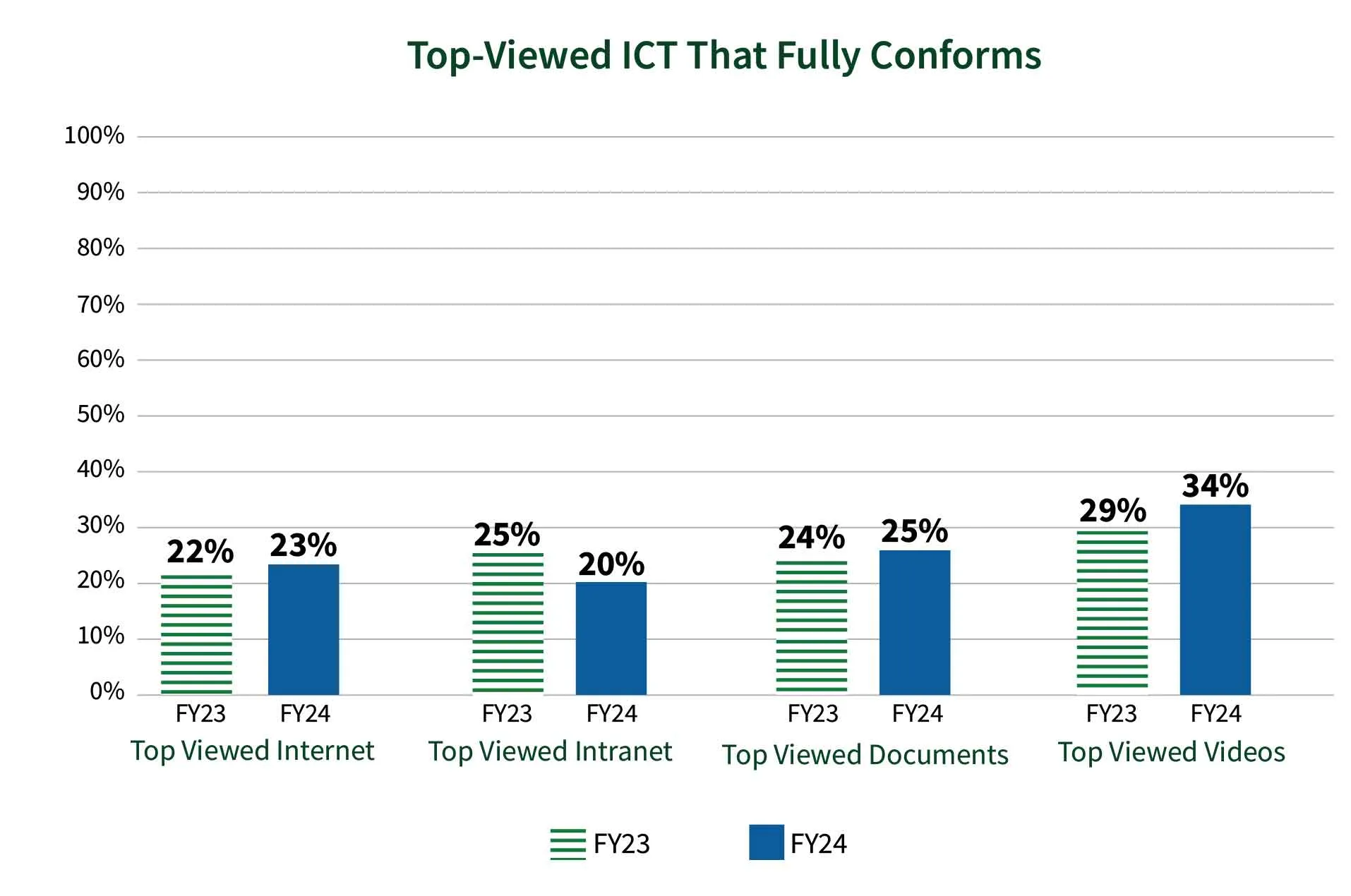
Image: Federal Accessibility Audit Results: Year-over-year comparison of fully conformant ICT types from the FY24 Governmentwide Section 508 Assessment shows limited improvement in accessibility conformance.
These numbers show that even with mandatory rules many digital content pieces do not meet basic accessibility standards.
Implementation challenges are not technical barriers
The assessment highlights several persistent issues that routinely prevent full accessibility:
• Limited testing: Only about 70% of organizations performed web accessibility testing and even fewer regularly tested internal systems.
• Limited resources: Many agencies lacked sufficient staffing or formal training programs dedicated to accessibility compliance.
• Lifecycle integration gaps: Nearly 41% of respondents said that accessibility was not included throughout the technology development lifecycle.
These findings make it clear that most accessibility issues come from process gaps rather than technology that can’t support accessibility.
How Most WCAG Failures Are Preventable
A pattern emerges when we combine WCAG’s testable criteria with these audit findings. It is observed that accessibility failures are largely due to implementation gaps and not because the rules are impossible to follow.
Testing Late is Not Enough
WCAG success criteria are designed to be checked throughout the development stages. Verification should be done via manual and automated WCAG testing.
However, many teams only test late in the product cycle through automated tools. These WCAG compliance checkers cannot catch the majority of issues like illogical focus order or poor reading structure. Accessibility testing needs to include both manual and automated checks to catch these problems early.
Lack of Accessibility Awareness and Training
The Section 508 data shows that agencies with stronger accessibility programs and dedicated staff perform better in accessibility audits. This suggests that when teams understand WCAG and apply it from the start, the items most commonly flagged in audits are far less likely to occur.
Process Gaps Over Technical Barriers
Many accessibility issues don’t happen because WCAG is difficult to meet. Compliance issues occur because implementation practices are not part of everyday workflows. For example:
• Designers not trained in WCAG accessibility
• Developers may not use proper semantic HTML
• QA teams may skip accessibility checks from their test plans
These are process gaps and fixing these can significantly reduce common failures.
How organizations can improve WCAG accessibility compliance
Do not add accessibility at the end. Make it a part of your everyday work if you want your digital products to be accessible.
Build WCAG into design and development
WCAG should guide decisions from the very beginning, during design and development. When accessibility is treated as a core requirement, the occurrence of accessibility barriers becomes lesser.
As the W3C explains:
“Accessibility is essential for people with disabilities and useful for everyone.”
This reinforces the idea that accessibility is a basic quality requirement.
Test for accessibility throughout the product lifecycle
Accessibility testing should happen early and often. Relying only on automated scans misses many WCAG issues. Problems like incorrect focus order, unclear headings, or poor screen-reader behavior usually require manual testing to detect.
WCAG success criteria are written to be tested. The W3C provides detailed techniques and failure examples to help teams verify accessibility at every stage.
Invest in skills and clear ownership
Organizations that perform better in accessibility audits usually have trained teams and clear responsibility for accessibility. Accessibility should not be loosely assigned across roles. Instead, spread accountability among training designers, developers, and QA teams.
Federal accessibility data supports this. The U.S. government’s Section 508 assessments consistently show that agencies with stronger accessibility programs and dedicated staff report higher accessibility maturity.
These reports make one thing clear that accessibility gaps are usually caused by process and implementation issues.
Need help making your product WCAG-compliant and procurement-ready?
Our accessibility experts provide practical WCAG consultations so that you can build accessibility into design, testing, and documentation. Book a consultation today.
Conclusion
WCAG guidelines and openly reported audit results from the U.S. federal government tell a strong story that most accessibility barriers are preventable. They result from process gaps, and insufficient testing. Therefore, all you need is a digital accessibility strategy from the beginning and WCAG compliance becomes fully attainable.
Address these implementation challenges early in the development lifecycle and your team can make measurable progress toward full accessibility. Follow the audit report findings to avoid common WCAG failures before they appear.
Don’t wait for an audit or procurement review to reveal gaps in your accessibility. Schedule a consultation with ADACP today, and make your digital products compliant and ready to impress government and enterprise buyers.
Book Your 30-minute WCAG Consultation Now.
References
W3C Web Accessibility Initiative (WAI). Web Content Accessibility Guidelines (WCAG) Overview.
World Wide Web Consortium (W3C). https://www.w3.org/WAI/standards-guidelines/wcag/
W3C WAI. Fundamentals of Web Accessibility.
W3C. Accessed 2025. https://www.w3.org/WAI/fundamentals/accessibility-intro/
W3C WAI. Understanding WCAG 2.2 Techniques and How to Test. https://www.w3.org/WAI/WCAG22/Understanding/
U.S. General Services Administration. FY24 Governmentwide Section 508 Assessment.
Section508.gov, 2024. Official government dataset for FY24 Section 508 Assessment.
https://www.section508.gov/manage/section-508-assessment/2024/assessment-data-downloads/
U.S. General Services Administration. Section 508 Assessment Findings & Executive Summary. https://www.section508.gov/manage/section-508-assessment/2024/findings/summary/
Introduction
Accessibility standards exist as actionable technical requirements. The Web Content Accessibility Guidelines published by the W3C precisely tell how digital content should be structured and coded so that people with disabilities can use it effectively.
Critics sometimes claim that WCAG is too difficult to implement. However, WCAG audit data from government accessibility assessments show that the majority of accessibility failures stem from predictable implementation issues.
In this article, we explore how WCAG documentation and U.S. federal auditing data reveal where digital accessibility tends to go wrong. This blog demonstrates how most issues could be prevented with proper implementation.
What is WCAG Implementation
WCAG is built around testable success criteria. As W3C explains, “WCAG is designed to be testable, technology-neutral and applicable across different platforms and tools.”
It is important to understand that most accessibility barriers start during design and development. If WCAG criteria are followed correctly from the start, common issues like missing labels, poor contrast or broken keyboard navigation often never come up.
In other words, WCAG means building accessibility into digital products and not adding later as a solution. This design-first approach is why so many real-world audits show that accessibility failures are preventable.
A WCAG consultation can help identify implementation gaps early. Schedule a 30-minute WCAG consult if you don’t want these gaps to turn into audit failures or procurement risks.
What Federal Accessibility Audits Reveal about WCAG Compliance
The U.S. Governmentwide Section 508 Assessments are annual evaluations of how well federal agencies’ digital content conforms to accessibility requirements. These assessments include WCAG provisions for web and electronic content.
In the FY24 Governmentwide Section 508 Assessment, publicly available data reveals several key trends about digital accessibility conformance across federal ICT.
Low and Persistent Conformance
According to the FY24 Assessment:
• Only about 23% of public web pages were fully conformant with applicable standards.
• Just 20% of intranet pages, 25% of public documents and 34% of videos met accessibility requirements.
• The overall governmentwide conformance index remained low. It was 1.74 out of 5.
Image: Federal Accessibility Audit Results: Year-over-year comparison of fully conformant ICT types from the FY24 Governmentwide Section 508 Assessment shows limited improvement in accessibility conformance.
These numbers show that even with mandatory rules many digital content pieces do not meet basic accessibility standards.
Implementation challenges are not technical barriers
The assessment highlights several persistent issues that routinely prevent full accessibility:
• Limited testing: Only about 70% of organizations performed web accessibility testing and even fewer regularly tested internal systems.
• Limited resources: Many agencies lacked sufficient staffing or formal training programs dedicated to accessibility compliance.
• Lifecycle integration gaps: Nearly 41% of respondents said that accessibility was not included throughout the technology development lifecycle.
These findings make it clear that most accessibility issues come from process gaps rather than technology that can’t support accessibility.
How Most WCAG Failures Are Preventable
A pattern emerges when we combine WCAG’s testable criteria with these audit findings. It is observed that accessibility failures are largely due to implementation gaps and not because the rules are impossible to follow.
Testing Late is Not Enough
WCAG success criteria are designed to be checked throughout the development stages. Verification should be done via manual and automated WCAG testing.
However, many teams only test late in the product cycle through automated tools. These WCAG compliance checkers cannot catch the majority of issues like illogical focus order or poor reading structure. Accessibility testing needs to include both manual and automated checks to catch these problems early.
Lack of Accessibility Awareness and Training
The Section 508 data shows that agencies with stronger accessibility programs and dedicated staff perform better in accessibility audits. This suggests that when teams understand WCAG and apply it from the start, the items most commonly flagged in audits are far less likely to occur.
Process Gaps Over Technical Barriers
Many accessibility issues don’t happen because WCAG is difficult to meet. Compliance issues occur because implementation practices are not part of everyday workflows. For example:
• Designers not trained in WCAG accessibility
• Developers may not use proper semantic HTML
• QA teams may skip accessibility checks from their test plans
These are process gaps and fixing these can significantly reduce common failures.
How organizations can improve WCAG accessibility compliance
Do not add accessibility at the end. Make it a part of your everyday work if you want your digital products to be accessible.
Build WCAG into design and development
WCAG should guide decisions from the very beginning, during design and development. When accessibility is treated as a core requirement, the occurrence of accessibility barriers becomes lesser.
As the W3C explains:
“Accessibility is essential for people with disabilities and useful for everyone.”
This reinforces the idea that accessibility is a basic quality requirement.
Test for accessibility throughout the product lifecycle
Accessibility testing should happen early and often. Relying only on automated scans misses many WCAG issues. Problems like incorrect focus order, unclear headings, or poor screen-reader behavior usually require manual testing to detect.
WCAG success criteria are written to be tested. The W3C provides detailed techniques and failure examples to help teams verify accessibility at every stage.
Invest in skills and clear ownership
Organizations that perform better in accessibility audits usually have trained teams and clear responsibility for accessibility. Accessibility should not be loosely assigned across roles. Instead, spread accountability among training designers, developers, and QA teams.
Federal accessibility data supports this. The U.S. government’s Section 508 assessments consistently show that agencies with stronger accessibility programs and dedicated staff report higher accessibility maturity.
These reports make one thing clear that accessibility gaps are usually caused by process and implementation issues.
Need help making your product WCAG-compliant and procurement-ready?
Our accessibility experts provide practical WCAG consultations so that you can build accessibility into design, testing, and documentation. Book a consultation today.
Conclusion
WCAG guidelines and openly reported audit results from the U.S. federal government tell a strong story that most accessibility barriers are preventable. They result from process gaps, and insufficient testing. Therefore, all you need is a digital accessibility strategy from the beginning and WCAG compliance becomes fully attainable.
Address these implementation challenges early in the development lifecycle and your team can make measurable progress toward full accessibility. Follow the audit report findings to avoid common WCAG failures before they appear.
Don’t wait for an audit or procurement review to reveal gaps in your accessibility. Schedule a consultation with ADACP today, and make your digital products compliant and ready to impress government and enterprise buyers.
Book Your 30-minute WCAG Consultation Now.
References
W3C Web Accessibility Initiative (WAI). Web Content Accessibility Guidelines (WCAG) Overview.
World Wide Web Consortium (W3C). https://www.w3.org/WAI/standards-guidelines/wcag/
W3C WAI. Fundamentals of Web Accessibility.
W3C. Accessed 2025. https://www.w3.org/WAI/fundamentals/accessibility-intro/
W3C WAI. Understanding WCAG 2.2 Techniques and How to Test. https://www.w3.org/WAI/WCAG22/Understanding/
U.S. General Services Administration. FY24 Governmentwide Section 508 Assessment.
Section508.gov, 2024. Official government dataset for FY24 Section 508 Assessment.
https://www.section508.gov/manage/section-508-assessment/2024/assessment-data-downloads/
U.S. General Services Administration. Section 508 Assessment Findings & Executive Summary. https://www.section508.gov/manage/section-508-assessment/2024/findings/summary/

.svg)
.svg)
.svg)

We will contact you shortly.
.webp)


.svg)

.svg)
.svg)