
Does the CVAA reach your product? The test and the FCC filing
 By David LoPresti August 12, 2026
 Your product has a chat panel, a huddle button, or a voice feature somebody asked for two years ago. A security questionnaire or a public sector buyer asks whether the CVAA applies, and the first thing to know is that there is no coverage certificate to apply for. The customized equipment exemption at 47 CFR 14.3(b) is written as a defense you raise in an enforcement proceeding, and the rule says a company “is not otherwise required to seek such an affirmative determination from the Commission.” A petition for declaratory ruling under 47 CFR 1.2 exists, but 1.2(b) makes it a docketed public proceeding with a comment round, not a compliance service.
What the rules do give you is a test you can run against the definitions, a set of substantive duties if you are covered, and two obligations that are unusually concrete for accessibility law. Keep records of your accessibility efforts for two years after the product stops being made or the service stops being offered. File a certificate, signed by an officer and supported by a declaration under penalty of perjury, every April 1.
This article runs the gates, states what coverage obliges you to do, gives both filing obligations in the rule’s own words, and answers whether the FCC’s April 2026 deletions took any of it away. They did not, and what they did remove is worth naming precisely.
The two obligations, in the rule’s own words
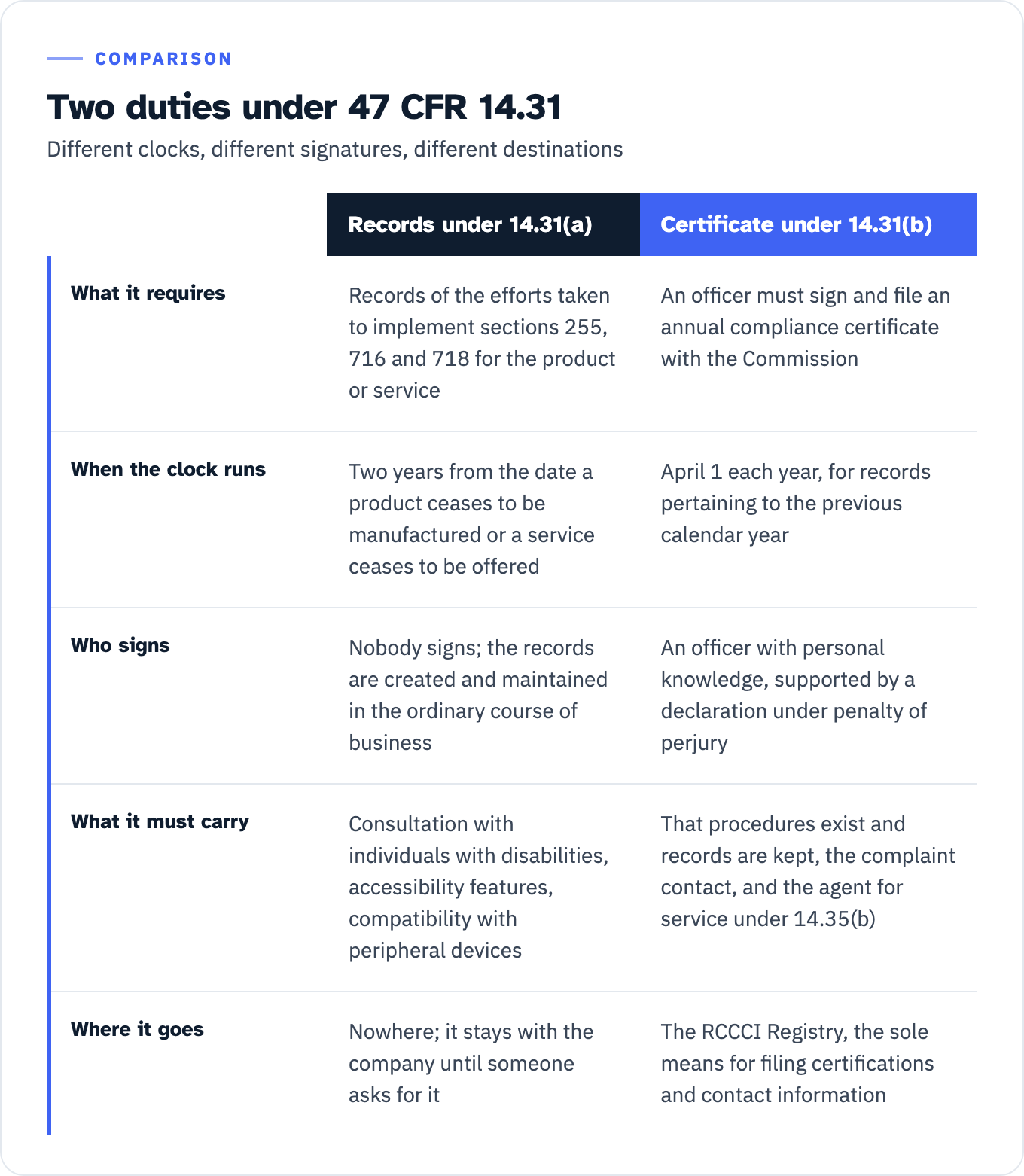
Start at the end, because the end is the part with a date on it. 47 CFR 14.31(a) says each manufacturer and service provider subject to section 255, 716 or 718 of the Act must create and maintain records “in the ordinary course of business and for a two year period from the date a product ceases to be manufactured or a service ceases to be offered, records of the efforts taken by such manufacturer or provider to implement sections 255, 716, and 718 with regard to this product or service.”
The clock does not run from the date of the record, and it does not run from a fiscal year. It starts the day you stop manufacturing the product or stop offering the service, so a design note written in 2021 for a service you sunset in 2027 is live until 2029. Three categories are named: efforts “to consult with individuals with disabilities,” descriptions of “the accessibility features of its products and services,” and information about compatibility “with peripheral devices or specialized customer premise equipment” used by disabled people to achieve access.
The second obligation is the filing. Under 14.31(b), “An officer of each manufacturer and service provider subject to section 255, 716, or 718 of the Act, must sign and file an annual compliance certificate with the Commission.” The certificate states that adequate operating procedures exist and that records are being kept, and it must “be supported with an affidavit or declaration under penalty of perjury, signed and dated by the authorized officer of the company with personal knowledge of the representations provided in the company’s certification.” The perjury language attaches to that supporting declaration, so the signer has to actually know the recordkeeping is happening.
The certificate also names two roles. Under 14.31(b)(2) it “shall identify the name and contact details of the person or persons within the company that are authorized to resolve complaints alleging violations of our accessibility rules and sections 255, 716, and 718 of the Act, and the agent designated for service pursuant to § 14.35(b).” That agent is appointed under 14.35(b) as the person “upon whom service may be made of all notices, inquiries, orders, decisions, and other pronouncements of the Commission.” The FCC’s undated RCCCI filing instructions say the agent must be in the United States and may be “your registered agent, an in-house or outside attorney, or a responsible person who is a non-attorney, including a designated company employee or the same person who you have designated to receive complaints directly from customers.”
Timing is fixed by 14.31(b)(3): the certification “must be filed with the Commission on April 1, 2013 and annually thereafter for records pertaining to the previous calendar year,” and “The certificate must be updated when necessary to keep the contact information current.” Because each filing covers the previous calendar year, a chat feature launched in July 2026 produces a first certificate due 1 April 2027. FCC Public Notice DA 24-733 names the channel and makes it exclusive: the Recordkeeping Compliance Certification and Contact Information Registry, the RCCCI Registry, “is the sole means for filing annual recordkeeping compliance certifications and contact information.” Three records go in: the certification, the consumer contact details, and the United States agent for service.
Letting the contact record go stale has a specific consequence. Under 14.32(c), the Consumer and Governmental Affairs Bureau forwards a consumer’s Request for Dispute Assistance to the company named in it and serves that company “using the contact details of the certification.” That service “is deemed served,” and “Failure by a manufacturer or service provider to file or keep the contact information current will not be a defense of lack of service.” Complaints themselves are served under 14.35 on the agent you designated. Either route can land in an inbox nobody reads, and under 14.32(e) the requester may file an informal complaint thirty days after the Request went in.
View the data as a table
| Records under 14.31(a) | Certificate under 14.31(b) | |
|---|---|---|
| What it requires | Records of the efforts taken to implement sections 255, 716 and 718 for the product or service | An officer must sign and file an annual compliance certificate with the Commission |
| When the clock runs | Two years from the date a product ceases to be manufactured or a service ceases to be offered | April 1 each year, for records pertaining to the previous calendar year |
| Who signs | Nobody signs; the records are created and maintained in the ordinary course of business | An officer with personal knowledge, supported by a declaration under penalty of perjury |
| What it must carry | Consultation with individuals with disabilities, accessibility features, compatibility with peripheral devices | That procedures exist and records are kept, the complaint contact, and the agent for service under 14.35(b) |
| Where it goes | Nowhere; it stays with the company until someone asks for it | The RCCCI Registry, the sole means for filing certifications and contact information |
The coverage gates
None of that applies unless part 14, part 6 or part 7 reaches you. Run the sequence as written rather than from memory, because each gate is a definition rather than a judgment call.
Gate 1: is there an advanced communications service in the product? 47 CFR 14.10(c) lists five: interconnected VoIP, non-interconnected VoIP, electronic messaging service, interoperable video conferencing service, and “any audio or video communications services used by inmates for the purposes of communicating with individuals outside the correctional institution where the inmate is held, regardless of technology used.” The sub-definitions do the work. Electronic messaging service means “a service that provides real-time or near real-time non-voice messages in text form between individuals over communications networks.” An interoperable video conferencing service “provides real-time video communications, including audio, to enable users to share information of the user’s choosing.”
Gate 2: are you the manufacturer or the provider? 47 CFR 14.1 applies the part to any manufacturer of equipment used for advanced communications services, “including end user equipment, network equipment, and software,” distributed in interstate commerce, and to any provider of those services offered in or affecting interstate commerce. The definitions widen both. A manufacturer is “an entity that makes or produces a product,” software included, and a service provider includes “a provider of applications and services that can be used for advanced communications services and that can be accessed (i.e., downloaded or run) by users over any service provider network.” A downloadable application is inside the definition by its terms.
Gate 3: are you only a conduit? 47 CFR 14.2(a) says no person is liable for a part 14 violation to the extent that person “Transmits, routes, or stores in intermediate or transient storage the communications made available through the provision of advanced communications services by a third party,” or provides “an information location tool” through which a user reaches someone else’s service. Note “to the extent”. This is a limitation on liability for particular conduct, not a status a company holds, so the same company can be a conduit in one feature and a covered provider in another.
Gate 4: do you lean on a third party for compliance? Paragraph (b) of the same section removes that shelter from “any person who relies on third party applications, services, software, hardware, or equipment to comply with the requirements of the rules in this part.” If your accessibility story for the chat feature is that the embedded vendor handles it, gate 3 stops helping you.
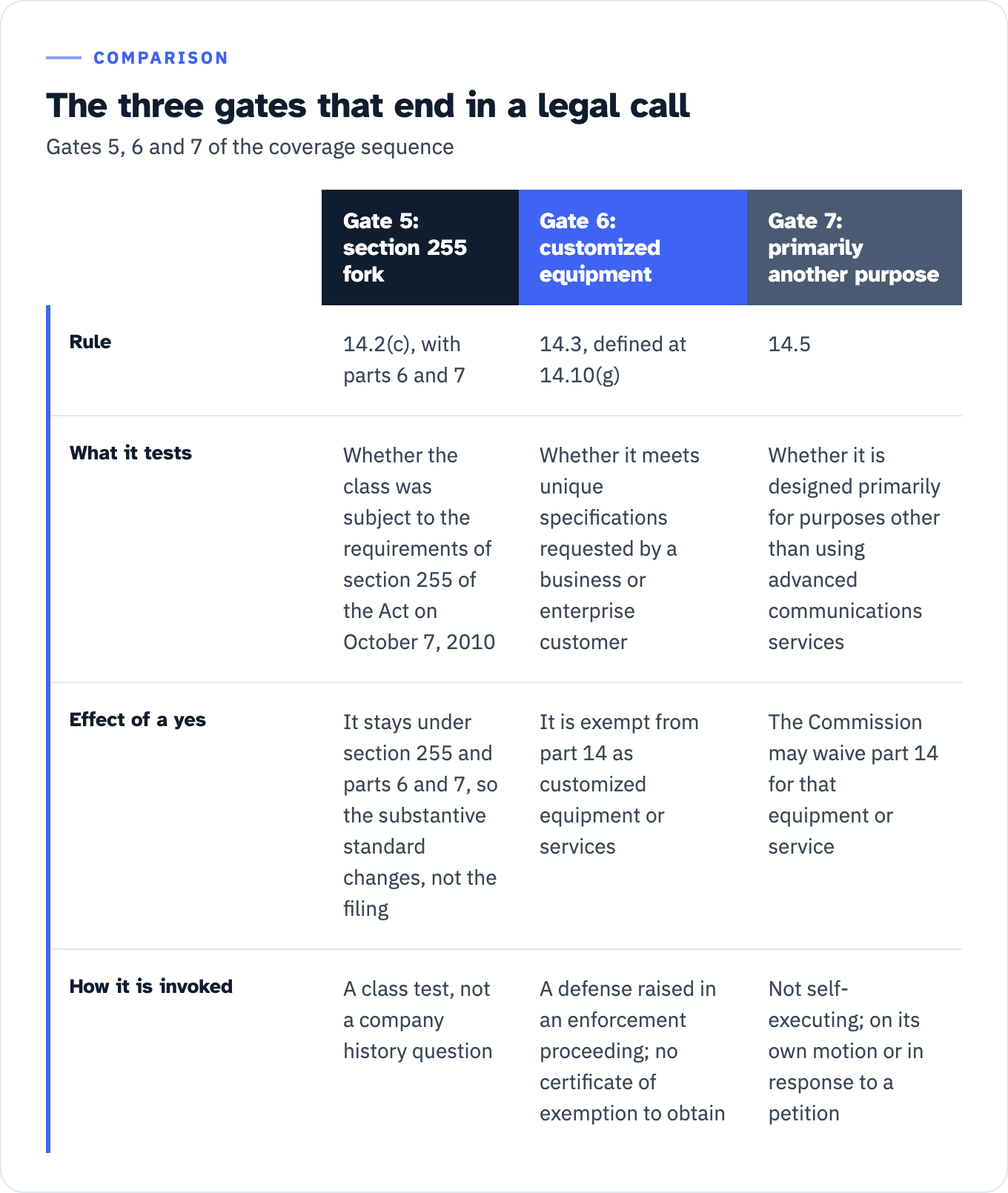
Gate 5: is it in a category already covered by section 255 on 7 October 2010? 14.2(c) forks those out of part 14’s substantive rules: equipment and services “including interconnected VoIP service, that were subject to the requirements of Section 255 of the Act on October 7, 2010” stay under section 255 and parts 6 and 7. This is a class test, not a company history question. Interconnected VoIP is named in the rule, so a VoIP service launched in 2024 is still on the section 255 side. That changes which substantive standard applies, not whether you file.
Gate 6: is it customized equipment? 47 CFR 14.3 exempts “customized equipment or services that are not offered directly to the public, or to such classes of users as to be effectively available directly to the public,” which 14.10(g) defines as equipment and services “produced or provided to meet unique specifications requested by a business or enterprise customer and not otherwise available to the general public, including public safety networks and devices.” Read paragraph (b) first: the exemption is a defense raised in an enforcement proceeding, and there is no certificate of exemption to obtain.
Gate 7: is the product primarily something else? 47 CFR 14.5 lets the Commission waive part 14 for equipment or services capable of accessing an advanced communications service but “designed for multiple purposes, but is designed primarily for purposes other than using advanced communications services.” This one is not self-executing. It arrives “On its own motion or in response to a petition,” 14.5(b) allows class waivers where the equipment or services share common defining characteristics, and the Commission weighs “Whether and how the advanced communications functions or features are advertised, announced, or marketed.”
Gates 5, 6 and 7 end in legal characterizations, which is why this is a set of gates and not a decision tree with a verdict at the bottom. Run them per feature, write down your reasons, and take the last three to counsel.
View the data as a table
| Gate 5: section 255 fork | Gate 6: customized equipment | Gate 7: primarily another purpose | |
|---|---|---|---|
| Rule | 14.2(c), with parts 6 and 7 | 14.3, defined at 14.10(g) | 14.5 |
| What it tests | Whether the class was subject to the requirements of section 255 of the Act on October 7, 2010 | Whether it meets unique specifications requested by a business or enterprise customer | Whether it is designed primarily for purposes other than using advanced communications services |
| Effect of a yes | It stays under section 255 and parts 6 and 7, so the substantive standard changes, not the filing | It is exempt from part 14 as customized equipment or services | The Commission may waive part 14 for that equipment or service |
| How it is invoked | A class test, not a company history question | A defense raised in an enforcement proceeding; no certificate of exemption to obtain | Not self-executing; on its own motion or in response to a petition |
What coverage obliges you to do
If the gates land you inside part 14, the filing is the smaller half. 47 CFR 14.20(a) is the substantive duty: a manufacturer must ensure that the equipment and software it distributes in interstate commerce “shall be accessible to and usable by individuals with disabilities, unless the requirements of this subsection are not achievable,” and a provider owes the same for its services. Where that is not achievable by building it in or by a third-party solution at nominal cost, 14.20(a)(3) requires compatibility with peripheral devices and specialized customer premises equipment instead. Paragraph (b) requires the performance objectives to be considered “at the design stage as early as possible,” paragraph (c) requires equipment to pass through the industry-standard codes an accessible service needs, and paragraph (d) requires user guides, bills and product support communications to be accessible and requires that people with disabilities can reach customer support “at no extra cost.” 47 CFR 14.21 supplies the detail: ten input, control and mechanical objectives at 14.21(b)(1), each written as “provide at least one mode” that works without vision, without hearing, without speech or without fine motor control, and nine information objectives at 14.21(b)(2).
The escape hatch is defined, not open ended. “Achievable” means “with reasonable effort or expense, as determined by the Commission,” and 14.10(b) directs the Commission to weigh four things: the nature and cost of the steps needed, the technical and economic impact on the operation of the manufacturer or provider, the type of operations, and the extent to which the company already offers accessible products at varying functionality and price points. Those four factors are what your 14.31(a) records are for. A decision that a feature was not achievable is worth exactly the documentation behind it.
What the FCC has said about video, and what it refused to say
The one modern software question the Commission has answered at length is video conferencing. In FCC 23-50 it declined to narrow the statutory definition, concluding that part 14 “applies to all services and equipment that ‘provid[e] real-time video communications, including audio, to enable users to share information of the user’s choosing.’” Paragraph 29 lists what coverage does not turn on. Application of the definition “does not depend on the options offered to users for connecting to a video conference (e.g., through a dial-up telephone connection or by broadband, through a downloadable app or a web browser), what operating systems or browsers their devices may use, whether the service works with more than one operating system, or whether the service may be classified as offered to the public or to a private group of users (such as a telehealth platform). What matters is that two or more people can use the service to share information with one another in real-time, via video.” The single carve-out in the same paragraph is one-way transmission: a service carrying real time video and audio “only from one user,” meaning video broadcasting, is outside the definition.
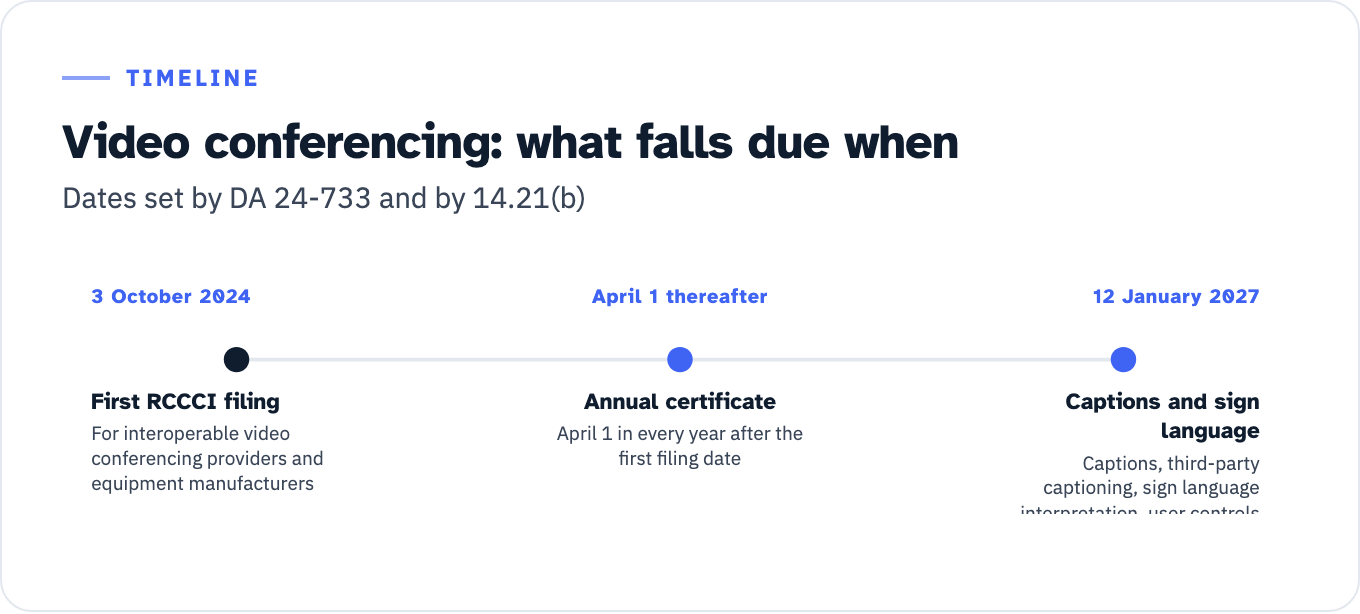
That ruling had a filing consequence with a date on it. DA 24-733 set 3 October 2024 as the first filing date for interoperable video conferencing providers and equipment manufacturers, with April 1 in every year after, and the FCC’s March 2025 reminder notice repeats that they “have been subject to the RCCCI obligations since October 3, 2024.” A category of software vendor became an FCC filer inside the last two years on the strength of a definition, not a new statute.
The same category carries substantive deadlines. From 12 January 2027, 14.21(b)(2)(iv) requires these services to “provide at least one mode with captions that accurately and synchronously display the spoken communications in a video conference, and enable users to connect with third-party captioning services so that captions provided by such services appear on the requesting user’s video conference screen.” From the same date, 14.21(b)(4)(i) requires them to “Enable the use of sign language interpretation provided by third parties, including the transmission of user requests for sign language interpretation to providers of video relay service,” and 14.21(b)(4)(ii) requires user controls to activate and adjust the display of captions, speakers and signers.
View the data as a table
| Time | Milestone | Detail |
|---|---|---|
| 3 October 2024 | First RCCCI filing | For interoperable video conferencing providers and equipment manufacturers |
| April 1 thereafter | Annual certificate | April 1 in every year after the first filing date |
| 12 January 2027 | Captions and sign language | Captions, third-party captioning, sign language interpretation, user controls |
Part 6, part 7 and part 14 end up in the same registry
Gate 5 sends some services to section 255 and parts 6 and 7. That fork is not a paperwork exit. 47 CFR 14.30(a) says the recordkeeping and enforcement rules of subpart D “are applicable to all manufacturers and service providers that are subject to the requirements of sections 255, 716, and 718 of the Act and parts 6, 7 and 14 of this chapter.” A telecommunications provider under part 6, or a voicemail and interactive menu provider under part 7, files the same annual certificate in the same registry as a messaging app. So does a manufacturer covered by section 718, which reaches “manufacturers of telephones used with public mobile services that include an Internet browser in such telephones.” DA 25-184 puts the reach in one line: “Any entity that provides services and equipment covered by Section 255, 716, or 718 of the Communications Act must submit its recordkeeping compliance certification and contact information annually.” The same notice names two categories pulled in recently, interoperable video conferencing services and Incarcerated People’s Communication Services, the second “pursuant to legislation enacted in 2023.”
Parts 6 and 7 also carry training language that part 14 does not. That contrast, and the other federal rules that command accessibility training by name, are set out in accessibility training legal requirements.
Why the records are the whole point
The retention clock has a stated rationale. In FCC 11-151, the order that created part 14, the Commission explained at paragraph 225 that purchasers “might not file a complaint for up to a year after they have purchased such products or services,” and that a resale purchaser buying a year later “might take up to an additional year to file an accessibility complaint.” Two years from end of life covers that chain. Format is left open: paragraph 223 says the Commission “will not mandate any one form for keeping records.” A shared drive of dated design reviews qualifies, and so does a ticket tracker, as long as the three categories in 14.31(a) are represented.
The reason to care shows up at 47 CFR 14.36(a). Once a complainant makes a prima facie case that a product is not accessible, the manufacturer or service provider “bears the burden of proving that the product or service is accessible or, if not accessible, that accessibility is not achievable under this part or readily achievable under parts 6 and 7.” To carry it, the company “must produce documents demonstrating its due diligence in exploring accessibility and achievability … throughout the design, development, testing, and deployment stages,” and the rule closes the door on improvisation: “Conclusory and unsupported claims are insufficient to carry this burden of proof.” The answer is due within 20 days of service under 14.36(b)(1)(i), which is not enough time to manufacture a consultation that never happened.
Read the statute and the rule together rather than one alone. 47 U.S.C. 618(a)(5)(A) requires records kept “in the ordinary course of business and for a reasonable period,” and the FCC’s filing instructions repeat that phrase. FCC 11-151 paragraph 225 supplies the number: “The statute requires manufacturers and service providers to preserve records for a ‘reasonable time period.’ Pursuant to this requirement, we adopt a rule that requires a covered entity to retain records for a period of two years.” The statute sets the standard. 14.31(a) is where the two years lives.
No, the April 2026 deletions did not remove the CVAA obligations
If you arrived here after reading that the FCC deleted accessibility rules in 2026, the claim has a real source: Commissioner Anna M. Gomez filed a dissenting statement. “This is particularly concerning when we’re dealing with rules that involve accessibility issues,” she wrote. “Many of the rules being removed through this process today involve the deaf and blind community. But this Direct Final Rule does little to explain exactly how these changes may impact their ability to receive accessible equipment or make it harder for consumers with disabilities to lodge complaints or understand their rights.” She objected to the process as well, which gave the public 20 days to review 386 rules.
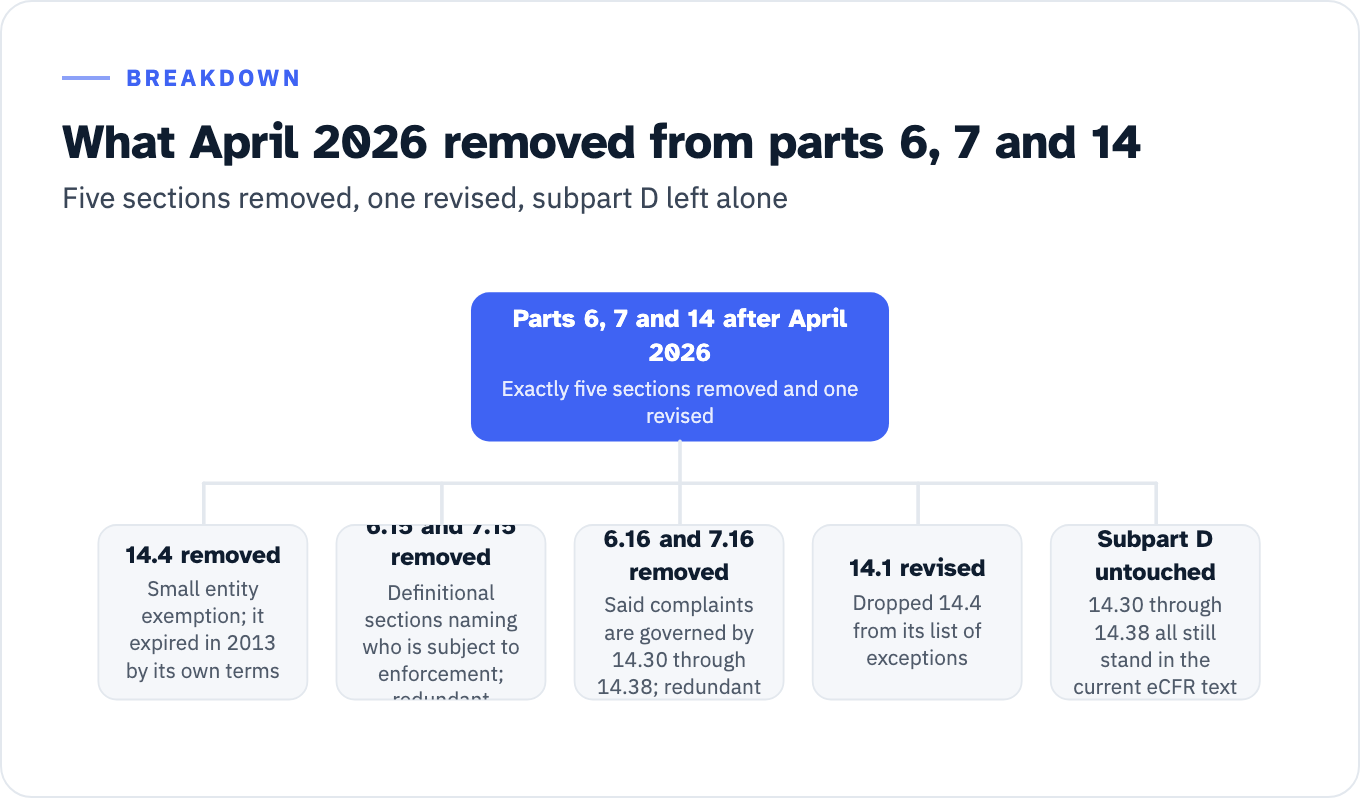
Now the amendatory text. The direct final rule, Deleting Obsolete and Duplicative Wireline Rules, was published 16 April 2026 at 91 FR 20372 and took effect 15 June 2026. It amends thirteen parts of title 47, of which parts 6, 7 and 14 are three, and across all thirteen FCC 25-68 identified “89 rule provisions, including 386 rules and requirements.” From the three accessibility parts it removed exactly five sections and revised one.
Section 14.4, the small entity exemption, is the only one that carried an expiry date in its own text. Its paragraph (c) read: “This exemption will expire no later than October 8, 2013.” The FCC’s justification says the same thing in seven words: “exemption for small entities expired in 2013.” Sections 6.15 and 7.15 were definitional sections naming who is subject to the enforcement provisions. Sections 6.16 and 7.16 each said that complaints alleging section 255 violations are governed by 47 CFR 14.30 through 14.38, which 14.30(a) also says. The Commission labeled all four “redundant rules.” Section 14.1 was revised for one reason: to drop “14.4” from its list of exceptions.
Two consequences are worth stating plainly. First, the small entity exemption did not disappear in 2026. It stopped operating on 8 October 2013 by its own terms, so a small software company assuming it is exempt has been wrong since then. The statutory authority survives: 47 U.S.C. 617(h)(2) still says “The Commission may exempt small entities from the requirements of this section.” Nothing located in this research indicates the Commission intends to adopt a replacement.
Second, subpart D was not touched. Sections 14.30 through 14.38 all still stand in the current eCFR text and still reach parts 6 and 7 entities by their own terms. The recordkeeping duty, the annual certificate and the complaint rules came through the sweep unchanged, and the April 1 filing date is where it was.
View the data as a list
Parts 6, 7 and 14 after April 2026: Exactly five sections removed and one revised
- 14.4 removed: Small entity exemption; it expired in 2013 by its own terms
- 6.15 and 7.15 removed: Definitional sections naming who is subject to enforcement; redundant
- 6.16 and 7.16 removed: Said complaints are governed by 14.30 through 14.38; redundant
- 14.1 revised: Dropped 14.4 from its list of exceptions
- Subpart D untouched: 14.30 through 14.38 all still stand in the current eCFR text
What happens to a company that skips the annual certificate
One published enforcement action involving 14.31(b) turned up in the research for this article. In August 2021 the Enforcement Bureau issued a Citation and Order against ViaTalk, LLC, captioned in part “Failure to File Annual Compliance Certifications.” Investigating a consumer complaint, the Bureau “determined that ViaTalk has failed to file an annual compliance certification as required by section 14.31(b) of the Commission’s rules since 2012, except in 2020 when it received an inquiry from Commission staff.” The order directed the company to cease and desist and to file its 2021 certification within 30 days.
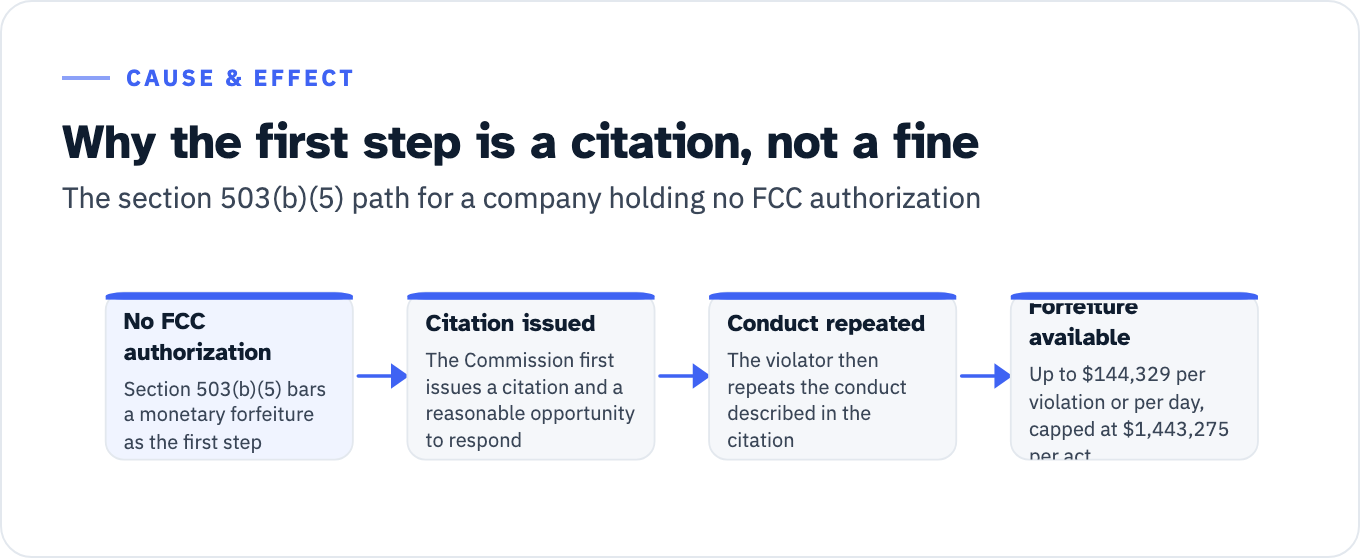
The procedure matters more to a software company than the outcome. The Bureau issued a citation rather than a fine because section 503(b)(5) of the Act bars monetary forfeitures against entities without FCC authorizations unless the Commission first issues a citation, gives the violator a reasonable opportunity to respond, and the violator then repeats the conduct described in it. A software company holding no FCC authorization sits in that category, so the first step against it cannot be a fine. It can be a citation that turns the second step into one.
The ceiling on that second step is real money. 47 CFR 1.80(b)(3), as read on 20 August 2026, sets a forfeiture of not more than $144,329 for each violation or each day of a continuing violation for a manufacturer or service provider subject to section 255, 716 or 718, capped at $1,443,275 for any single act or failure to act. Under 1.80(b)(12) those maxima are adjusted for inflation “by order published no later than January 15 each year,” and the table carrying those figures is headed “after 2025 annual inflation adjustment,” so quote them with a date attached. No forfeiture actually imposed for a 14.31 violation turned up in this research.
The channel it would come through is small. The FCC’s 2024 biennial report to Congress records that between 1 January 2022 and 31 December 2023, consumers filed 44 requests for dispute assistance alleging violations of section 255, 716 or 718, with a further 723 found ineligible because they alleged no such violation. The Disability Rights Office resolved 43 through facilitated dialogue, and one consumer went on to file an informal complaint. Filing costs the consumer nothing: 47 U.S.C. 618(a)(1) bars any fee for such a complaint.
View the data as a list
- No FCC authorization: Section 503(b)(5) bars a monetary forfeiture as the first step
- Citation issued: The Commission first issues a citation and a reasonable opportunity to respond
- Conduct repeated: The violator then repeats the conduct described in the citation
- Forfeiture available: Up to $144,329 per violation or per day, capped at $1,443,275 per act
A VPAT is not a CVAA filing
These get conflated in vendor conversations, so state the boundary once. No rule in part 14 requires a VPAT or an Accessibility Conformance Report, and no VPAT satisfies 14.31. The certificate says records exist and names two people. The ACR is a product-level conformance report written for buyers, scored against the standard named by the VPAT edition used, 508, WCAG, EU or INT, and taken apart on the terms set out in how to score a vendor’s ACR. The two can share evidence, since a conformance report and its test artifacts are the documentation 14.36(a) asks for, but filing one does not discharge the other.
What is not settled
Coverage in the ordinary software case is settled by the definitions, not by case law. No court decision and no Commission adjudication applying the part 14 definitions to a general purpose software product with a communications feature turned up in this research. ViaTalk was an interconnected VoIP provider, cited under section 255 of the Act and sections 6.11(a) and 14.31(b) of the rules. Treat the gates above as text on the page rather than as construed law.
The customized equipment exemption at 14.3 has not been tested in any published decision located here, so what “not otherwise available to the general public” means for a multi-tenant product configured per customer is open. Whether a purely internal communications tool is “offered … in or affecting interstate commerce” within 14.1 is not resolved by any source located either. The FCC 23-50 passage about public and private groups addresses the video conferencing definition, not the distribution hook in 14.1, and should not be stretched to cover it.
One absence is worth recording: the count of entities registered in the RCCCI Registry is not published anywhere located here, so any claim about the size of the filer population has nothing behind it. The annual reminder itself is on the record and current. Public Notice DA 26-190, released 25 February 2026, repeats the obligation in the same form as the 2025 notice, and carries one stale detail: its released text still tells filers to file “no later than April 1, 2025.” The rule, 14.31(b)(3), governs the date.
Where this stops
Deciding whether your company is a covered manufacturer or a covered service provider is a legal determination, and it belongs to counsel who can look at what you sell, to whom, and under what contracts. So does any decision to rely on the customized equipment defense or to petition for a waiver under 14.5. What sits on the accessibility side of the line is what the rule asks you to have ready: consultation you actually did with disabled users, a description of the accessibility features you shipped, compatibility findings with assistive technology, an achievability analysis against the four factors in 14.10(b) wherever you relied on one, and dates on all of it.
Your next step
Inventory every feature in your product that lets two people communicate: chat, huddles, voice calls, video rooms, in-app messaging, voicemail. Mark each against the five categories in 14.10(c), write down which definition it matches or why it does not, and keep the note. That inventory is the input to the coverage question, the scope statement for the records under 14.31(a), and the thing your officer will want to see before signing under penalty of perjury.
If the answer is that you file, the address is the RCCCI Registry at apps.fcc.gov/rccci-registry. The filing instructions confirm that “no separate documents or attachments are necessary to satisfy the requirements of 47 CFR § 14.31(b)”: the registry asks you to certify and to enter the contact details on screen. A company that finds it has never filed can file the current year there.
If your product is software sold to enterprises and public sector buyers, the same evidence base feeds the conformance reporting those buyers ask for. Our SaaS and software vendor work starts from the product inventory rather than from a template, for the same reason the FCC did: the feature list is what decides which rules are in play.