
Accessibility training legal requirements: what the CFR says
 By David LoPresti July 30, 2026
 The training line in the budget comes back with one comment on it: show me where it says we have to.
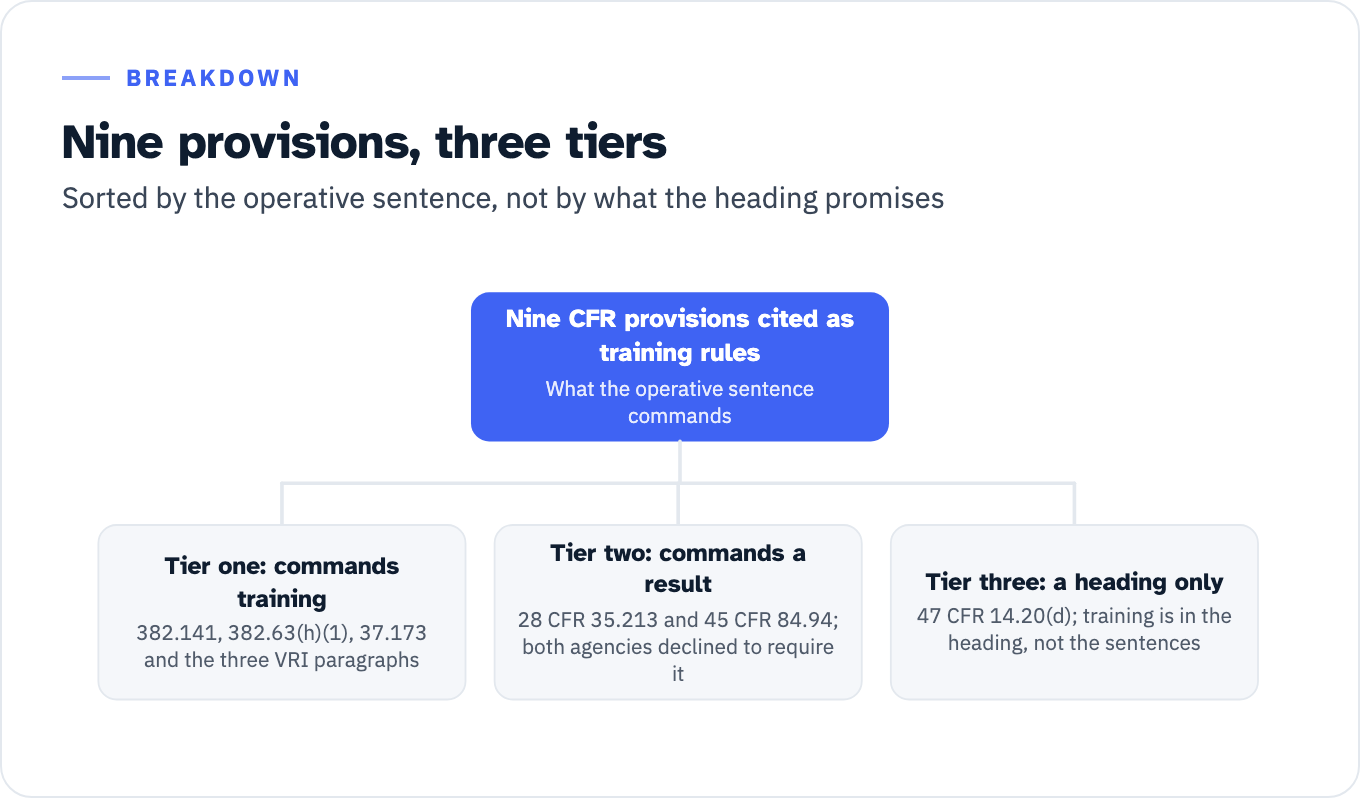
That question has an answer, and it is not the one either side of the argument expects. Nine provisions of the Code of Federal Regulations get cited as accessibility training mandates, and they do not command the same thing. Six order training outright. Two order a result and leave the method open, on the record, on purpose. One carries the word “training” in its paragraph heading and nowhere in its operative sentences. Cite the wrong one and the reviewer opens the link, reads three sentences, and the ask loses credibility over an overstatement you did not need to make.
So this piece sorts them: who each provision binds, what its text commands, what frequency it states, what record it requires. Where a rule commands less than its reputation suggests, that is said plainly. The reader most likely to open your citation is the one you are trying to persuade.
Three tiers, not one requirement
Tier one commands training. 14 CFR 382.141 tells air carriers “you must ensure training.” 14 CFR 382.63(h)(1) tells them “You must train flight attendants to proficiency on an annual basis.” 49 CFR 37.173 tells transit operators they “shall ensure that personnel are trained to proficiency.” Three more sit as paragraph (4) of a communications section in three separate parts, and each tells an entity that chooses video remote interpreting that it shall ensure it provides “Adequate training to users of the technology and other involved individuals.”
Tier two commands a result and leaves the method to you. 28 CFR 35.213 and 45 CFR 84.94 require that staff “are able to” do certain things. Both agencies were asked to require training and both declined in the preamble.
Tier three is a heading. 47 CFR 14.20(d) is headed “Information, documentation, and training.” Its operative sentences require accessible information, accessible documentation and access to customer support. The word “training” appears in none of them.
View the data as a list
Nine CFR provisions cited as training rules: What the operative sentence commands
- Tier one: commands training: 382.141, 382.63(h)(1), 37.173 and the three VRI paragraphs
- Tier two: commands a result: 28 CFR 35.213 and 45 CFR 84.94; both agencies declined to require it
- Tier three: a heading only: 47 CFR 14.20(d); training is in the heading, not the sentences
The table covers those nine provisions in six rows, merging the parallel provisions that carry identical text. Recordkeeping and scoping sections named alongside them are there for reference and are not part of the nine.
| Citation | Who it binds | What the text commands | Frequency stated in the rule | Record the rule requires |
|---|---|---|---|---|
| 14 CFR 382.141 | Carriers operating aircraft with 19 or more passenger seats; every employee and contractor who interacts with the traveling public or handles passengers’ assistive devices | ”you must ensure training … to proficiency” | 12 months for physical assistance and wheelchair handling personnel and for CROs; 3 years for all other personnel; initial training by 17 June 2026 | Yes. Individual employee training records retained three years, plus manuals produced to DOT on request (14 CFR 382.145) |
| 14 CFR 382.63(h)(1) | Carriers operating at least one aircraft with an FAA-certificated maximum seating capacity of 60 or more; flight attendants | ”You must train flight attendants to proficiency on an annual basis” | Annual. Compliance date 2 October 2026 | Not stated in 382.63 |
| 49 CFR 37.173 | Every public or private entity operating a fixed route or demand responsive system | ”shall ensure that personnel are trained to proficiency” | None stated. 49 CFR 37.209 adds refresher training “as needed to maintain proficiency” for over-the-road bus operators | None stated |
| 28 CFR 35.160(d)(4); 28 CFR 36.303(f)(4); 45 CFR 84.77(d)(4) | Any Title II public entity, Title III public accommodation or HHS recipient that chooses to provide interpreters by video remote interpreting | ”shall ensure that it provides … Adequate training to users of the technology and other involved individuals” | None stated | None stated |
| 28 CFR 35.213; 45 CFR 84.94 | Title II public entities; recipients of HHS federal financial assistance | Staff “must … be able to” operate accessible MDE, assist with transfers and positioning, and carry out the program access obligation. Training is not commanded | None stated | None stated |
| 47 CFR 14.20(d) | Manufacturers and providers of advanced communications services | Accessible information, accessible documentation and accessible customer support. Training appears only in the paragraph heading | None stated | 47 CFR 14.31: two years of records of efforts, plus an annual officer-signed compliance certificate |
The most detailed of the nine is an airline rule
14 CFR 382.141 fixes scope and audience in one sentence: “As a carrier that operates aircraft with 19 or more passenger seats, you must ensure training, meeting the requirements of this paragraph, for all personnel who interact with the traveling public or who handle passengers’ assistive devices, as appropriate to the duties of each employee or contractor.” Contractors are named, not implied. Carriers flying only aircraft with fewer than 19 seats get a lighter duty under paragraph (b).
Then it names content. Paragraph (a)(1) requires “training to proficiency” on the requirements of part 382, on the carrier’s own procedures including safe operation of accommodation equipment, and on “procedures that safeguard the safety and dignity of passengers with disabilities.” Paragraph (a)(2) covers disability awareness and communication, and draws its own boundary in seven words any curriculum owner will appreciate: “Training in sign language is not required.”
Three features matter more than the subject matter, because they port to any program.
The first is assessment. Paragraphs (a)(3)(iii) and (a)(4)(iii) require that “the employees and contractors must be able to successfully demonstrate their knowledge on the matters listed” in the preceding subparagraphs, and give the rule’s own examples: “competency assessments or certification exams.” Attendance is not the deliverable.
The second is curriculum governance. Paragraph (a)(5): “You must consult with organizations representing individuals with disabilities in your home country when developing your training program and your policies and procedures.” Who helped write the training is part of whether it counts.
The third is the record. 14 CFR 382.145(b) requires the carrier to “retain for three years individual employee training records demonstrating that all persons required to receive initial and refresher training have done so,” and 382.145(a) requires the underlying manuals to be kept “for review by the Department on the Department’s request.” Only two of the six rows above sit next to a recordkeeping rule that creates an artifact a reviewer can ask for: 382.141 with 382.145, and 14.20 with 14.31.
One drafting defect is worth knowing. 14 CFR 382.143 carries two stale cross-references into the current text of 382.141. Its paragraph (a)(1) sends the reader to 382.141(a)(7) for the Complaint Resolution Official training duty, but (a)(7) is now Contractors and the CRO duty sits at (a)(8). Its paragraph (a)(2) sends the reader to 382.141(a)(8) for the one-time training of employees already on staff in 2009, and that paragraph is gone. The December 2024 amendment renumbered one section without conforming the other.
What DOT paused on 4 August 2026, and what it did not
On 4 August 2026 the Department of Transportation published a notification of enforcement discretion, “Accessible Lavatories on Single-Aisle Aircraft and Ensuring Safe Accommodations for Air Travelers With Disabilities Using Wheelchairs”, at 91 FR 49272. The DATES paragraph, whole: “As of August 4, 2026, enforcement of 14CFR 382.125(e), 382.130(a), 382.132, and the at least once every 12-month training requirements found in §§ 382.141(a)(6) and 14 CFR 382.63(h)(1) are delayed until April 30, 2027.” That replaced an end date of 31 December 2026, itself set by a notice published 30 September 2025 at 90 FR 46751.
Read the object of that sentence carefully. What is delayed is the twelve-month frequency, in two places. The initial training duties at 382.141(a)(1) through (a)(4) are untouched, as are the demonstrate-your-knowledge requirement at (a)(3)(iii) and (a)(4)(iii), the consultation duty at (a)(5), the CRO training duty at (a)(8), and the recordkeeping duty at 382.145. The contractor duty at (a)(7) is the partial case: it stands, but it requires contractor training to “meet the requirements of paragraphs (a)(1) through (6) of this section,” so it inherits whatever (a)(6) is doing. DOT drew the same narrow line for the lavatory rule in its own words: “This notice does not affect the enforcement of requirements in the Accessible Lavatory Rule other than the one identified.”
What the pause does not do is drop you onto some other interval. Sections 542(b)(3) and 543(b)(2) of the FAA Reauthorization Act of 2024 direct the Secretary to set training standards that require, at a minimum, that covered personnel “complete refresher training within 18 months of an initial training and be recertified on the job every 18 months thereafter by a relevant superior in order to remain qualified for providing aisle chair assistance,” with 543(b)(2) carrying the same cycle for wheelchair and scooter stowage. That obligation runs to the rulemaking, not to a carrier. DOT read it the same way at 89 FR 102432: “the Department cannot allow refresher training to be less frequent than 18 months but is permitted to adopt more rigorous standards as it sees fit.” It then chose twelve months. The 18-month floor constrains what the next rule may adopt. It does not create an enforceable interval while enforcement of 382.141(a)(6) is paused.
Two further limits on how far the pause reaches. It is enforcement discretion, not an amendment, so the regulation still says what it said. And it binds the Department, which is not the only party who can raise the subject.
The reason DOT expanded the pause will be familiar to anyone whose training calendar collides with another calendar. A large US carrier told the Department that the FAA had approved its flight attendant safety training under 14 CFR part 121 on an 18-month cycle, and that running DOT-required training annually alongside it was inefficient. What happens after 30 April 2027 is open: DOT says the provisions will be addressed in a rulemaking titled “Airline Obligations to Accommodate Air Travelers with Disabilities Using Wheelchairs,” RIN 2105-AF35, and that the exercise of discretion “does not prejudge the outcome of the new rulemaking.” The date has already moved once.
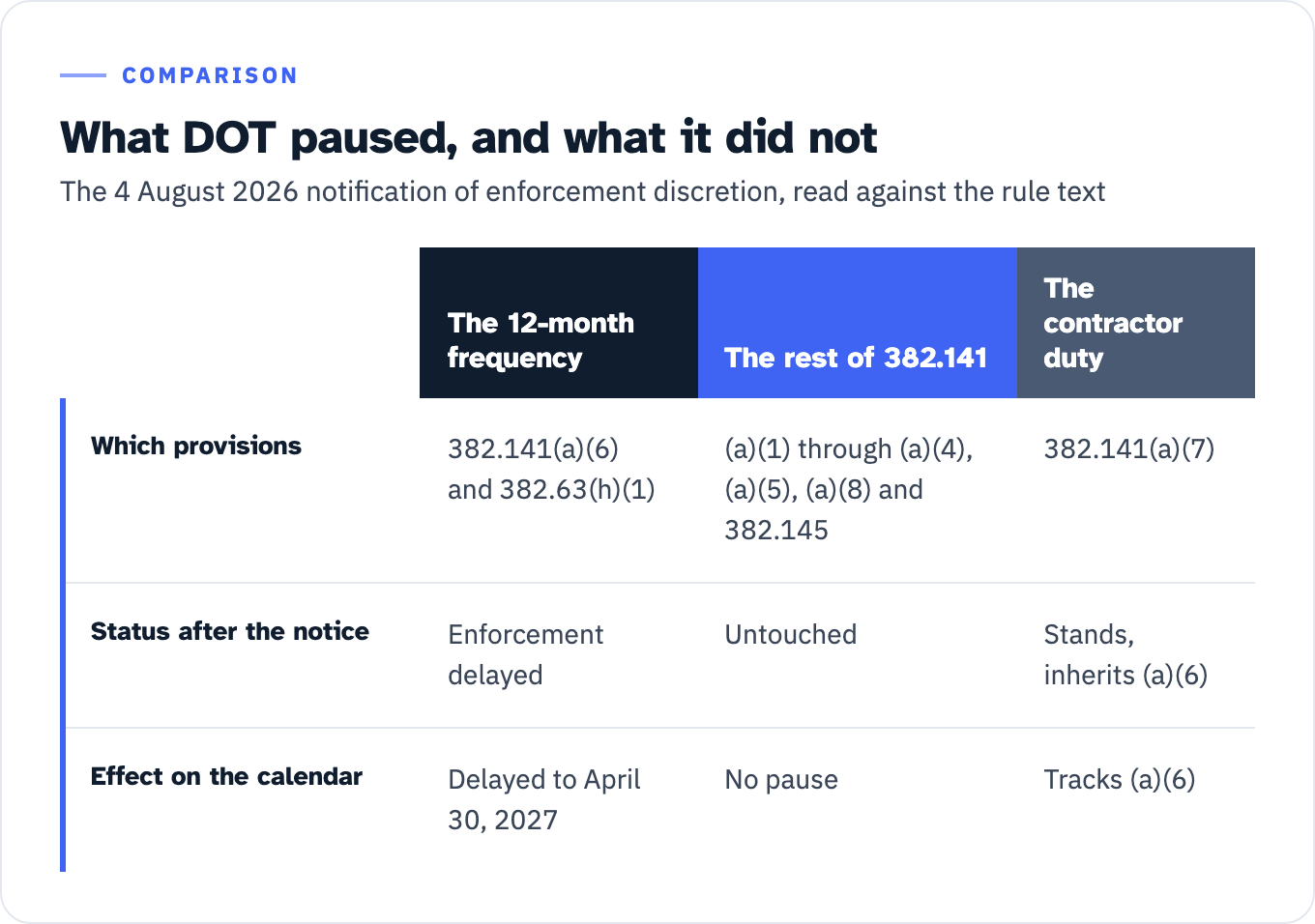
View the data as a table
| The 12-month frequency | The rest of 382.141 | The contractor duty | |
|---|---|---|---|
| Which provisions | 382.141(a)(6) and 382.63(h)(1) | (a)(1) through (a)(4), (a)(5), (a)(8) and 382.145 | 382.141(a)(7) |
| Status after the notice | Enforcement delayed | Untouched | Stands, inherits (a)(6) |
| Effect on the calendar | Delayed to April 30, 2027 | No pause | Tracks (a)(6) |
Transit: trained to proficiency, no interval, no record
49 CFR 37.173 is one sentence and it binds a wide class: “Each public or private entity which operates a fixed route or demand responsive system shall ensure that personnel are trained to proficiency, as appropriate to their duties, so that they operate vehicles and equipment safely and properly assist and treat individuals with disabilities who use the service in a respectful and courteous way, with appropriate attention to the difference among individuals with disabilities.”
The command is real and the standard is proficiency, but the section states no interval, no curriculum and no record. The only content list arrives sideways, at 49 CFR 37.209, where for over-the-road bus operators “training to proficiency” is deemed to include operation and maintenance of accessibility features and equipment, boarding assistance, securement of mobility aids, sensitive and appropriate interaction with passengers with disabilities, handling and storage of mobility devices, and familiarity with the requirements of the subpart. That is also the only place a refresher appears, and only “as needed to maintain proficiency.”
The training duty that arrives with a software purchase
At paragraph (d)(4) of 28 CFR 35.160, (f)(4) of 28 CFR 36.303 and (d)(4) of 45 CFR 84.77 sits the same sentence, word for word. An entity that chooses to provide qualified interpreters via video remote interpreting “shall ensure that it provides … Adequate training to users of the technology and other involved individuals so that they may quickly and efficiently set up and operate the VRI.”
Three regulations, three covered classes, one identical duty binding Title II public entities, Title III public accommodations and HHS recipients alike. The trigger is a procurement decision. Nobody has to use VRI, but an organization that does has taken on a training obligation attached to a piece of software.
Two limits. The rule gives no frequency, no syllabus and no record. And “other involved individuals” is not defined in the rule text. DOJ’s published section-by-section analysis, printed as Appendix A to 28 CFR part 35, reads the duty to reach “staff who would have reason to use the equipment in an emergency room, State or local court, or elsewhere,” which settles the front-line question. It does not say whether the person who schedules the session or configures the endpoint is covered.
The medical equipment sections command competence, not a course
This is where a careless citation does the most damage, because these two sections read like training rules and are not. 28 CFR 35.213 says, entire: “Public entities must ensure their staff are able to successfully operate accessible MDE, assist with transfers and positioning of individuals with disabilities, and carry out the program access obligation regarding existing MDE.” 45 CFR 84.94 is identical except that it says “Recipients.” Both state results. Neither names training.
That was deliberate, and both agencies said so. DOJ, in the preamble to the rule that created 35.213 (89 FR 65199): “Often, the most effective way for public entities to ensure that their staff members are able to successfully operate accessible MDE is to provide staff training on the use of MDE, but the final rule does not mandate that approach.” A page later it “declines to impose more specific requirements in § 35.213” and decided “not to mandate one specific process or curriculum.” HHS put it flatly for 84.94 (89 FR 40172): “Although specific trainings are not required,” and pointed practices to earlier joint guidance from HHS and DOJ.
The honest citation, then: the outcome is mandatory and training is your chosen method of reaching it. That does not make training optional in effect, and DOJ said so in one sentence that belongs in the budget memo: “The lack of a specific requirement to provide training to these personnel regarding these issues would not excuse a related ADA violation.”
The gap should be named rather than papered over. Neither section states a frequency, a duration, a certification or a record, and nothing published explains how a public entity demonstrates compliance with 35.213 in an investigation. The equipment deadlines have passed: 28 CFR 35.211(c) required at least one accessible examination table and one accessible weight scale within two years after 9 August 2024, and 45 CFR 84.92(c) set the same pair within two years after 8 July 2024. Neither staffing section says when staff had to be able to operate the equipment.
DOJ did price the training it declined to require. Its Final Regulatory Impact Analysis for the MDE rule breaks out incremental training costs of roughly $7.4 million in the first year and about $2.5 million in later years, both in 2023 dollars, on an assumption that 75 percent of health care provider employees receive one hour of training. Those are the Department’s modeling assumptions, not a benchmark.
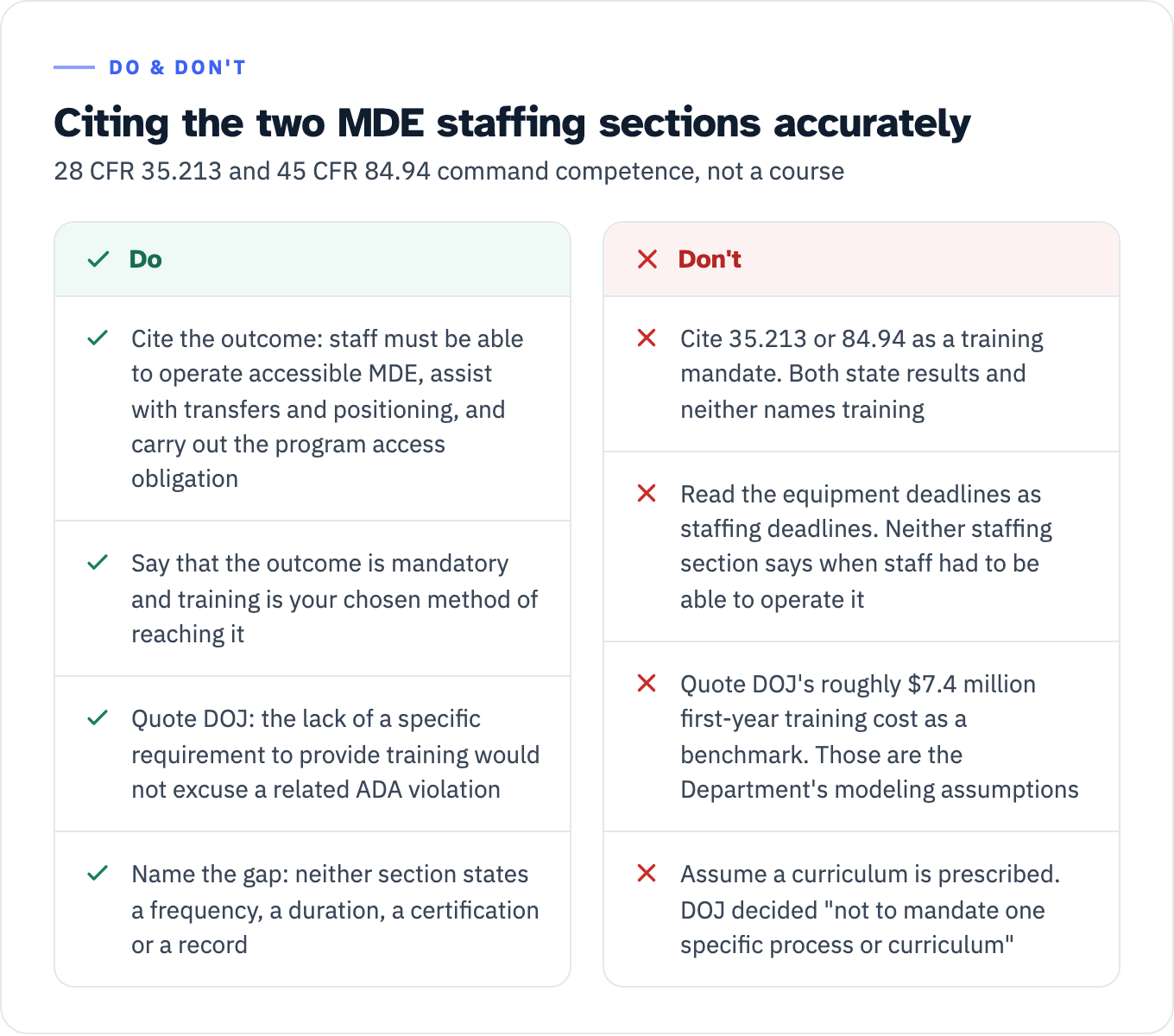
View the data as a table
| Do | Don’t |
|---|---|
| Cite the outcome: staff must be able to operate accessible MDE, assist with transfers and positioning, and carry out the program access obligation | Cite 35.213 or 84.94 as a training mandate. Both state results and neither names training |
| Say that the outcome is mandatory and training is your chosen method of reaching it | Read the equipment deadlines as staffing deadlines. Neither staffing section says when staff had to be able to operate it |
| Quote DOJ: the lack of a specific requirement to provide training would not excuse a related ADA violation | Quote DOJ’s roughly $7.4 million first-year training cost as a benchmark. Those are the Department’s modeling assumptions |
| Name the gap: neither section states a frequency, a duration, a certification or a record | Assume a curriculum is prescribed. DOJ decided “not to mandate one specific process or curriculum” |
An FCC heading that promises training and does not deliver it
47 CFR 14.20(d) is headed “Information, documentation, and training,” and the heading is the only place training appears. The operative text requires manufacturers and service providers to ensure that information and documentation provided to customers is accessible, if achievable, and extends the duty to “ensuring that individuals with disabilities can access, at no extra cost, call centers and customer support.”
The FCC’s training language lives in the older section 255 rules. 47 CFR 6.11(c) says that “In developing, or incorporating existing training programs, manufacturers and service providers, shall consider the following topics,” then lists five, among them means of communicating with individuals with disabilities and designing for accessibility. 47 CFR 7.11(c) carries the same five-topic list in near-identical wording. A duty to consider is not a duty to train. Part 14 reuses the heading and drops the training paragraph, and nothing in the rule text explains the difference.
What part 14 supplies instead is a records regime standing in for a training record: 47 CFR 14.31(a) requires two years of records of implementation efforts after a product or service ends, and 14.31(b) requires an officer to sign and file an annual compliance certificate.
The duty that runs the other way: your training materials are regulated content
Several of these provisions govern physical assistance, patient transfers, aisle chairs and on-board wheelchairs. That is a long way from a web accessibility program, and the connection has to be earned rather than asserted. Two facts earn it. The first is the VRI duty above, which sits in regulations a Title II or Title III program already works under and is triggered by a software choice.
The second is 36 CFR part 1194, the Revised Section 508 Standards, which point the obligation the opposite way. Section 508 does not tell a federal agency to train its staff. It tells the agency the training itself is in scope. Provision E205.3 lists nine categories of non-public-facing electronic content that must conform when it constitutes official business, and item H is “Educational or training materials.” Appendix C runs the same logic at 603.1: “ICT support services including, but not limited to, help desks, call centers, training services, and automated self-service technical support, shall conform to 603.” A federal agency’s own accessibility training materials are regulated content.
Check the version number before writing it into a syllabus. E205.4 sets the Section 508 standard at WCAG 2.0 Level A and AA, still the version incorporated by reference in the Revised 508 Standards. DOJ’s Title II web rule at 28 CFR 35.200 sets a different one, WCAG 2.1 Level A and AA, beginning 26 April 2027 for public entities with a population of 50,000 or more and 26 April 2028 for smaller entities and special district governments.
What transfers to a digital accessibility program
Strip out the subject matter and 14 CFR 382.141 is a template with five parts, all of them portable to a program with no aircraft in it: an audience defined by function rather than job title, named content, a stated frequency, an assessment the learner must pass, and a retained record with a stated retention period.
Measure the rest against it. 382.63(h)(1) supplies three parts: audience, content and frequency. 37.173 and the three VRI paragraphs supply an audience and, at most, a line of content. 35.213, 84.94 and 14.20(d) command no training at all, so they supply none of the five and cannot be cited as if they did. One provision of the nine supplies all five.
Where a rule requires no record, those five parts still say what to keep: who attended, on what date, against which version of the content, with what assessment result, and for how long the file is retained. That is the structure behind a role-based accessibility training curriculum.
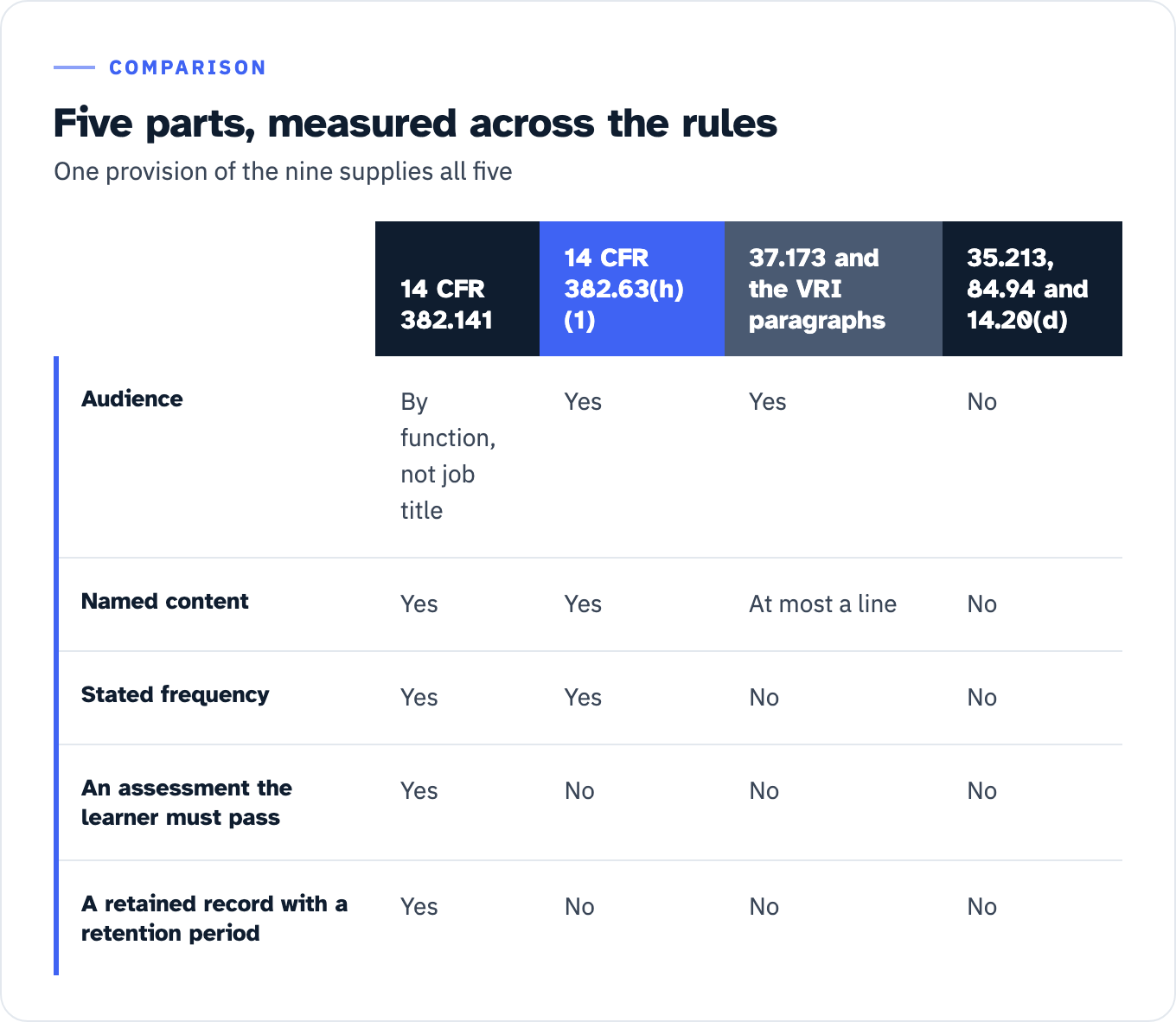
View the data as a table
| 14 CFR 382.141 | 14 CFR 382.63(h)(1) | 37.173 and the VRI paragraphs | 35.213, 84.94 and 14.20(d) | |
|---|---|---|---|---|
| Audience | By function, not job title | Yes | Yes | No |
| Named content | Yes | Yes | At most a line | No |
| Stated frequency | Yes | Yes | No | No |
| An assessment the learner must pass | Yes | No | No | No |
| A retained record with a retention period | Yes | No | No | No |
What is not known
No published judicial decision applying 28 CFR 35.213, 45 CFR 84.94, 14 CFR 382.141, 14 CFR 382.63(h)(1), 49 CFR 37.173 or the VRI training provisions was located. Treat every provision here as text on the page rather than as construed law.
No DOT consent order turning on an accessibility training provision is cited here, because none was verified against a primary document.
The sources used supply no count of how many entities 49 CFR 37.173 reaches or how many airline personnel 382.141 covers, and no dollar figure attaches to a training failure. Section 542(e) of the FAA Reauthorization Act of 2024 authorizes a civil penalty “in accordance with section 46301 of title 49” and names no amount for training.
Where this stops
Several of these provisions are about lifting people, transferring them between chairs, and operating clinical or aviation equipment. Those modules belong to clinical educators, airline and transit safety trainers, and the equipment manufacturers. This firm does not deliver physical-assistance or transfer training, and a piece that mapped the regulations without saying so would be selling past its competence. Whether a citation supports a particular legal position is a question for your counsel, not your accessibility vendor.
What sits on our side of the line is the digital half and the structure: which rule binds you, what its text says, what the curriculum has to name, what the assessment has to prove, what the record has to show. Take the provision that binds your organization, put its operative sentence at the top of the memo, and build the ask around those five parts rather than a course catalog. ADACP’s accessibility training work starts there: which rule, which audience, which evidence, and what gets retained.