
WCAG 3.0 in August 2026: what the draft says and cannot yet do
 By David LoPresti August 3, 2026
 The question behind the delay objection
There is a contract clause in front of you that will still be running in 2031, and someone in the review has asked whether it should name WCAG 3.0 instead of WCAG 2.2, or whether the audit should wait for WCAG 3. It is a fair question with a checkable answer: read what the current WCAG 3.0 document says about its own maturity.
There is a real document to read. W3C Accessibility Guidelines (WCAG) 3.0 exists as a W3C Working Draft dated 3 March 2026. It defines 44 guidelines and 181 provisions, and it names a three-rung conformance model with the levels Bronze, Silver and Gold. None of that makes it citable in a contract, and the document says so in the Status of This Document section every W3C technical report carries:
“This is a draft document and may be updated, replaced, or obsoleted by other documents at any time. It is inappropriate to cite this document as other than a work in progress.”
Everything below was verified on 24 August 2026 against that dated snapshot, WD-wcag-3.0-20260303, which will not change even when the next draft publishes.
The draft grades itself, and it has not reached the top two grades
WCAG 3 does something no published WCAG 2.x document does: it labels each of its own normative sections with a maturity status, which section 1.1.2 says indicates “how far along in the development this section is, how ready it is for experimental adoption, and what kind of feedback the Accessibility Guidelines Working Group is looking for.” That section defines five statuses, and the companion Explainer orders them “from least to most mature” as Placeholder, Exploratory, Developing, Refining and Mature. Two of the Working Draft’s own definitions matter to a buyer. Refining means “This content is ready for wide public review and experimental adoption. The working group has reached consensus on this section.” Mature means “This content is believed by the working group to be ready for recommendation.”
Now count the markers in the 3 March 2026 draft. It carries 188 section status markers and a further 121 attached to individual glossary terms. Of the 188 sections, 187 read Developing and exactly one reads Exploratory: section 3, Conformance. Of the 121 glossary terms, 89 read Developing, 24 read Exploratory and 8 read Placeholder, the last eight being definitions whose entire content is an Editor’s note reading “To be defined.” Refining is used as a marker zero times. So is Mature.
All 181 provisions, the 92 core requirements, 61 supplemental requirements and 28 assertions, plus the draft’s single best practice, sit at Developing, defined in the draft as content that “has been roughly agreed on in terms of what is needed for this section, although not all high-level concerns have been settled.”
Nothing in the draft has reached the rung labeled ready for experimental adoption. That is the working group’s own assessment of its own text, in the document a buyer would be citing.
A second filter sits on top of the labels. Section 1.1 states: “Requirements and assertions at the Exploratory status are not included in this Working Draft. If you would like to see the complete list, please review the Editor’s Draft.” The published draft is not WCAG 3. It is the subset of WCAG 3 that reached Developing. The same section adds the sentence that settles the wait question on the draft’s own terms: “While this draft has moved closer towards completion, it still has several years of work.”
The conformance model is nameable, and its interior is not
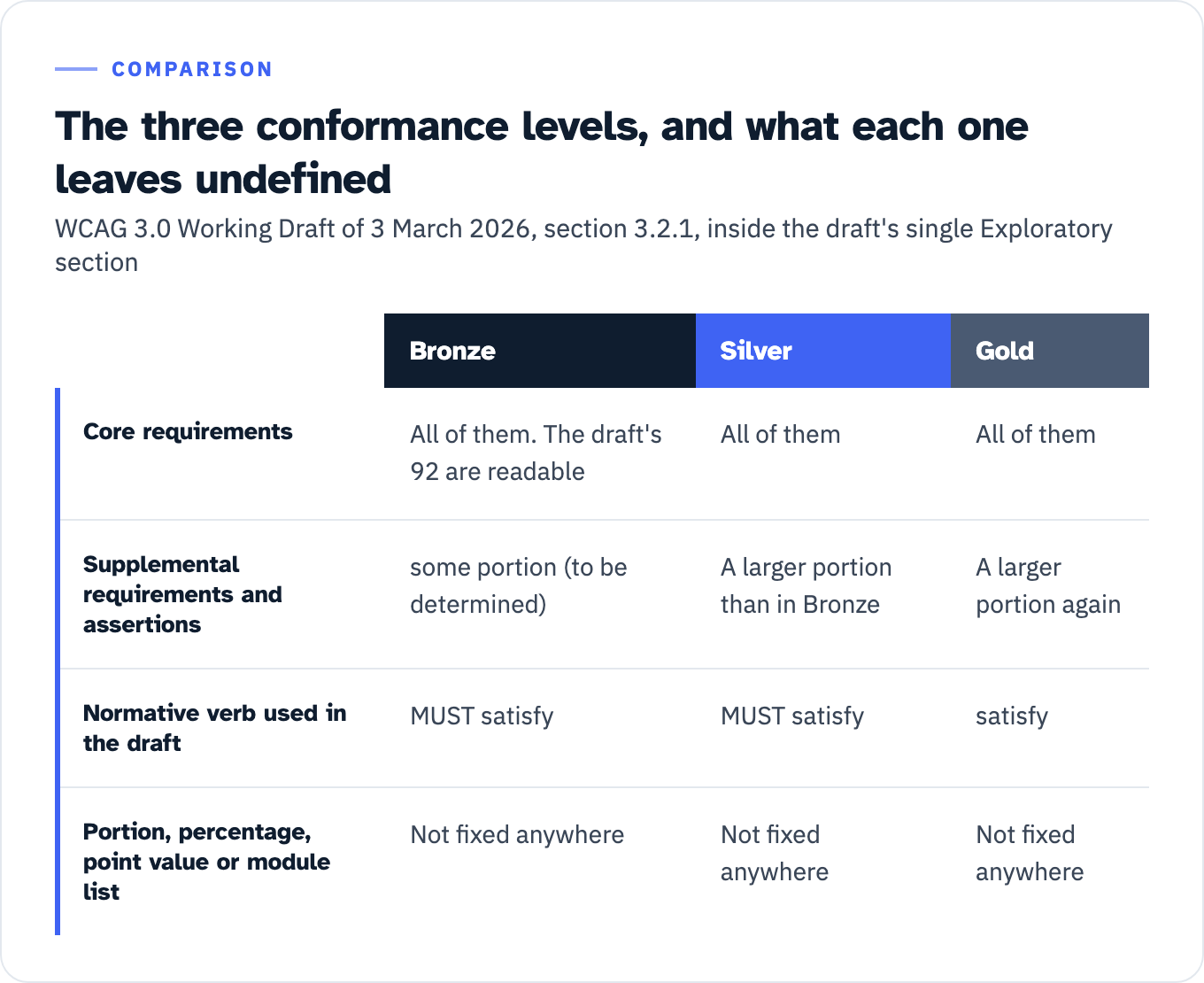
Bronze, Silver and Gold are in the current draft, in normative text, at section 3.2.1. What is missing is not the model. It is the content of the model.
Section 3, Conformance, is the single Exploratory section in the entire specification. Its markup reads <section id="conformance" data-status="exploratory">, and the draft defines Exploratory as “This content is not refined; details and definitions may be missing. The working group is exploring what direction to take with this section.” The one section a buyer would have to cite is the least settled section in the document.
Now the minimum rung, verbatim, because the parenthetical is the whole story:
“For Bronze conformance (the minimum level of conformance), all of the pages/views and processes within the conformance scope MUST satisfy all the core requirements and some portion (to be determined) of the supplemental requirements and assertions within each functional performance statement.”
The 92 core requirements are enumerated and readable. The supplemental fraction that Bronze also demands is not, so nobody can determine whether a product meets the minimum level. A normative MUST with an undetermined quantity inside it is not a testable requirement. The phrase “to be determined” appears twice in the entire draft. One is inside the definition of the minimum level of conformance. The other is the contrast glossary note: “The contrast algorithm used in WCAG 3 is yet to be determined.”
Silver reads the same way one degree up, requiring “a larger portion of the supplemental requirements and assertions than in Bronze.” Gold is a larger portion again. No portion, percentage, point value or module list is fixed anywhere, and the Explainer confirms nothing has been chosen: “AGWG will be exploring whether meeting the higher levels would work best based on points, percentages, or predefined sets of provisions (modules).”
Two further pieces of the model do not exist yet.
The accessibility support baseline is the set of browsers and assistive technologies a claim is measured against. WCAG 3 intends to define one, an improvement on WCAG 2, where W3C’s non-normative Understanding document states that W3C and the working group do “not specify which or how many assistive technologies must support a web technology in order for it to be classified as accessibility supported.” The Editor’s note at section 3.2.2.1 opens: “The default accessibility support set has not yet been defined.”
Sampling is the mechanism an audit of a large site depends on. The Editor’s note at section 3.2.3 defers it: “While it is not addressed within this document at this time, our intent is to later address it within this document or in a separate document before the guidelines reach the Candidate Recommendation stage.”
One smaller observation, not a conclusion: Bronze and Silver are written with “MUST satisfy”, Gold with “satisfy”. Whether that asymmetry is deliberate is not stated anywhere found.
View the data as a table
| Bronze | Silver | Gold | |
|---|---|---|---|
| Core requirements | All of them. The draft’s 92 are readable | All of them | All of them |
| Supplemental requirements and assertions | some portion (to be determined) | A larger portion than in Bronze | A larger portion again |
| Normative verb used in the draft | MUST satisfy | MUST satisfy | satisfy |
| Portion, percentage, point value or module list | Not fixed anywhere | Not fixed anywhere | Not fixed anywhere |
Where the draft and the Explainer disagree
Two documents published by the same working group on 3 March 2026 give different answers about the size of the core set. The Explainer states it as settled: “The most basic level of conformance will require meeting all of the Core Requirements. This set will be somewhat comparable to WCAG 2.2 Level AA.” The Working Draft asks it as an open review question: “Should the core set of requirements provide approximately the same coverage as WCAG 2.2 A & AA? If not, should it be smaller or larger?”
Status decides which governs. The Working Draft is on the Recommendation track; the Explainer is a Group Note Draft whose own status section says it “is informative, not normative, and is not expected to become a W3C Recommendation.” The normative document is the one saying the question is open.
A related loose thread sits in the introduction, which describes WCAG 3 as having “different scoring mechanics.” The word “scoring” appears exactly once in the entire draft, in that sentence, and the conformance section it points at describes no scoring, no points and no percentages.
Nine drafts, no Candidate Recommendation, and no year from anybody
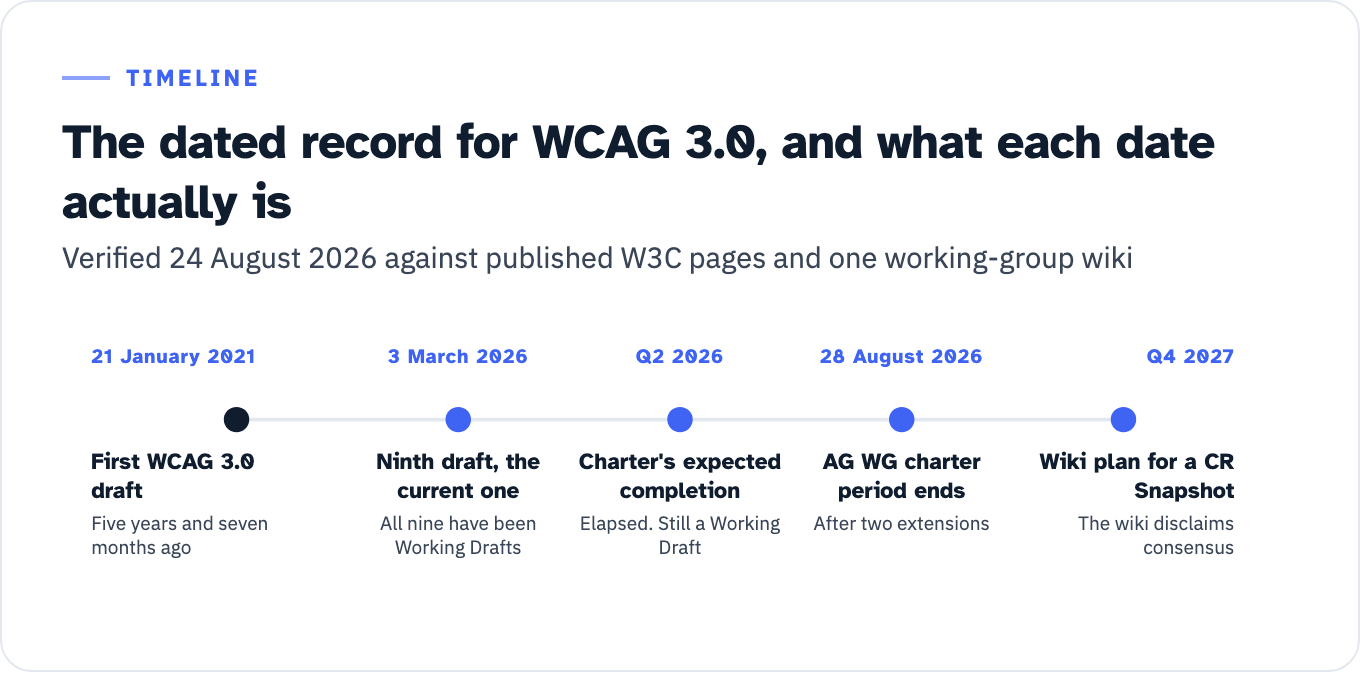
WCAG 3.0 has been published nine times between 21 January 2021 and 3 March 2026, every one a Working Draft. There has been no Candidate Recommendation, no Proposed Recommendation and no Recommendation, and five years and seven months have elapsed since the first draft.
The active AG WG charter says two things that do not sit together. It lists WCAG 3.0 with “Draft state: Working Draft” and “Expected completion: Q2 2026”, against a key defining that as when a deliverable “is projected to become a Recommendation, or otherwise reach a stable state.” It also says “WCAG 3 will not be brought to Recommendation during this charter period”, a period that runs to 28 August 2026 after two extensions. What “otherwise reach a stable state” was meant to cover is not defined in the charter, so the one thing Q2 2026 establishes is that the group’s own schedule document no longer describes where the work is. Whether a new charter, a third extension or a gap follows 28 August 2026 is not knowable from any published source found. The Explainer has not caught up: it still reads “AG is currently chartered through April 2026.”
No W3C document names a release year. WAI’s introduction page says WCAG 3 “is not expected to be a completed W3C standard for a few more years.” WCAG 2.2 itself, a Recommendation, calls the work “a multi-year effort.” The only dated targets found anywhere sit on a working-group wiki, the w3c/wcag3 Schedule page. It set a 2026 objective, “Publish WCAG 3 draft in Refining for wide review”, and the March 2026 draft carries zero Refining markers. It puts a Candidate Recommendation Snapshot in Q4 2027 and adds: “Historically, it has taken an additional 2 years from that point to final publication.” The page disclaims itself, and the disclaimer is worth quoting whole: “This Wiki page is edited by participants of the Accessibility Guidelines Working Group. It does not necessarily represent consensus and it may have incorrect information or information that is not supported by other Working Group participants, WAI, or W3C.” That is the entire dated record. This article makes no prediction, and no W3C document on the Recommendation track names a year.
View the data as a table
| Time | Milestone | Detail |
|---|---|---|
| 21 January 2021 | First WCAG 3.0 draft | Five years and seven months ago |
| 3 March 2026 | Ninth draft, the current one | All nine have been Working Drafts |
| Q2 2026 | Charter’s expected completion | Elapsed. Still a Working Draft |
| 28 August 2026 | AG WG charter period ends | After two extensions |
| Q4 2027 | Wiki plan for a CR Snapshot | The wiki disclaims consensus |
Two sentences close the wait question. The Explainer sets the gate: “WCAG 3 will not be published until it covers at least as much as WCAG 2.2.” WAI sets the runway on the far side: “WCAG 3 will not supersede WCAG 2 and WCAG 2 will not be deprecated for at least several years after WCAG 3 is finalized.”
No regulator has adopted WCAG 3, and one explained why it will not pre-adopt anything
Pull the current XML of 28 CFR part 35 through the eCFR versioner and search it, and “WCAG 3” appears exactly once, in a bibliographic footnote in Appendix D that notes a working draft published in December 2021 and cites the specification’s page as of 24 July 2023. Searching the whole CFR through the eCFR search API for the string that actually appears in it, “WCAG 3.0”, returns two hits, both that same footnote, retrieved 24 August 2026. No operative CFR provision names it. DOJ did not evaluate WCAG 3.0 and did not adopt it.
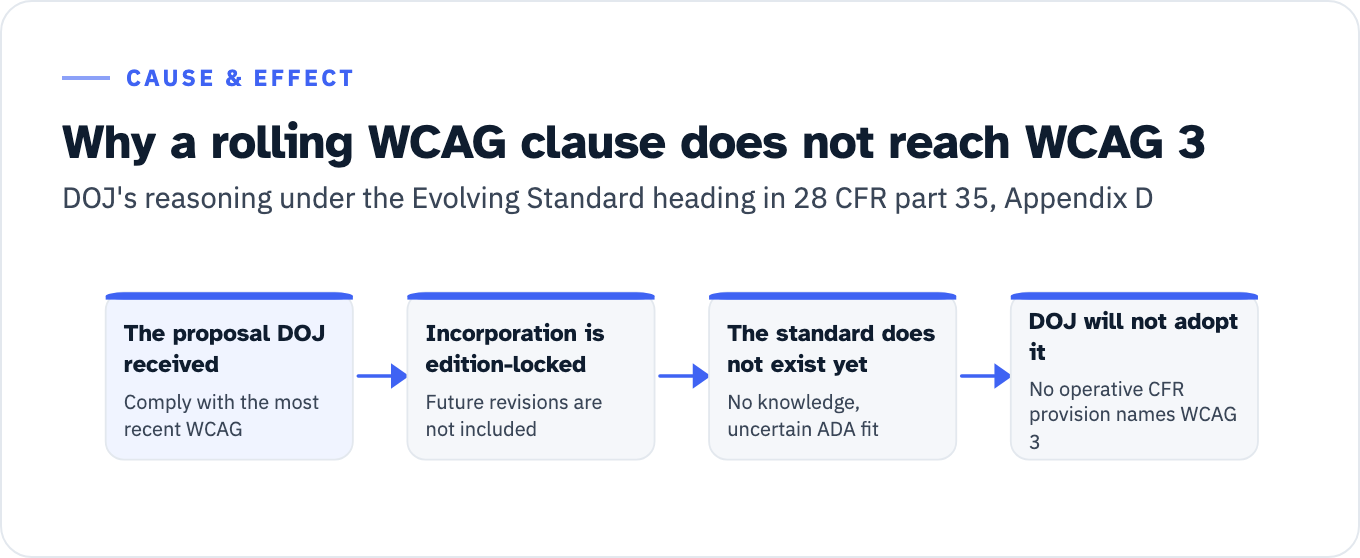
What DOJ did address, under the heading “Evolving Standard” in that appendix, is the contract construction a delay objection produces:
“Other commenters suggested that the Department take an approach in the final rule whereby public entities would be required to comply with whatever is the most recent version of WCAG at the time. … Based on several legal considerations, the Department will not adopt such an approach.”
The first reason is mechanical and reaches every federal incorporation by reference. DOJ points to 1 CFR 51.1(f): “Incorporation by reference of a publication is limited to the edition of the publication that is approved. Future amendments or revisions of the publication are not included.” The second reason is worth reading twice before drafting a clause: the Department “has concerns about regulating to a future standard of WCAG that has yet to be created, of which the Department has no knowledge, and for which compatibility with the ADA and covered entities’ content is uncertain.”
View the data as a list
- The proposal DOJ received: Comply with the most recent WCAG
- Incorporation is edition-locked: Future revisions are not included
- The standard does not exist yet: No knowledge, uncertain ADA fit
- DOJ will not adopt it: No operative CFR provision names WCAG 3
The versions federal regulation does name come with dates and levels. The Revised Section 508 Standards at 36 CFR part 1194 contain 23 occurrences of “WCAG 2.0” and zero of “WCAG 2.1” or “WCAG 3”, verified through the eCFR versioner on 24 August 2026. The ADA Title II web rule at 28 CFR 35.200(b) requires a public entity “other than a special district government” with a total population of 50,000 or more to meet “Level A and Level AA success criteria and conformance requirements specified in WCAG 2.1” from 26 April 2027. Entities under 50,000, and special district governments whatever their size, take 26 April 2028. Both dates were set by the interim final rule at 91 FR 20902. Our version-by-rule matrix covers the other US rules that name a WCAG version.
What to name in a 2027 contract
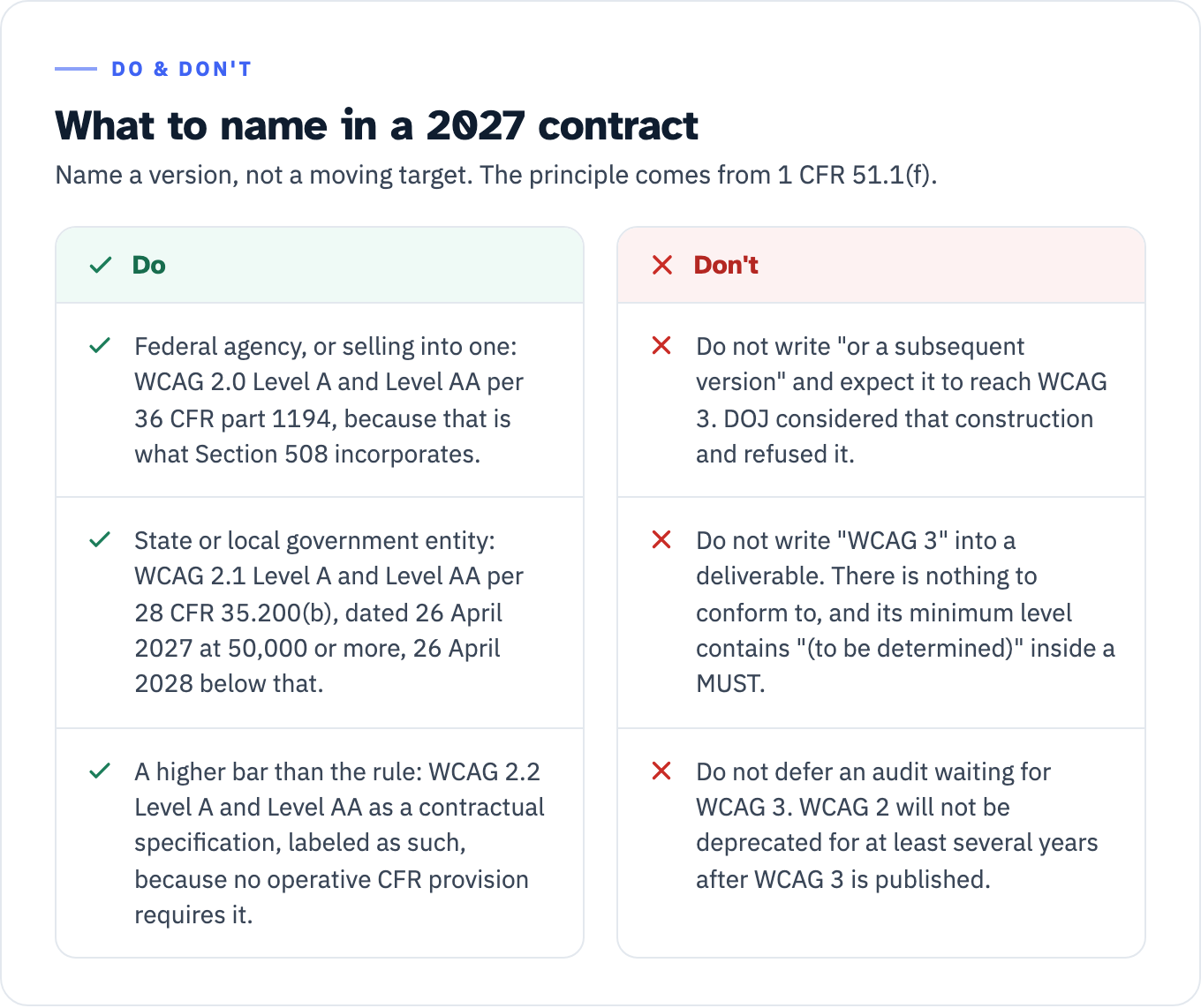
The drafting principle comes straight from 1 CFR 51.1(f) and reaches past the CFR: name a version, not a moving target.
- Federal agency, or selling into one. WCAG 2.0 Level A and Level AA per 36 CFR part 1194, because that is what Section 508 incorporates.
- State or local government entity. WCAG 2.1 Level A and Level AA per 28 CFR 35.200(b), with the applicable date of 26 April 2027 at a population of 50,000 or more, or 26 April 2028 below that and for special district governments of any size.
- A higher bar than the rule. WCAG 2.2 Level A and Level AA as a contractual specification, labeled as such, because no operative CFR provision requires it.
- Do not write “or a subsequent version” and expect it to reach WCAG 3. DOJ considered that construction and refused it.
- Do not write “WCAG 3” into a deliverable. There is nothing to conform to. Its minimum level contains “(to be determined)” inside a MUST, its default accessibility support set does not exist, and its contrast algorithm is undecided.
- Do not defer an audit waiting for WCAG 3. It will not be published until it covers at least as much as WCAG 2.2, and WCAG 2 will not be deprecated for at least several years after that.
View the data as a table
| Do | Don’t |
|---|---|
| Federal agency, or selling into one: WCAG 2.0 Level A and Level AA per 36 CFR part 1194, because that is what Section 508 incorporates. | Do not write “or a subsequent version” and expect it to reach WCAG 3. DOJ considered that construction and refused it. |
| State or local government entity: WCAG 2.1 Level A and Level AA per 28 CFR 35.200(b), dated 26 April 2027 at 50,000 or more, 26 April 2028 below that. | Do not write “WCAG 3” into a deliverable. There is nothing to conform to, and its minimum level contains “(to be determined)” inside a MUST. |
| A higher bar than the rule: WCAG 2.2 Level A and Level AA as a contractual specification, labeled as such, because no operative CFR provision requires it. | Do not defer an audit waiting for WCAG 3. WCAG 2 will not be deprecated for at least several years after WCAG 3 is published. |
What was looked for and is not there
- No release year for WCAG 3.0 in any W3C document.
- No final count of core requirements at Bronze. The draft’s own 92 is provisional: “The final set of requirements in WCAG 3 will be different from what is in this draft.”
- No percentage, point value or module list for Silver or Gold.
- No published mapping from WCAG 2.2 success criteria to WCAG 3 requirements. The charter lists that mapping guidance among documents that “may be created” as other deliverables, and none has been published.
- No figure for the work a WCAG 2.2 AA conformant product would have left. The draft says “additional work will be needed to reach full conformance” without quantifying it.
- No contrast thresholds, no default accessibility support set, no sampling methodology.
- No agency guidance, no enforcement position and no decision applying or construing WCAG 3 turned up in the research for this article.
Where this stops
Everything above is a reading of published standards and published regulations, offered as procurement and testing guidance. Choosing the citation form for a clause, allocating the risk when a standard changes mid-contract, and setting the remedy for a nonconforming deliverable are your counsel’s work, not an accessibility consultant’s.
The testing sits on this side of the line. If your 2027 obligation is WCAG 2.1 Level A and AA and your last report speaks to WCAG 2.0, or if a supplier has asked you to wait for WCAG 3 before commissioning an audit, that is a scope question with a measurable answer, and it is what our WCAG audits and testing work is for. Send the clause and the last report, and the first thing back is which version each document actually speaks to.
One caution before you rely on any count above in a document of your own. Every figure here is a reading of the 3 March 2026 snapshot taken on 24 August 2026, the AG WG charter expires on 28 August 2026, and the Explainer says “The working group aims to publish two new drafts each year.” Two pages settle a re-check in a minute: the current draft, whatever it is when you read this, and the WCAG 3.0 publication history, which shows at a glance whether the March 2026 draft is still the latest and whether anything has left Working Draft status.