
28 CFR 36.302: booking rooms and selling accessible seats online
 By David LoPresti August 17, 2026
 Two subsections that read like a product spec
You have a booking engine or a ticket checkout, and someone has told you it needs to be ADA compliant. No federal regulation says what a private company’s website must look like. Two subsections of one regulation say, clause by clause, what the transaction has to do.
They are 28 CFR 36.302(e), reservations made by places of lodging, and 28 CFR 36.302(f), ticketing, both added by the Justice Department’s 2010 title III final rule at 75 FR 56236. Neither names a web standard or a WCAG version. Both are written as policy, and both decompose into states you can observe in a running system: which inventory is sellable when, what the seat map draws, what the cart offers.
This article stays inside the purchase flow; the physical side of ADA venue requirements is covered in ADA compliance for concert venues. One boundary: what follows is regulation text and the tests it implies, and whether your property or contract is exposed belongs to your counsel.
The correction that put your own website in scope
Read 36.302(e)(1) today and the stem reads: “A public accommodation that owns, leases (or leases to), or operates a place of lodging shall, with respect to reservations made by any means, including by telephone, in-person, or through a third party”. Two things sit in that sentence: the duty holder is the lodging entity, not whoever operates the screen, and the channel list is open. As published on 15 September 2010 the stem said “reservations made by telephone, in-person, or through a third party”: three channels, none of them a hotel’s own website.
DOJ fixed that on 11 March 2011 in a correction notice at 76 FR 13287: “The intention was not to limit reservation policies to only those made in those three scenarios… The language indicating that those three scenarios operated as examples was inadvertently deleted.”
So your booking page sits inside 36.302(e) on text restored by that correction, and the rest of the online story is thinner still. There is no title III web accessibility rule: DOJ withdrew that rulemaking in December 2017, and the 2024 web rule at 28 CFR 35.200, which sets WCAG 2.1 Level A and AA for web content and mobile apps, binds public entities under title II only. Its compliance dates now read 26 April 2027 and 26 April 2028, moved there from the dates the 2024 rule itself set by an extension rule at 91 FR 20902, published 20 April 2026. Nobody should sell a private hotel or arena a 2027 deadline.
What a private interface has instead is 36.302(e) and (f), the reasonable modification duty at 36.302(a), and one interpretive sentence at 75 FR 56276: DOJ “has consistently interpreted the ADA to cover Web sites that are operated by public accommodations” and said such sites must serve accessibly “or provide an accessible alternative” available around the clock.
Reservations: five clauses, five tests
The transition is over. 36.302(e)(3): “The requirements in this section will apply to reservations made on or after March 15, 2012.”
(e)(1)(i), same hours and same manner. Accessible rooms must be bookable “during the same hours and in the same manner as individuals who do not need accessible rooms”. A “call us to book this room type” interstitial reads as a failure of the same-manner condition, though that is a reading of the clause rather than something DOJ has said about it. One symmetry rule survives: where no reservation is final until every guest has been contacted, “a hotel may follow the same process when reserving accessible rooms” (75 FR 56273).
(e)(1)(ii), enough detail to decide alone. Describe accessible features “in enough detail to reasonably permit individuals with disabilities to assess independently whether a given hotel or guest room meets his or her accessibility needs”. DOJ set two tiers at 75 FR 56274. For a property built to the 1991 Standards it “may be sufficient to specify that the hotel is accessible and, for each accessible room” to describe the general type of room, the size and number of beds, the type of accessible bathing facility, and the communications features in the room. An older property adds accessible entrances, “the path of travel to guest check-in and other essential services”, the accessible route to the room, and the features that do not comply, with a blunt example: “door to guest room measures 30 inches clear.” The ceiling is on the same page: “a reservations system is not intended to be an accessibility survey.”
(e)(1)(iii), hold back. Accessible rooms are “held for use by individuals with disabilities until all other guest rooms of that type have been rented and the accessible room requested is the only remaining room of that type”. Two conditions joined by “and”, not one: the hold lifts when the non-accessible stock of that type is gone and the requested accessible room is the last of its type standing. DOJ’s arithmetic at 75 FR 56274: with 25 rooms of a type and two accessible, the service “is required to rent all 23 non-accessible rooms” first. This is inventory logic, not a display rule. One carve-out: “If a one-of-a-kind room is accessible, that room is available to the first party to request it.”
(e)(1)(iv), block and remove from all systems. On request, reserve the room and “ensure that the guest rooms requested are blocked and removed from all reservations systems”. The target, at 75 FR 56275, is double-booking, “a common problem that arises when rooms are made available to be reserved through more than one reservations service”. That is an integration test, not a page test.
(e)(1)(v), guarantee the unit. The guarantee attaches to “the specific accessible guest room reserved”, not to a room type, because otherwise “any guarantee for accessible rooms would be meaningless” (75 FR 56275). If the property guarantees room types at all, accessible bookings need their own code path.
Three limits, and the two that get merged
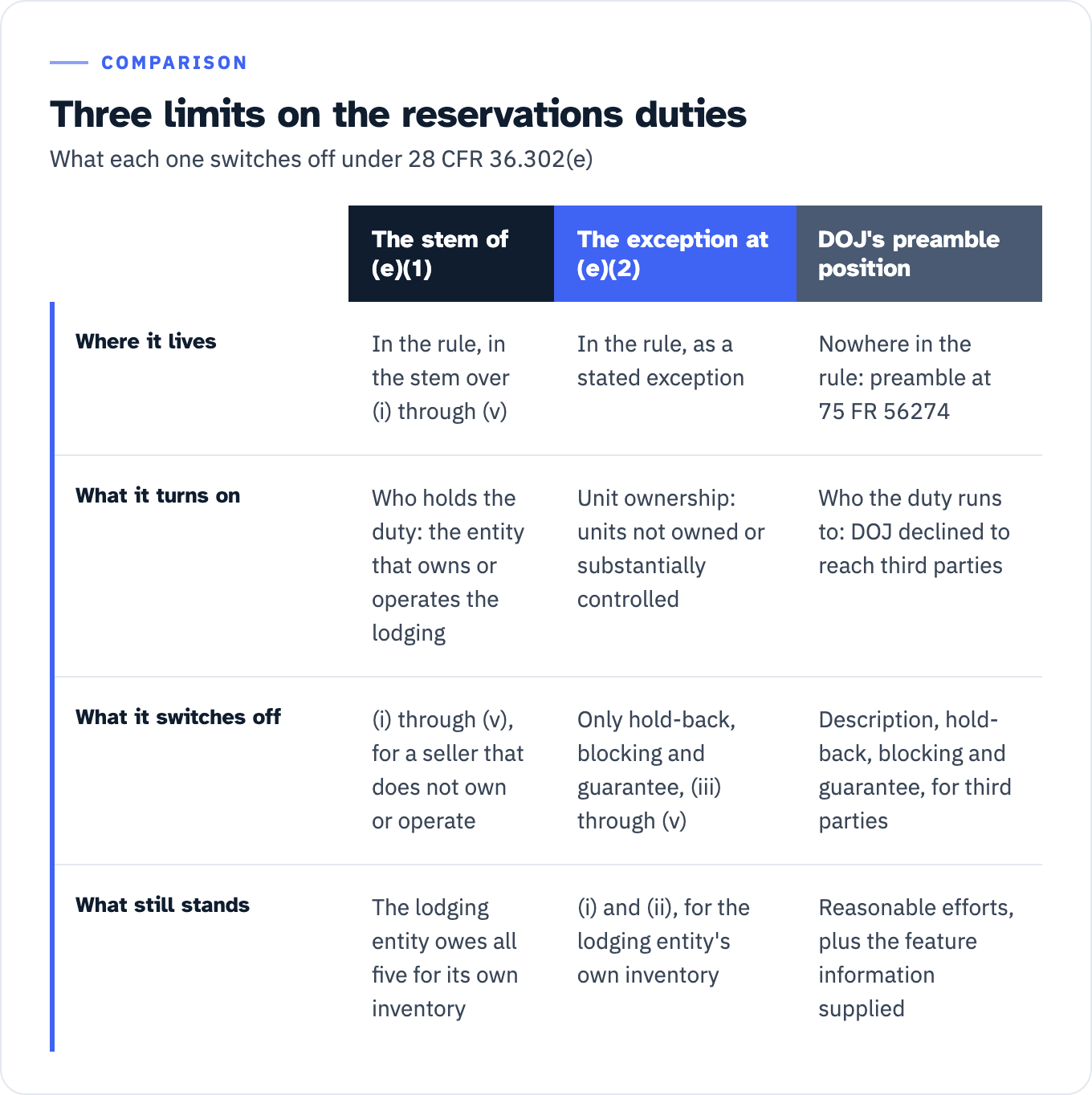
Three separate things stop the reservations duties short of a third-party seller. They sit in three different places, and the one that gets left out of the discussion is the one printed first.
The first is the stem quoted above. The obligated party under 36.302(e)(1) is “a public accommodation that owns, leases (or leases to), or operates a place of lodging”, and that stem governs all five of (i) through (v). An online travel agency that neither owns nor operates the property is a channel the reservation arrives through, which is exactly how the stem names third parties. Whatever such a seller owes elsewhere in title III, it does not owe (i) through (v).
The second is the exception at 36.302(e)(2): “The requirements in paragraphs (iii), (iv), and (v) of this section do not apply to reservations for individual guest rooms or other units not owned or substantially controlled by the entity that owns, leases, or operates the overall facility.” It says “of this section” where it means (e)(1)(iii) through (v), since section 36.302 has no top-level paragraphs numbered that way, and it is enacted with that slip. It is a unit-level ownership test aimed at timeshare, condo-hotel and rental-pool inventory, and it switches off only the hold-back, blocking and guarantee duties. For the lodging entity’s own inventory, (i) and (ii) stand.
The third limit is nowhere in the regulation. In the section-by-section analysis DOJ declined to extend the description, hold-back, blocking and guarantee duties directly to third-party reservations services at all (75 FR 56274, repeated twice at 56275). What the place of lodging owes instead is on the same pages: it “must make reasonable efforts to make accessible rooms available through at least some of these services and must provide these third-party services with information concerning the accessible features”, and where it does that and the third party then fails, “the hotel or other place of lodging will not be responsible.”
That calls for two artifacts a hotel can hand over: proof that accessible inventory reached at least some of its channels, and the feature content supplied to them. It is preamble, so it is DOJ’s position rather than an enacted defense, and the research for this article located no decision construing either 36.302(e)(2) or that passage.
View the data as a table
| The stem of (e)(1) | The exception at (e)(2) | DOJ’s preamble position | |
|---|---|---|---|
| Where it lives | In the rule, in the stem over (i) through (v) | In the rule, as a stated exception | Nowhere in the rule: preamble at 75 FR 56274 |
| What it turns on | Who holds the duty: the entity that owns or operates the lodging | Unit ownership: units not owned or substantially controlled | Who the duty runs to: DOJ declined to reach third parties |
| What it switches off | (i) through (v), for a seller that does not own or operate | Only hold-back, blocking and guarantee, (iii) through (v) | Description, hold-back, blocking and guarantee, for third parties |
| What still stands | The lodging entity owes all five for its own inventory | (i) and (ii), for the lodging entity’s own inventory | Reasonable efforts, plus the feature information supplied |
Ticketing: the equality conditions are channel-neutral by design
Ticketing had no extra transition year. The 2010 rule carries one effective date, “Effective Date: March 15, 2011” (75 FR 56237), and only reservations were pushed out to 2012 by (e)(3). Every clause below has been in force since March 2011.
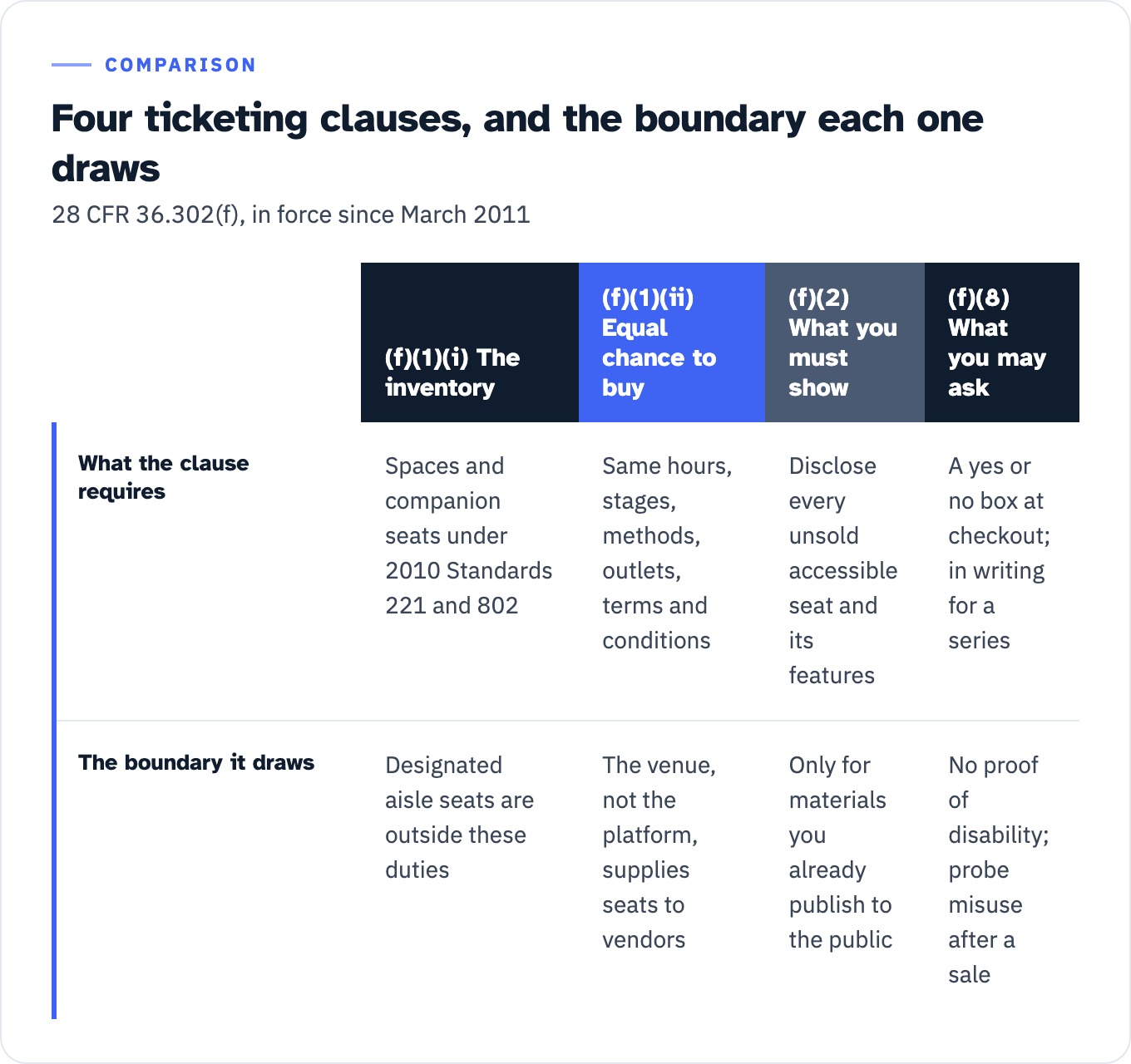
36.302(f)(1)(i) defines the inventory: wheelchair spaces and companion seats complying with sections 221 and 802 of the 2010 ADA Standards, plus any other seats owed under paragraph (4). It borrows the design standard only to name the thing being sold, and it leaves something out. Designated aisle seats, the ones with retractable armrests, are inside the design standard and outside these ticketing duties: “The defined term does not include designated aisle seats” (75 FR 56276), and DOJ’s ticketing guidance agrees they “are not covered by these ticketing requirements”.
36.302(f)(1)(ii) then requires equal opportunity to purchase accessible seating during “the same hours”, during “the same stages of ticket sales, including, but not limited to, pre-sales, promotions, lotteries, wait-lists, and general sales”, through “the same methods of distribution”, in “the same types and numbers of ticketing sales outlets, including telephone service, in-person ticket sales at the facility, or third-party ticketing services”, and on “the same terms and conditions”.
The stages condition means a fan-club or card-holder pre-sale that cannot transact a wheelchair space fails, whatever the general on-sale does. The distribution conditions settle allocation at the venue, not at the platform: “venue operators that provide tickets to third-party ticket vendors are required to provide accessible seating to the third-party ticket vendor,” and “once third-party ticket vendors acquire accessible tickets, they are obligated to sell them in accordance with these rules” (75 FR 56276).
36.302(f)(2) governs what the interface shows: on inquiry, disclose the locations of all unsold or available accessible seating, describe its features well enough for an independent assessment, and provide materials “such as seating maps, plans, brochures, pricing charts, or other information” that identify accessible seating “with the same text or visual representations as other seats, if such materials are provided to the general public”. The condition is part of the clause: the duty runs to the materials you publish, not to materials you do not have. DOJ’s example is an instruction to whoever renders the map: “if a seating map displays color-coded blocks pegged to prices for general seating, then accessible seating must be similarly color-coded” (75 FR 56276).
36.302(f)(8) limits what checkout may ask: “A public accommodation may not require proof of disability, including, for example, a doctor’s note, before selling tickets for accessible seating.” Permitted instead is a purchase-time question for a single event and a written attestation for a series. DOJ gave the online implementation at 75 FR 56280: “if the method of purchase is via the Internet, then the question(s) should be answered by clicking a yes or no box during the transaction”. A checkbox in the cart, not a document upload. The enforcement route is (f)(8)(iii), which lets a public accommodation “investigate the potential misuse of accessible seating where there is good cause to believe that such seating has been purchased fraudulently”. That is an investigation opened on good cause after a sale, not a gate placed in front of one.
View the data as a table
| (f)(1)(i) The inventory | (f)(1)(ii) Equal chance to buy | (f)(2) What you must show | (f)(8) What you may ask | |
|---|---|---|---|---|
| What the clause requires | Spaces and companion seats under 2010 Standards 221 and 802 | Same hours, stages, methods, outlets, terms and conditions | Disclose every unsold accessible seat and its features | A yes or no box at checkout; in writing for a series |
| The boundary it draws | Designated aisle seats are outside these duties | The venue, not the platform, supplies seats to vendors | Only for materials you already publish to the public | No proof of disability; probe misuse after a sale |
Price parity, and what not to lift from DOJ’s guidance
36.302(f)(3) does three things. Accessible seating “shall not be set higher than the price for other tickets in the same seating section”, so the comparison is section by section. “Tickets for accessible seating must be made available at all price levels for every event or series of events,” with no qualifier. And where barrier removal is not readily achievable at a price level, the proportional share goes on sale at that price in a nearby or similar accessible location, the proportion being “the ratio of the total number of tickets at that price level to the total number of tickets in the assembly area”.
DOJ works that at 75 FR 56277. For a 20,000-seat facility built in 1980 where the $20 category sits on an inaccessible upper deck holding 2,000 seats, “the facility must place 10 percent of its accessible seating in an accessible location for $20”, and it may not put that seating in a $10 section.
Three things in the ticketing guidance need handling before they reach a specification. The first is one inverted sentence inside an otherwise correct passage. The guidance states the operation the right way round, “The ratio of the total number of seats in the non-accessible price level to the total number of seats in the venue is used to determine the number of accessible seats that must be provided in an accessible location,” which is 200 over 1,000 and matches the regulation. Its worked example then says “The total number of seats in the venue divided by the total number of seats in the upper balcony (1,000 divided by 200) is 20 percent.” One thousand divided by 200 is 5. The passage lands on the right answer, 20 percent and two seats, by way of a sentence that names the wrong division, so copy the preamble example into a spec rather than that one.
The second is a hedge. The guidance says venues “must generally offer accessible seats in all price categories available to the public”; 36.302(f)(3) carries no such qualifier. The third is a rule with no counterpart in the regulation: “This concept also applies to service charges added to the cost of a ticket, whether charged by the venue or a third-party seller.” If you implement it, label where it comes from, because the guidance says of itself that guidance documents “have no legally binding effect, and have no force or effect of law.”
Companion seats: four cases your cart has to branch on
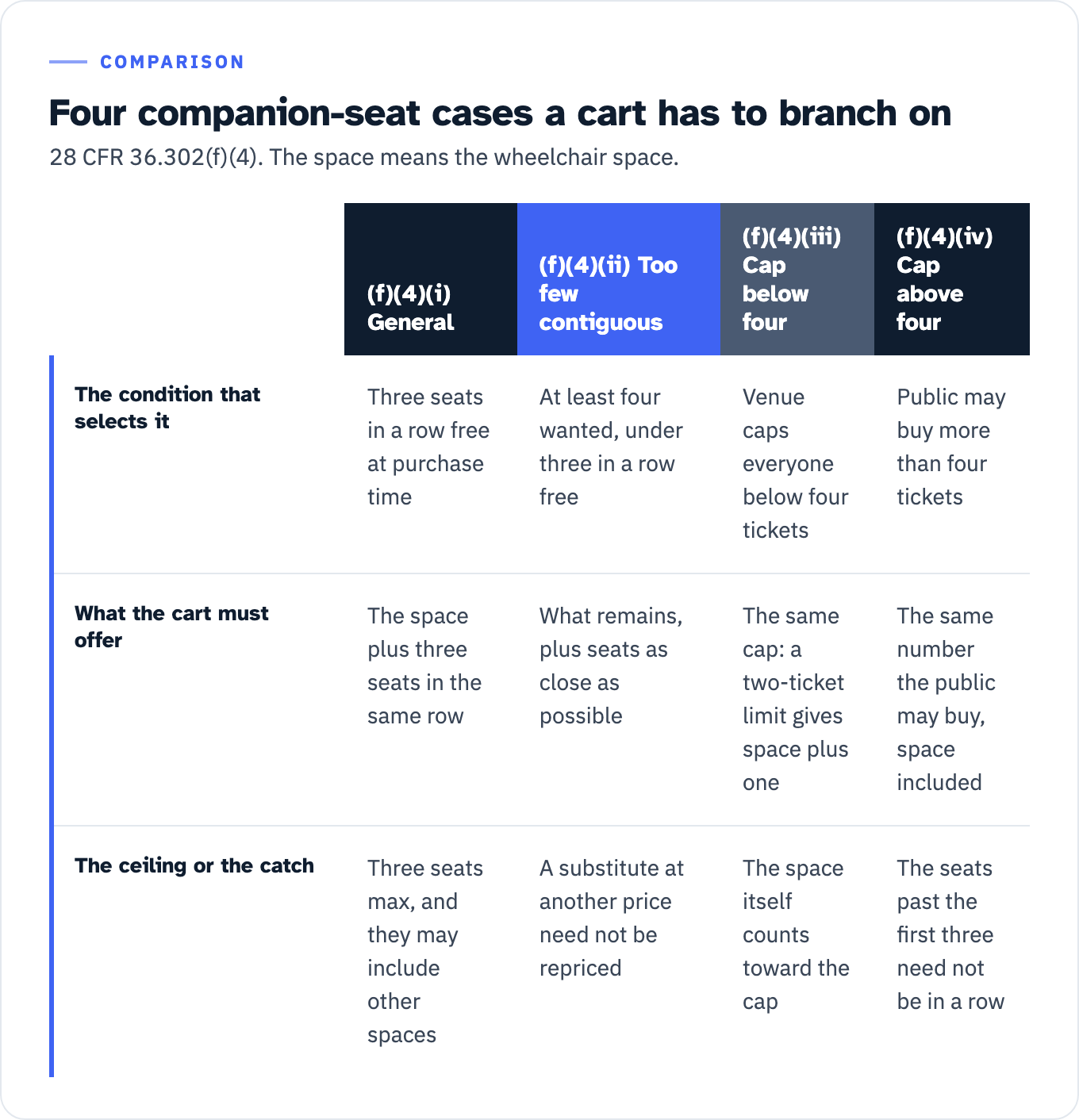
The design standard sets the floor: 2010 Standards 221.3 requires at least one companion seat per required wheelchair space, and 802.3.2 requires those seats to be “equivalent in size, quality, comfort, and amenities to the seating in the immediate area”. 36.302(f)(4) sits on top as a purchase right, in four branches.
General, (f)(4)(i). Make three additional contiguous seats in the same row available for each wheelchair space ticket, “provided that at the time of purchase there are three such seats available”. A public accommodation is “not required to provide more than three contiguous seats for each wheelchair space”, which is a ceiling on the duty rather than on what a venue may offer, and those seats “may include wheelchair spaces”. On contiguity, 75 FR 56277: “at least one of the additional seats should be immediately adjacent to the wheelchair space.”
Insufficient contiguous seats, (f)(4)(ii). Patrons may buy at least four but fewer than three contiguous seats remain. Offer what remains and make up the difference with seats “as close as possible to the accessible seats”. DOJ’s worked example at 75 FR 56277: two remain, so the buyer gets those two plus one nearby seat. Where the substitute sits in a different price category, the guidance says “the venue is not required to modify the price”.
Cap below four, (f)(4)(iii). The patron gets the same cap, counting the wheelchair space. A two-per-customer limit yields the space plus one contiguous seat.
Cap above four, (f)(4)(iv). The branch that summaries leave out. Where the public may buy more than four, a patron with a disability may buy the same number, counting the wheelchair space, and tickets beyond the space and its three contiguous seats “do not have to be contiguous with the wheelchair space” (75 FR 56277).
Over all four sits (f)(4)(v): seat a group containing someone who needs accessible seating in an area with accessible seating, together if possible, and if it must be split, do not isolate the wheelchair users. One gap, stated rather than filled: no source consulted here says how the count works when two wheelchair users buy together.
View the data as a table
| (f)(4)(i) General | (f)(4)(ii) Too few contiguous | (f)(4)(iii) Cap below four | (f)(4)(iv) Cap above four | |
|---|---|---|---|---|
| The condition that selects it | Three seats in a row free at purchase time | At least four wanted, under three in a row free | Venue caps everyone below four tickets | Public may buy more than four tickets |
| What the cart must offer | The space plus three seats in the same row | What remains, plus seats as close as possible | The same cap: a two-ticket limit gives space plus one | The same number the public may buy, space included |
| The ceiling or the catch | Three seats max, and they may include other spaces | A substitute at another price need not be repriced | The space itself counts toward the cap | The seats past the first three need not be in a row |
Hold and release is not a three-transition machine
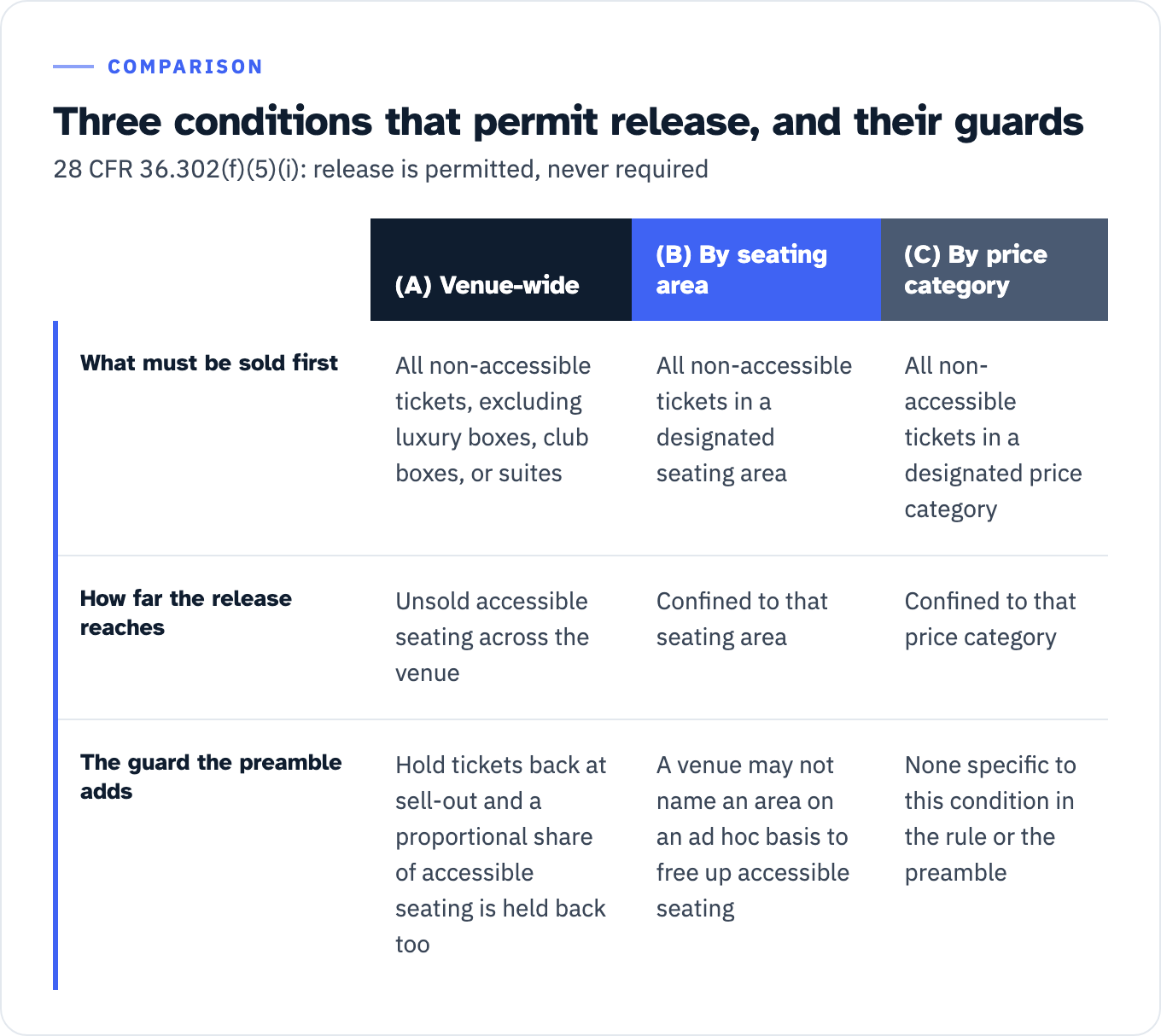
36.302(f)(5)(i) is a prohibition with exceptions. A venue may release unsold accessible seating to individuals without disabilities “only under the following circumstances”: (A) all non-accessible tickets sold, “excluding luxury boxes, club boxes, or suites”; (B) all non-accessible tickets in a designated seating area sold, with release confined to that area; (C) all non-accessible tickets in a designated price category sold, with release confined to that category.
Four further constraints sit on those three, and a state machine built from the conditions alone is wrong.
There is no duty to release at all: “Nothing in this paragraph requires a facility to release tickets for accessible seating to individuals without disabilities for their own use.”
Condition (B) cannot be manufactured. At 75 FR 56278 DOJ says venues cannot designate or redesignate seating areas to maximize release: “a venue may not determine on an ad hoc basis that a group of seats at the orchestra level is a designated seating area in order to release unsold accessible seating in that area.”
Condition (A) turns on a word DOJ left undefined. A public accommodation “should continue to use its own approach to defining a ‘sell-out’”, and then comes a constraint found nowhere in the regulation: where a venue declares a sell-out by reference to seats available for sale while holding tickets back for later release, “it must hold back a proportional percentage of accessible seating to be released as well”. The guidance folds that into the (A) exclusion list, adding “seats the venue holds back when declaring a sell-out” to a list the regulation ends at suites. Implement the holdback, and cite it to the preamble.
Series tickets add two duties. On releasing a sold-out series, a venue must “establish a process that prevents the automatic reassignment of the accessible seating to such ticket holders for future seasons, future years, or future series”. And where series tickets with an ownership right in accessible seating are forfeited or returned, it modifies its policies so someone who requires those features can buy them.
The rule contains no clock: no earliest release, no latest, no notice period. Commenters asked for one, proposing that accessible seating not be released during the first two weeks of sale, or not earlier than 48 hours before a sold-out event. DOJ refused: “Adopting any of the alternatives proposed in the comments summarized above would have upset the balance between protecting the rights of individuals with disabilities and meeting venues’ concerns about lost revenue from unsold accessible seating” (75 FR 56277-78). If your release job runs on a timer, that timer is your policy, not the rule’s.
View the data as a table
| (A) Venue-wide | (B) By seating area | (C) By price category | |
|---|---|---|---|
| What must be sold first | All non-accessible tickets, excluding luxury boxes, club boxes, or suites | All non-accessible tickets in a designated seating area | All non-accessible tickets in a designated price category |
| How far the release reaches | Unsold accessible seating across the venue | Confined to that seating area | Confined to that price category |
| The guard the preamble adds | Hold tickets back at sell-out and a proportional share of accessible seating is held back too | A venue may not name an area on an ad hoc basis to free up accessible seating | None specific to this condition in the rule or the preamble |
Transfer, resale, and the case that turned on a phone call
36.302(f)(6) requires that holders of accessible seating be allowed to transfer tickets “under the same terms and conditions and to the same extent as other spectators holding the same type of tickets”. A platform that blocks transfer of accessible seating, or restricts it to buyers who attest to a disability, imposes a condition other holders do not face. 36.302(f)(7) runs the other way, in two parts. Under (f)(7)(i) a public accommodation must ensure that an individual with a disability “may use a ticket acquired in the secondary ticket market under the same terms and conditions as other individuals who hold a ticket acquired in the secondary ticket market for the same event or series of events”. That reaches the policy layer around resold tickets, not only the moment of exchange. Under (f)(7)(ii), someone holding an inaccessible secondary-market seat may exchange it for an accessible seat in a comparable location “if accessible seating is vacant at the time the individual presents the ticket”, though a venue that has sold all its accessible seating “has no obligation to provide accessible seating” to such a purchaser (75 FR 56279).
The one violation of (f)(7) this research located is worth reading for its purchase channel, because the case gets retold as an online failure. In Smith v. Board of Commissioners of the Louisiana Stadium and Exposition District, 385 F. Supp. 3d 491 (E.D. La. 14 May 2019), the plaintiff’s daughter “bought tickets for herself and her mother via telephone” from a reseller she took for the Superdome box office, and the seats sold as wheelchair-accessible were not. The violation was at the venue, where staff failed to offer a transfer to an accessible seat, and the Fifth Circuit affirmed the injunctive relief and damages against the operator in an unpublished per curiam opinion in March 2021, while vacating the injunction against the public official sued alongside it.
What the record does not settle
The reach of the ticketing rule beyond assigned seating is open. In Anderson v. Franklin Institute, 185 F. Supp. 3d 628 (E.D. Pa. 6 May 2016), the court read DOJ’s ticketing guidance as addressing “situations where there are a pre-set number of ‘assigned,’ i.e. fixed, seats” and held that “the Guidance has no applicability to general admission”. That is one district court reading the guidance rather than parsing the regulation, in a dispute about personal care attendants at a science museum, and no other decision on the point turned up in this research.
Who may sue over a hotel reservations page is unresolved. The Supreme Court took Acheson Hotels, LLC v. Laufer, 601 U.S. 1 (5 December 2023), to decide whether an ADA tester has standing to sue a hotel whose website does not state whether it has accessible rooms, then vacated the case as moot. Justice Barrett noted that the plaintiff “has singlehandedly generated a circuit split.” That is a question about who can bring a case, not about what 36.302(e) requires of a booking engine. Keep the two apart when Acheson is quoted at you.
What to check this week
These are tests derived from the clauses above. DOJ publishes no test suite for 36.302(e) or (f), so treat each as a way of making a clause observable rather than as a checklist anyone has blessed.
- Book an accessible room end to end in your own flow, in one session, with no callback a standard booking would not trigger. Then read the description back against (e)(1)(ii) for an older property, not just a new one.
- Reserve an accessible unit in one channel, then attempt the same unit in every other channel it is sellable through. If it is still offered in a channel the property controls, (e)(1)(iv) is not implemented. If it is still offered by a third-party service, the question is a different one: whether the property made the reasonable efforts and supplied the feature information DOJ describes at 75 FR 56274, and whether 36.302(e)(2) took that unit out of (iv) to begin with.
- Take every seating map, plan, brochure and pricing chart you publish to the general public, and compare how accessible seating is drawn against every other price block: same color coding, same detail, same pricing display.
- Enter your next pre-sale as an eligible buyer and try to complete a wheelchair space plus companions inside it. Then repeat at a price level where you suspect no accessible seating exists.
- Read your release job and write down which of the three conditions in 36.302(f)(5)(i) it actually tests, and whether anything holds back a proportional share when a sell-out is declared with inventory still in reserve.
Every check above resolves in inventory logic or in content, not in a widget. If you want these run against your live flow and written up clause by clause, that is what our hospitality, travel and entertainment accessibility work covers. Send the URL and the channels the same inventory is sold through, and the first thing back is the list of clauses with an observable failure behind them.