
Overlay pricing compared: AudioEye, accessiBe, Level Access
The renewal is on the desk and the price is not on the page
You have a number to put in a budget line by a date. Perhaps a demand letter arrived and somebody asked what a widget costs. Perhaps an annual renewal came in with an increase attached, or a security review asked for an accessibility artifact before a deal closes, or you are a Title II or Section 504 covered entity building a budget against a dated deadline. The first question is the same in each case, and it is arithmetic rather than philosophy. Is this a few hundred dollars a year or a five-figure contract, and which one am I looking at for my traffic and my number of domains.
For two of the three vendors named here, that question cannot be answered from the vendor’s own website. Checked on 27 July 2026: accessiBe publishes a full rate card for its widget. AudioEye publishes three tier names, three feature lists and no prices. Level Access publishes no pricing page at all. That asymmetry, not a price list, is what this page is about, and it changes how you run the evaluation.
One boundary before the numbers. This page does not re-argue whether a widget can support a conformance claim. That question is settled somewhere else, and if you have not settled it you are comparing the wrong prices. What a widget lets you write in an ACR row, and what a federal reviewer does with it, is worked through in what an accessibility overlay can and cannot put in an ACR. Read that first if the artifact matters more than the invoice.
Vendor URLs below are printed rather than linked, and each carries the date it was retrieved. The figures move. The retrieval date is the point.
What the three vendors published on 27 July 2026
| Vendor | Publishes a price | Published figures | What the tier is metered on | Source, retrieved 27 July 2026 |
|---|---|---|---|---|
| accessiBe, accessWidget | Yes, in full | Micro $490/yr, Growth $1,490/yr, Scale $3,990/yr, Enterprise “Custom”. Monthly-billing figures $59, $179, $479 | Monthly website visits, per domain | accessibe.com/pricing/accesswidget |
| accessiBe, accessFlow | No | Three tiers with limits, no figures, “Book a demo” on all three | Web pages, domains and users | accessibe.com/pricing/accessflow |
| accessiBe, accessServices | No | Five service lines, all “Get A Quote” | Not stated | accessibe.com/pricing/accessservices |
| AudioEye | No | Three tier names, no figures, no billing period. CTAs are “Get Started” and “Talk to an Expert” | Not stated on the page | audioeye.com/plans-and-pricing/ |
| Level Access | No | No pricing page exists | Not stated | levelaccess.com/pricing/ returns 404 |
Two notes on that table before the detail. The first row is one product, not one company. And a 404 is a different problem for a buyer than a page with no numbers on it. They call for different questions.
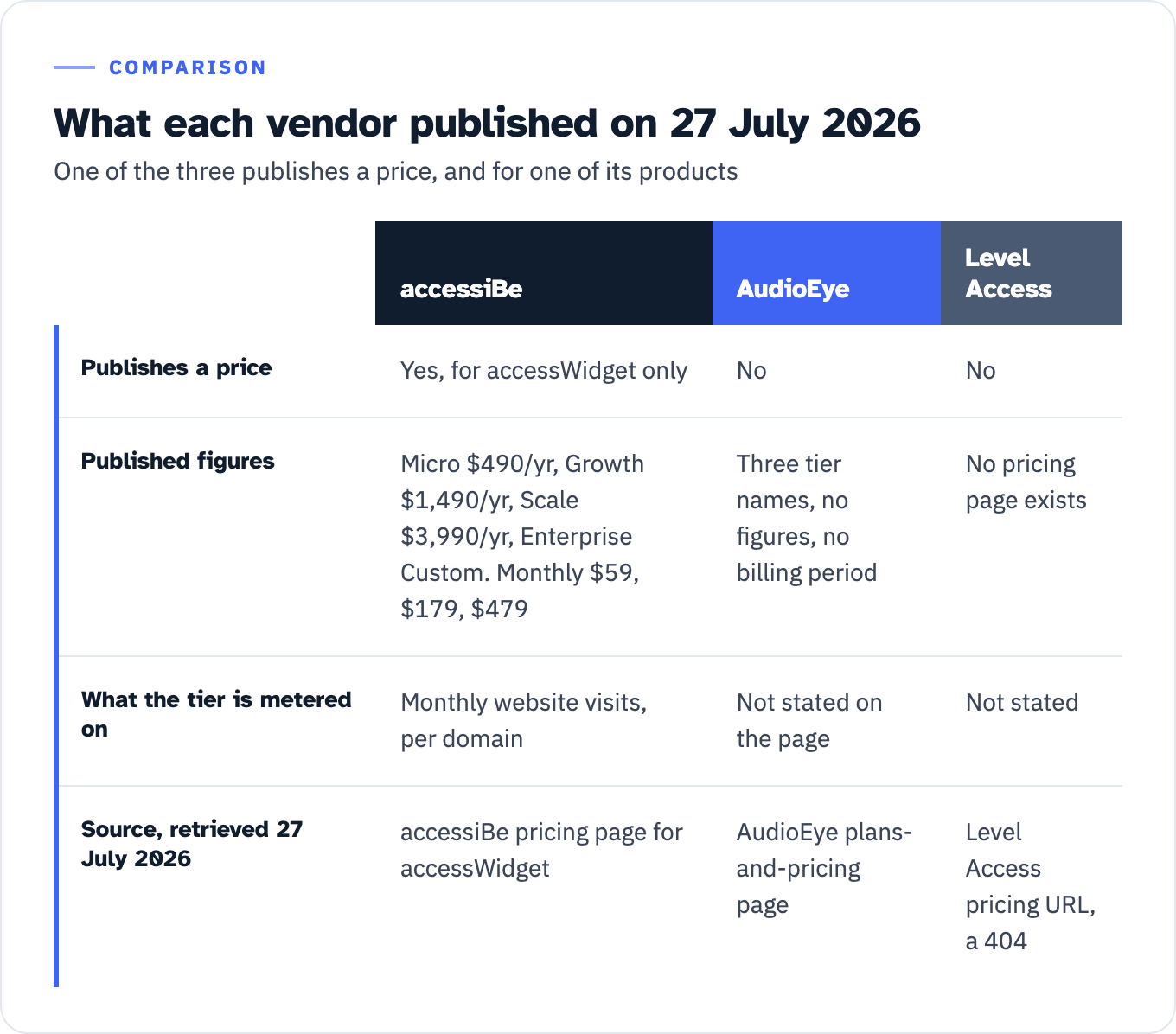
View the data as a table
| accessiBe | AudioEye | Level Access | |
|---|---|---|---|
| Publishes a price | Yes, for accessWidget only | No | No |
| Published figures | Micro $490/yr, Growth $1,490/yr, Scale $3,990/yr, Enterprise Custom. Monthly $59, $179, $479 | Three tier names, no figures, no billing period | No pricing page exists |
| What the tier is metered on | Monthly website visits, per domain | Not stated on the page | Not stated |
| Source, retrieved 27 July 2026 | accessiBe pricing page for accessWidget | AudioEye plans-and-pricing page | Level Access pricing URL, a 404 |
accessiBe publishes a rate card for one product and quotes the rest
The accessWidget page carries four tiers. Three have figures: Micro $490 a year for up to 5,000 website visits a month, Growth $1,490 a year for up to 30,000, Scale $3,990 a year for up to 100,000. Above that the page says “Enterprise Custom”, for “Above 100,000 website visits/month”.
The buy path stops before the top priced tier. Micro and Growth carry a “Buy Now” button. Scale, at a published $3,990, carries “LET’S TALK”, the same call to action as the unpriced Enterprise tier. The highest number you can look up is not a number you can transact against without a conversation.
The page defaults to annual billing and offers a monthly toggle labeled “SAVE 30%”. Switch the toggle and the same three tiers read $59, $179 and $479, with Enterprise “Custom” in both states. The advertised saving reconciles against the vendor’s own two sets of figures. Twelve payments of $59 is $708 against an annual $490, twelve of $179 is $2,148 against $1,490, and twelve of $479 is $5,748 against $3,990. The annual price sits 30.6 to 30.8 percent below twelve monthly payments on every priced tier. This is arithmetic on published figures, not a vendor statement, and it is worth doing because the same product is quoted publicly at both $490 and $59. accessiBe’s own FAQ on that page answers the cost question in monthly terms: “Plans for accessWidget, our AI-powered accessibility solution, start at $59 a month.”
Four things about the meter matter more than the headline figures.
The meter is a third-party estimate, not your analytics. The page states it: “accessiBe subscription plans are priced according to your website’s monthly traffic. Using Similarweb, we calculate the average monthly visits (non-unique, desktop, and mobile) to your domain based on data from the past six months.” Your own analytics number can differ from the number that sets your price. Confirm which figure the order form uses before you sign, and ask in writing what happens when a band is exceeded mid-term, because the pricing page does not address it.
The bands are cliffs, not slopes. The step from the Micro band to the Growth band is $490 to $1,490, so one visit over 5,000 a month triples the subscription. On a per-visit basis the direction reverses as you scale. Priced at each band ceiling, Micro is $490 for 5,000 visits a month, which is 60,000 a year, about $8.17 per thousand. Growth is $1,490 for 30,000 a month, or 360,000 a year, about $4.14. Scale is $3,990 for 100,000 a month, or 1.2 million a year, about $3.33. The expensive case is a site that has just crossed a boundary. The cheap case is one sitting at the top of a band.
One plan covers one domain. The FAQ is explicit: “accessWidget will scan and remediate accessibility issues existing on any page within your domain. If you’d like accessWidget to scan and remediate your subdomains, you will need to subscribe for additional plans.” Any total has to be multiplied by the number of domains and subdomains in scope, each priced on its own traffic band.
Manual work starts at the third tier. Micro buys automation and support. Growth adds “Comprehensive Litigation Support”, a “Dedicated case manager” and account management features, which is real but is not testing. Scale, at $3,990 a year, is the first tier whose card lists “Manual testing & custom remediation”, “Yearly testing & validation by accessibility experts” and “Top ADA attorney consultation”. The comparison grid meters the attorney line by tier: the Micro and Growth columns carry a dash, Scale reads “1 hour” and Enterprise reads “5-10 hours”.
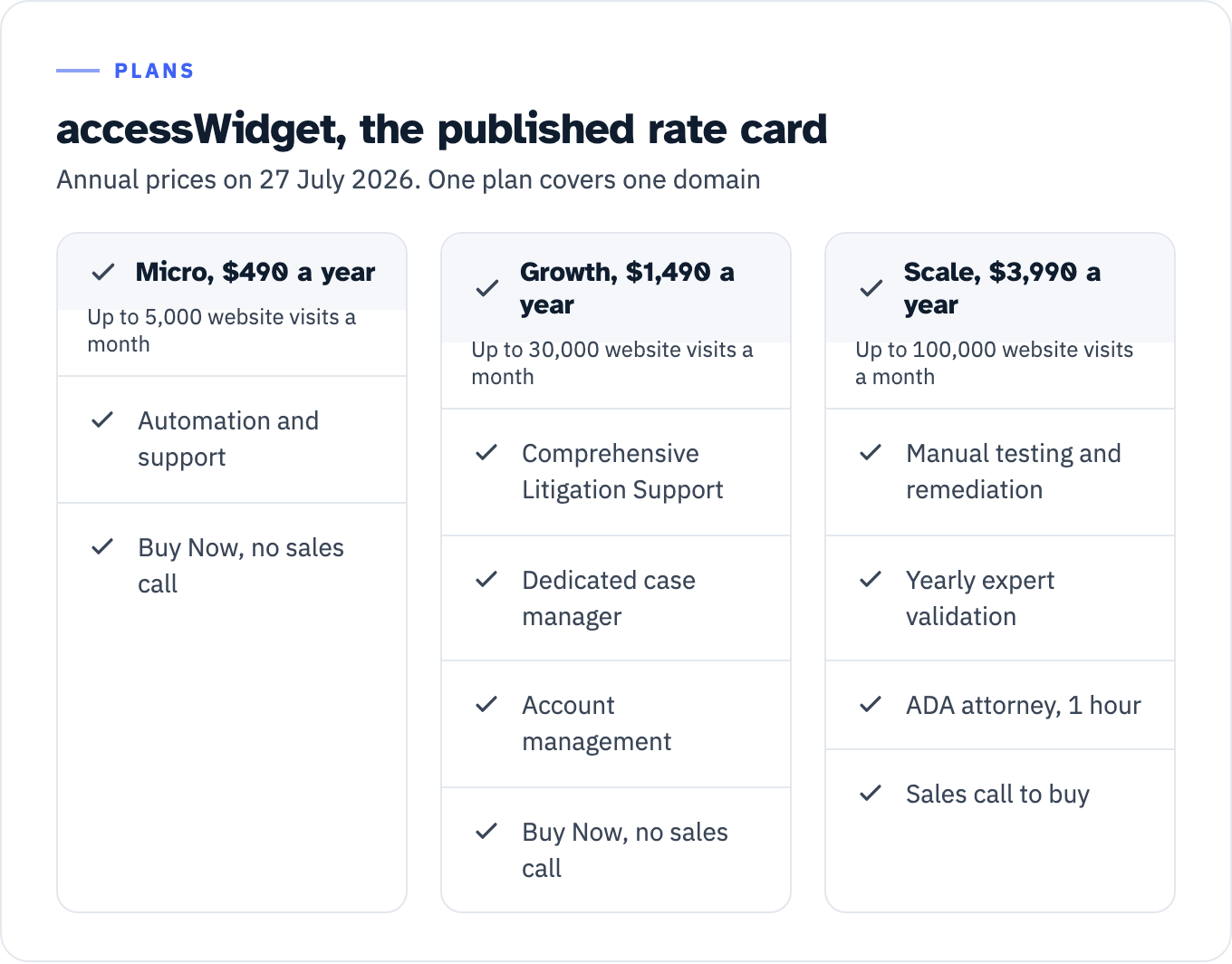
View the data as a table
| Tier | Best for | Includes |
|---|---|---|
| Micro, $490 a year | Up to 5,000 website visits a month | Automation and support; Buy Now, no sales call |
| Growth, $1,490 a year | Up to 30,000 website visits a month | Comprehensive Litigation Support; Dedicated case manager; Account management; Buy Now, no sales call |
| Scale, $3,990 a year | Up to 100,000 website visits a month | Manual testing and remediation; Yearly expert validation; ADA attorney, 1 hour; Sales call to buy |
One figure on that page invites a misreading. A “$20k+” appears in the Enterprise column of the comparison grid. It is not the Enterprise plan price. It sits in the row labeled “Custom legal terms”, whose tooltip reads “Relevant for businesses with a yearly Enterprise package”, and the Micro, Growth and Scale columns of that row carry a dash. The most natural reading is that the cell points to an annual spend level rather than to a plan price, and the page does not say so in words. The Enterprise plan price is published as “Custom”.
The transparency is product-specific. accessFlow, the developer-facing product, publishes three tiers with caps and no prices: “Essential Up to 1,000 web pages Up to 2 domains Up to 2 users”, “Professional Up to 10,000 web pages”, “Enterprise 10,000+ web pages”, each with “Book a demo”. The accessServices page lists five lines, File accessibility, VPAT, User testing, Expert audit and Litigation support, and every one says “Get A Quote”. The accurate description of this vendor is not that it publishes its pricing. It is that it publishes a rate card for one product and quotes the rest.
AudioEye publishes three tier names and no numbers
The live page is audioeye.com/plans-and-pricing/. The obvious guess, audioeye.com/pricing/, returns 404, verified on 27 July 2026. Do not construct that URL from memory when you send it to a colleague. The site also answers at the near-identical path audioeye.com/plans-and-pricings/, with different tier copy, so quote the path you actually retrieved and date it. Everything quoted below is from /plans-and-pricing/ on 27 July 2026.
The page names three tiers: Basic Protection (“Automated”, “Basic monitoring & automated fixes”), Self-Serviced Protection (“Self-Managed”, “We guide you to fix at source”) and Maximum Protection (“Managed”, “We manage accessibility for you”). There is no price on any of them, no billing period, and no calculator input that produces one. The buttons are “Get Started” on the first tier and “Talk to an Expert” on the other two.
Three statements on that page do the work a price would otherwise do, and all three are the vendor’s own.
The automated tier is scoped by the vendor. Its feature list reads “Automated tools addressing ~50% accessibility issues”, with a footnote directly beneath: “*Does not include expert testing for remaining issues.”
Legal support is gated on a purchase, not on a tier. In the features grid, the “Legal Support” row does not carry a check mark or a blank. It carries a sentence: “Included after purchasing Expert Audits & Custom Fixes.”
The financial guarantee is gated and qualified. The footnote to “AudioEye Assurance Guarantee” reads: “*Requires purchase of a Managed package that includes Assurance. AudioEye’s Offerings are designed to help you comply with website standards published by the Web Content Accessibility Guidelines (WCAG). Subject to the terms of an applicable Order, AudioEye provides you with limited, guaranteed financial protection against WCAG-related demand letters and/or lawsuits.”
Below the tiers the same page lists what sits outside them, under the heading “ADDITIONAL SERVICES”: Document Remediation, Consulting and Training, Mobile Audit, Custom Legal Response, VPAT and Closed Captioning. Each is a separate purchase. If the request that sent you looking for a price named a VPAT or a folder of PDFs, it named something on that list rather than something inside a tier.
Level Access publishes no pricing page
levelaccess.com/pricing/ returns 404. The page sitemap the company publishes at levelaccess.com/page-sitemap.xml lists 84 URLs, with lastmod dates running to 24 July 2026, and contains no pricing, plans, cost or packages path. The nearest match in that inventory is a planning page at levelaccess.com/multi-year-accessibility-plan/. The buyer routes the company does publish are levelaccess.com/request-a-demo/ and levelaccess.com/contact/. All checked 27 July 2026.
No Level Access page publishes a price, so any figure you find for this vendor is somebody’s estimate rather than the vendor’s number. This page does not print those estimates. There is a source that is neither, and it is public. See the federal award section below.
Four public AudioEye numbers, and why they do not reconcile
Search for the missing price and you will find figures. Here are the four that surface, what each actually describes, and whether it can be used as a price. None of them describes what a named customer pays, because no contract was read to write this.
| Figure | Where it comes from | What it actually describes | Usable as AudioEye’s price |
|---|---|---|---|
| $9.99 and $99.99 a month | Duda App Store listing “Accessibility by AudioEye”, Plans tab, apps.duda.co/apps/accessibility-by-audioeye | Two reseller-channel SKUs named “AUDIOEYE STANDARD” and “AUDIOEYE PREMIUM”. Neither name matches a tier on AudioEye’s own page, and no vendor page maps them | No. Reseller-channel prices for a platform’s customers |
| $12.99 a month | AudioEye press release dated 6 November 2019 | ”Starting at $12.99 per month, AudioEye Pro removes any cost barrier”. AudioEye Pro belonged to a Free, Pro and Managed lineup the current site no longer uses | No. Dated November 2019, for a tier name the current site no longer uses |
| $49 a month | GetApp directory profile for AudioEye, starting-price field | A directory’s own field. It cites no vendor source and matches no vendor page | No |
| About $305 a year | Arithmetic on two figures in AudioEye’s FY2025 Form 10-K | A blended average across two very different sales channels | No. See the caveat below |
The last row is the useful one, so here is the derivation in full.
AudioEye is a public company and files with the SEC. Its FY2025 Form 10-K, filed 12 March 2026, states: “As of December 31, 2025, Annual Recurring Revenue (‘ARR’) was approximately $40.0 million, which represented an increase of 9% from December 31, 2024” and “As of December 31, 2025, AudioEye had approximately 131,000 customers, an increase from 127,000 customers at December 31, 2024.” Divide one by the other and you get roughly $305 per customer per year, or about $25 a month.
Three qualifications travel with that number and none is optional.
It is a subscription measure, which is why the division is meaningful at all. The filing defines ARR as the annualized recurring fee under each active Enterprise contract plus the annual or monthly recurring fee for all active Partner and Marketplace customers, and states that it “excludes non-recurring fees, which are defined as revenue expected to be generated from services typically not offered as a subscription service … such as our PDF remediation services business, one-time mobile application reports, and other miscellaneous services”.
It is a blend of two channels that are priced differently. The filing reports FY2025 revenue of $22,233 thousand from Partner and Marketplace and $18,078 thousand from Enterprise, a total of $40,311 thousand, and puts the ARR split at about 58 percent Partner and Marketplace and about 42 percent Enterprise. It also describes how the Enterprise channel is priced, which is the structural reason no Enterprise figure could appear on a web page. That channel “consists of our larger customers and organizations, including those with non-platform custom websites, who generally engage directly with AudioEye sales personnel for custom pricing and solutions. This channel also includes federal, state, and local government agencies.”
It cannot be broken down further. The filing discloses the ARR split by channel but not the customer split by channel, so no channel-level average can be derived from it, and nothing derived this way describes any individual contract. Use $305 as a sanity check on the order of magnitude at the self-serve end of the market, and for nothing else. As an aside on how fast these figures go stale, the pricing page’s own banner on 27 July 2026 read “Trusted by 127,000+ leading brands and happy customers”, which is the prior-year figure from the same filing.
So the honest answer to “what does AudioEye cost” is that four public numbers exist, they span $9.99 to a custom enterprise contract, and none is a price the vendor stands behind for your site. That is a finding you can put in a budget paper, and a reason to write the question down and send it rather than keep searching.
The only checkable Level Access prices are federal award records
Where a vendor sells to the federal government, the government publishes what it obligated. USAspending.gov carries the award records. Four Level Access awards, each verified against the USAspending API on 27 July 2026:
| Agency | PIID | Description as filed | Obligated | Period of performance |
|---|---|---|---|---|
| Army, US Army Corps of Engineers | W912HQ25C0075 | ”HQ USACE - WEB ENTERPRISE BUSINESS PROGRAM - PURCHASE OF LEVEL ACCESS SOFTWARE FOR 508 COMPLIANCE TRAINING” | $499,900.02 | 30 Sep 2025 to 29 Sep 2026 |
| HHS, Food and Drug Administration | 75F40123F80004 | ”SECTION 508 ACCESSIBILITY TESTING TOOL, TRAINING, AND SUPPORT - ACCESSIBILITY MANAGEMENT PLATFORM (AMP)“ | $304,585.67 | 10 Jan 2023 to 30 Apr 2026 |
| USDA, Forest Service | 12760424F0112 | ”FY 24 AMP 508 SOFTWARE BASE YEAR PLUS FOUR OPTION PERIODS” | $204,016.62 | 1 Mar 2024 to 28 Feb 2027 |
| DoD, Washington Headquarters Services | HQ003421F0545 | ”ACCESSIBILITY MANAGEMENT PLATFORM ANNUAL SOFTWARE SUBSCRIPTION” | $143,720.00 | 22 Sep 2021 to 24 Sep 2025 |
Read those correctly or do not read them at all. An obligated award amount covers everything the agency bought under that order, over the stated period of performance. The first record is a twelve-month period coded DA10, “IT AND TELECOM - BUSINESS APPLICATION/APPLICATION DEVELOPMENT SOFTWARE AS A SERVICE”, and its description names training in the same breath as software. The third spans a base year plus four option periods. None of them is a list price, a per-seat rate, or a quote you can ask to match. What they do establish is the order of magnitude at which named federal agencies bought this category of platform, on the record, with a period of performance and a product service code attached. An estimate on a review site carries none of that.
The same dataset is worth a query on the other vendor, because the answer is instructive. A USAspending search for AudioEye prime contract awards, run across the full window the API supports and checked on 27 July 2026, returns four records. Three carry obligated dollars and all three are at the Merit Systems Protection Board: $36,585.90 (2015 to 2020), $11,342.00 (2021 to 2022) and $10,802.00 (2020 to 2021), each described as document remediation and support services rather than the widget. The fourth, PIID FCC17P0027 at the Federal Communications Commission, ran 22 March 2017 to 15 November 2017 and carries an obligated amount of $0.00. Absence of larger prime awards is not evidence of absence of federal business, which can arrive through resellers and other vehicles, so do not over-read it. The useful part is what the line items are called.
What the subscription does not cover, in the vendors’ own words
This is the part that decides whether the subscription line is the whole budget or the first line of five, and both vendors document it themselves.
accessiBe links a document called Excluded Issues directly from the accessWidget pricing page: “NOTE: For a list of accessibility issues that are not remediated by accessWidget, read our excluded issues article.” That document, at accessibe.com/excluded-issues, is dated “Effective as of April 6, 2026” and states that “Neither accessWidget nor accessFlow address or resolve certain accessibility issues”. The carve-outs that matter to a budget holder:
- Documents. “accessibility remediation of documents (such as Word files), slideshows and presentations (such as ppt files), spreadsheets (such as Excel files), PDFs, audio files, video files, SVG files”.
- Third-party embeds. “content presented in ‘iframe’ third-party plug-ins (such as for payment processing), and other embedded formats and/or self contained content”, naming ShadowDom, ShadowRoot and Salesforce-based sites.
- Single-page applications, with the verification duty assigned to you. “accessibility remediation made on a web application or single-page application may not be fully effective, and it is the Customer’s responsibility to verify the accessibility of such applications”.
- CAPTCHA. Neither product “render[s] or suggest[s] remediations for making CAPTCHA elements accessible, including by providing alternative authentication methods”.
- Third-party pages, non-HTML elements, keyboard layouts other than QWERTY, and images whose text is baked into the image.
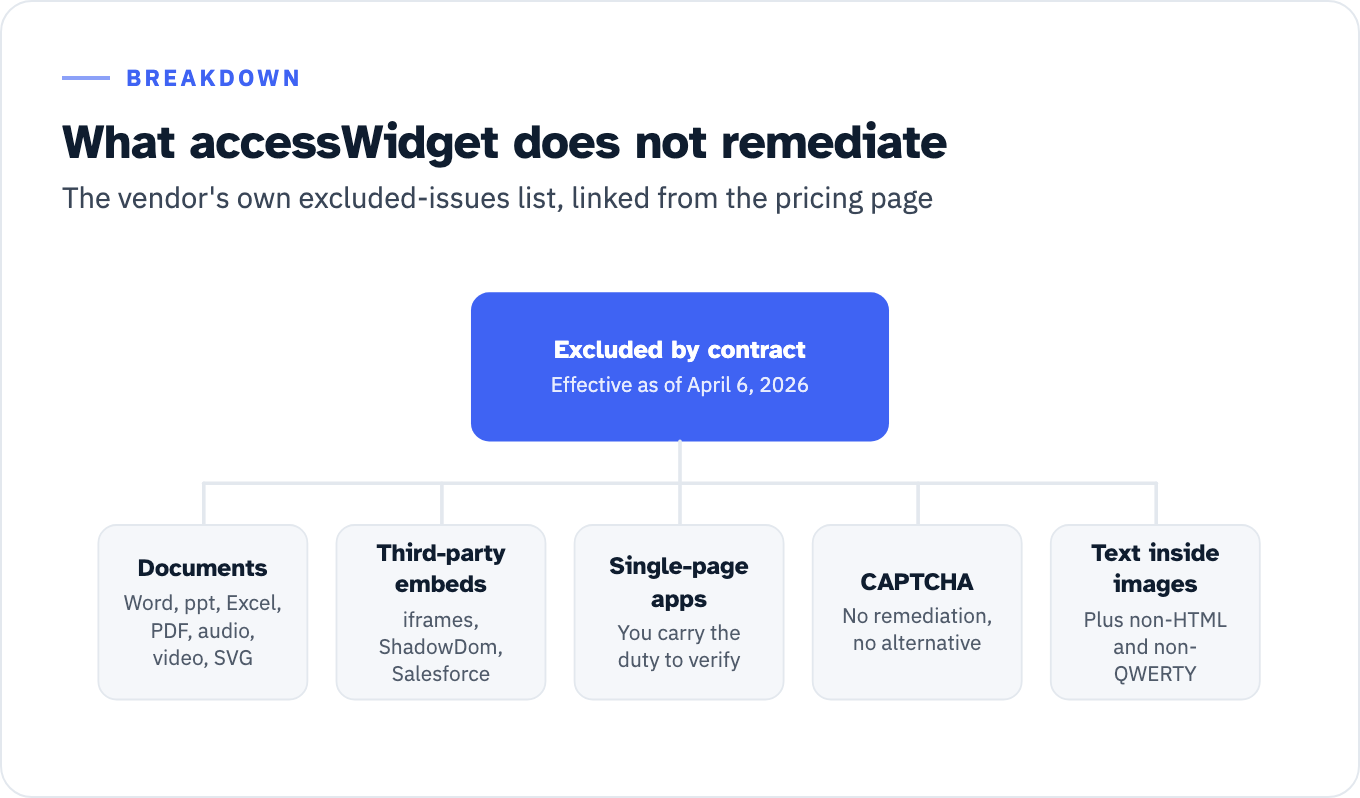
View the data as a list
Excluded by contract: Effective as of April 6, 2026
- Documents: Word, ppt, Excel, PDF, audio, video, SVG
- Third-party embeds: iframes, ShadowDom, Salesforce
- Single-page apps: You carry the duty to verify
- CAPTCHA: No remediation, no alternative
- Text inside images: Plus non-HTML and non-QWERTY
Set that list beside a map of your own estate before you set it beside the price. The checkout iframe, the application form built as a single-page app and the document library are three of the exclusions, and on a given site they may also be the surfaces carrying the defects with the highest user impact. That is a question about your estate, and the exclusions list is the checklist for answering it.
AudioEye draws the same boundary in two places. Its pricing page puts Document Remediation, Mobile Audit and VPAT under “ADDITIONAL SERVICES”, outside the three tiers. Its 10-K makes the accounting treatment explicit, describing a business that focuses “on recurring revenue growth in both channels, while still offering our website and mobile application reporting services and PDF remediation services that provide non-recurring revenue”. The ARR definition in the same filing then excludes “our PDF remediation services business, one-time mobile application reports, and other miscellaneous services” from the recurring measure. When a vendor’s own SEC filing books document remediation outside the subscription metric, the subscription does not include it.
If your document mountain is the real exposure, price it as its own program rather than as a widget feature. The triage decisions, retire, replace with HTML, remediate now or remediate on request, and how to plan throughput against a date, are covered in triaging a legacy document mountain before a 2027 deadline.
A total cost of obligation you can build from published figures
Here is a stack you can fill in without a single invented average, because every anchor in it is somebody else’s published number.
Assumptions for the worked example, stated so you can substitute your own: one main site at about 45,000 visits a month, two smaller sites under 5,000 visits a month each, one subdomain under 5,000, a PDF library, a checkout that loads in a third-party iframe, and a solicitation that asked for an ACR. Traffic bands are the vendor’s Similarweb-derived figures, not your analytics.
| Line | What it is | Public anchor | In the widget subscription |
|---|---|---|---|
| Widget subscription, main site | Scale band, above 30,000 and up to 100,000 visits a month | $3,990/yr, accessiBe published rate card | Yes |
| Widget subscription, three further properties | Micro band each, one per domain and one per subdomain | $490/yr each, $1,470 total | Yes, as separate plans |
| Manual testing on the covered pages | Listed on the Scale card and above | Included in the $3,990 line at that tier only | Yes, at Scale and above |
| Expert audit of what automation does not reach | The remaining defects on the excluded surfaces | AudioEye’s own calculator implies $8,500 per manual audit | No |
| Document remediation | PDFs, Word, PowerPoint, Excel | No public per-page price from any of the three | No, excluded by contract |
| Third-party iframe and single-page app work | Checkout, embedded forms, app shells | No public price from any of the three | No, excluded by contract |
| ACR authoring | The completed report a reviewer assesses | The VPAT template itself is free. The testing behind it is quote-only | No. accessiBe lists VPAT under accessServices and AudioEye lists it under Additional Services |
| Retest and reissue | Confirming the fixes and updating the report | No public price from any of the three | No |
On those assumptions the published subscription line is $5,460 a year. Of the five lines beneath the manual-testing row, exactly one carries a vendor-published anchor: the $8,500 per manual audit implied by AudioEye’s own calculator. The ACR line has a free template with quote-only testing behind it. The remaining three carry no published price from any of the three vendors. That is the actual shape of the decision. The number you can look up is the smallest number in the stack.
Two of those anchors deserve their own note.
The $8,500 audit figure is AudioEye’s, not ours. AudioEye publishes a cost calculator at audioeye.com/accessibility-calculator/, also embedded on its pricing page, and every input is exposed. Its defaults are 229 pages (“The average site we scan has about 229 pages”), 50 issues per page, 15 minutes per issue and $82 per developer hour (“The U.S. average is $82 per hour”). Its default output is $269,725 a year, itemized as $234,725 developer cost, $17,000 for “Manual Audits (2x/year)” and $18,000 for developer tools. The arithmetic reproduces: 229 pages times 50 issues is 11,450 issues, at 15 minutes each is 2,862.5 hours, at $82 an hour is $234,725, and adding $17,000 and $18,000 gives $269,725. The $17,000 line divided by two audits implies $8,500 per manual audit as the vendor’s own planning assumption. The page carries its own caveat: “Actual costs will vary based on how your site is built (i.e., page templates and reusable components can reduce work), but this gives you a starting point.” Treat $269,725 as a vendor-published planning assumption on vendor-chosen defaults, substitute your own page count, and do not quote it as a market figure.
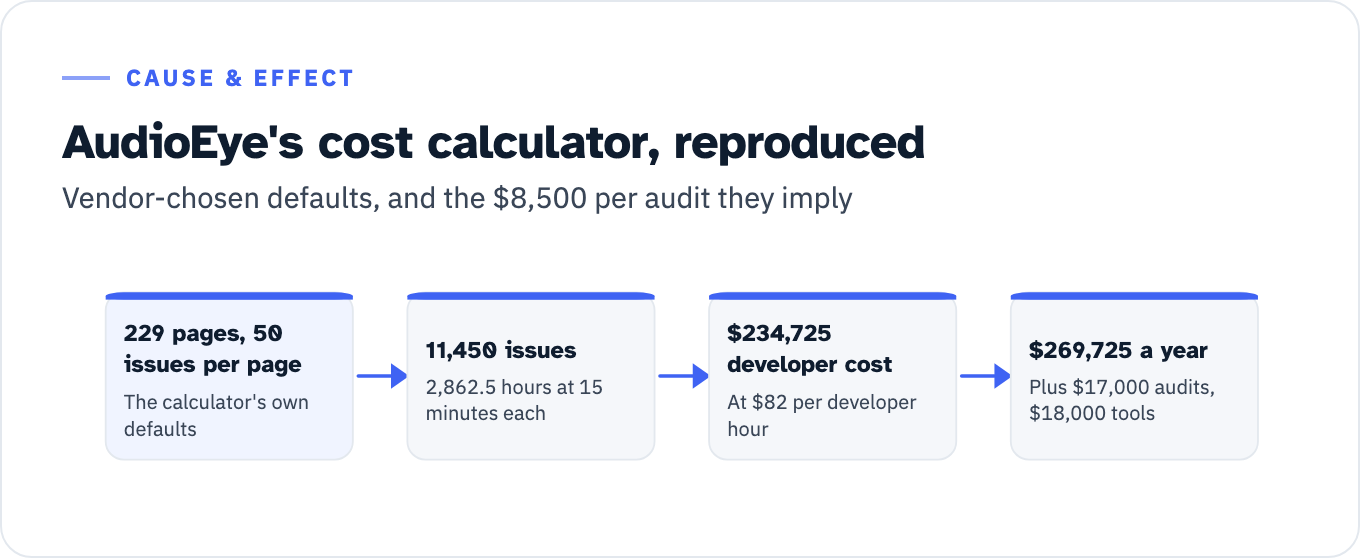
View the data as a list
- 229 pages, 50 issues per page: The calculator’s own defaults
- 11,450 issues: 2,862.5 hours at 15 minutes each
- $234,725 developer cost: At $82 per developer hour
- $269,725 a year: Plus $17,000 audits, $18,000 tools
The 50-issues-per-page input needs a correction if you reuse it. The calculator sources that input from WebAIM. The WebAIM Million 2026 report states that across the one million home pages analyzed in February 2026, “56,114,377 distinct accessibility errors were detected”, “an average of 56.1 errors per page”, up from 51 in 2025. That is a home-page average produced by automated detection, applied to home pages, and WebAIM says plainly that “Absence of detected errors does not indicate that a page is accessible or conformant.” The same report found that “95.9% of home pages had detected WCAG 2 failures” using automated detection alone. If you carry the input into your own model, carry the scope with it.
The vendor’s own scoping numbers point the same way. AudioEye’s calculator page splits residual effort by what you buy: “Do It All Yourself (100% You)”, “Automated Accessibility (~50% You)” and “Managed Accessibility (3% You)”, with the caveat “Actual effort saved depends on how your site is built.” The first table in this article shows what a subscription costs. That split shows how much of the work a subscription leaves behind, on the vendor’s own estimate: about half of it, at the automated tier.
What else the same money buys
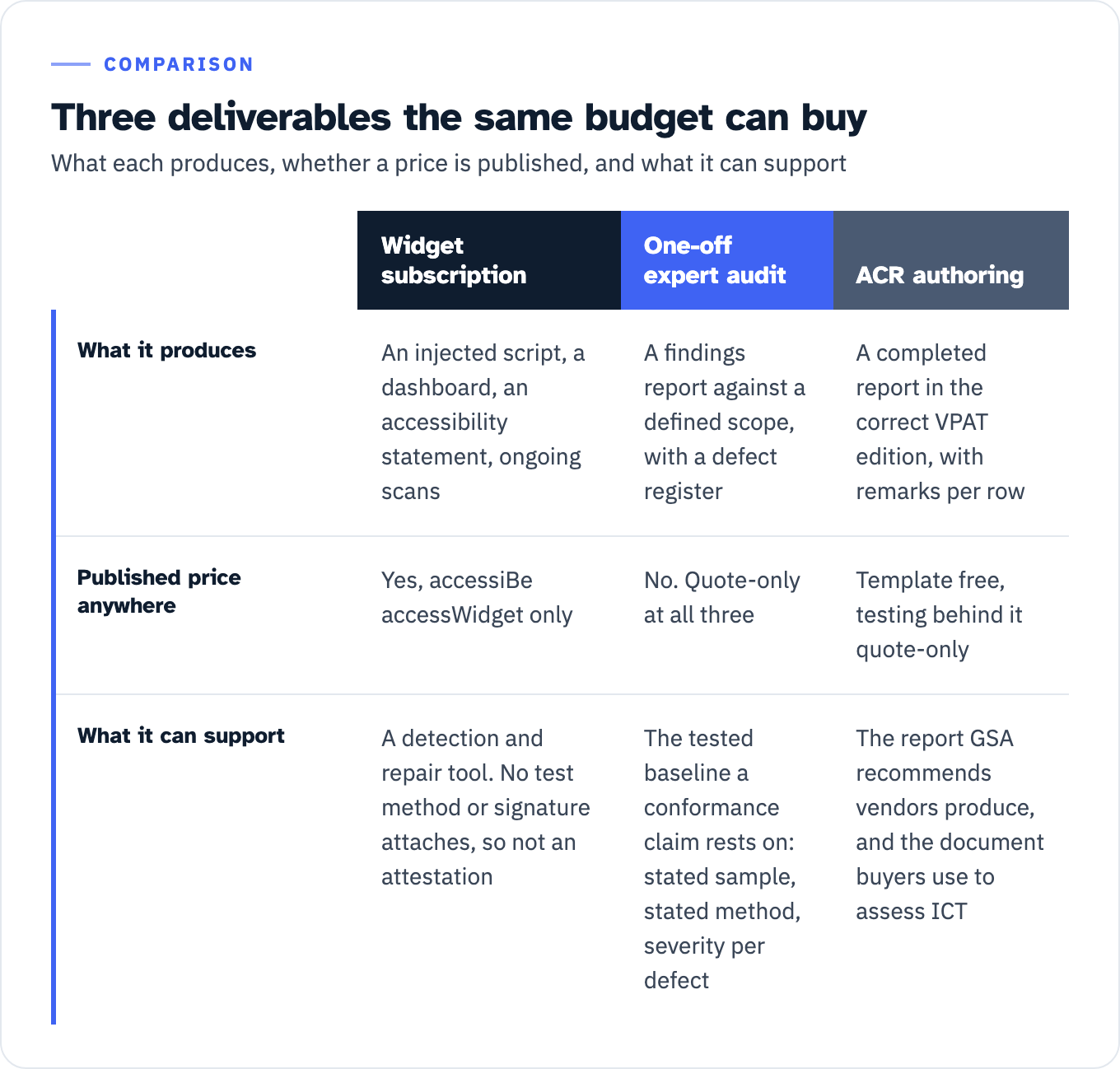
The three vendors here sell more than the widget, and the alternatives are best understood as a menu of deliverables rather than a ladder of tiers. What changes across the rows is not quality. It is what lands on your desk and whether it can carry a claim.
| What you buy | What it produces | Published price anywhere | What it is, and what it can support |
|---|---|---|---|
| Automated widget subscription | An injected script, a dashboard, an accessibility statement, ongoing scans | Yes, accessiBe accessWidget only | A detection and repair tool. No test method, scope statement or signature attaches to it, so it is not an attestation |
| Monitoring and workflow platform | Scan results across an estate, issue tracking, developer workflow | No. accessiBe accessFlow and the Level Access platform are both quote-only | Evidence that a program exists and is running, not a statement of conformance against a standard |
| One-off expert audit | A findings report against a defined scope, with a defect register | No. Quote-only at all three | The tested baseline a conformance claim rests on: a stated sample, a stated method, a severity per defect |
| ACR authoring | A completed report in the correct VPAT edition, with remarks per row | The template is free. The testing behind it is quote-only | The report GSA recommends vendors produce, and by its own definition the document buyers use to assess ICT |
| Document remediation | Remediated PDFs and Office files, per file or per page | No public per-page price from any of the three | Closes the exclusion the subscription writes into its own terms |
| Remediation retainer | A prioritized defect queue, a fix cadence, a retest per closed defect | No | A dated commitment plus evidence of progress against it |
View the data as a table
| Widget subscription | One-off expert audit | ACR authoring | |
|---|---|---|---|
| What it produces | An injected script, a dashboard, an accessibility statement, ongoing scans | A findings report against a defined scope, with a defect register | A completed report in the correct VPAT edition, with remarks per row |
| Published price anywhere | Yes, accessiBe accessWidget only | No. Quote-only at all three | Template free, testing behind it quote-only |
| What it can support | A detection and repair tool. No test method or signature attaches, so not an attestation | The tested baseline a conformance claim rests on: stated sample, stated method, severity per defect | The report GSA recommends vendors produce, and the document buyers use to assess ICT |
Two points anchor that table. The first is that the artifact a federal buyer assesses is the report, not the dashboard. GSA’s guidance to vendors on ACRs defines it: “An Accessibility Conformance Report (ACR) is a document that explains how information and communication technology (ICT) products such as software, hardware, electronic content, and support documentation meet (conform to) the Revised 508 Standards for IT accessibility. ACRs help Federal agency contracting officials and government buyers to assess ICT for accessibility when doing market research and evaluating proposals.” The same page recommends “that vendors generate an ACR for any ICT that’s intended to be marketed to the Federal government.”
The second is that the template producing that report costs nothing. ITI publishes the VPAT “free of charge”, currently VPAT 2.5Rev, dated 24 April 2025, in four editions. What a buyer pays for in an ACR line is the testing behind the report and the accountability of the person who signs it, never the document. If a quote for ACR authoring does not name a test method, the assistive technology and the versions used, you are buying the document. How a reviewer on the other side takes that report apart is set out in how to score a vendor’s ACR.
One more thing the subscription does not buy, and this one comes from a government source rather than a vendor page. The FTC’s final consent order, approved on 22 April 2025, “bars accessiBe from representing that its automated products can make any website WCAG-compliant or can ensure continued compliance with WCAG over time, unless it has the evidence to support such claims.” The same release states that the order “prohibits accessiBe from making misleading claims and requires the company to pay $1 million.”
Read that as a pricing fact rather than as a scandal. A conformance guarantee is not what is on the menu here. The order names accessiBe. AudioEye’s own footnote offers something different again, “limited, guaranteed financial protection against WCAG-related demand letters and/or lawsuits”, gated to a Managed package that includes Assurance. Financial protection against a demand letter is not a statement that a site conforms, so a line item labeled “compliance” is mispriced before it is negotiated. If you are choosing between a subscription and an engagement, the five engagement types and what each produces are laid out in buying accessibility services: five engagement types compared.
Six questions to answer in writing before the renewal date
Send these to the vendor and file the reply with the quote. Each is answerable from the published material above, which means an unanswered one is a finding.
- Which figure sets my tier, and who owns it. Confirm whether the traffic band comes from the Similarweb-derived estimate or from your own analytics, and what happens if the two disagree.
- What happens when I cross a band mid-term. The published pricing page does not address overage. Get the answer in the order form, not in an email.
- How many plans am I actually buying. Count domains and subdomains, then price each on its own band. One plan is one domain.
- Monthly or annual, and what is the twelve-month total. With a monthly figure of $59 and an annual figure of $490 for the same tier, the billing period changes the budget line by about 30 percent.
- Attach the exclusions document to the contract. Ask for the current excluded-issues list as a contract attachment with its effective date, then walk your own estate against it: documents, iframes, single-page apps, CAPTCHA.
- Name the artifact the subscription delivers. If a reviewer asked you for an ACR, ask the vendor in writing whether the subscription produces one, what test method sits behind it, and who signs it. If the answer is a separate quote, that quote belongs in this year’s budget rather than next year’s.
Your next step
Open the renewal quote and count two things: the number of domains and subdomains it actually covers, and how many of your top ten highest-traffic pages contain a PDF link, a third-party iframe or a single-page app route. The first count multiplies the subscription line. The second lists the work the subscription excludes by contract. Then ask the vendor for the current exclusions document in writing.
If the count comes back uncomfortable, ADACP scopes the two lines the subscription excludes: a manual audit of the surfaces automation does not reach, under WCAG audits and testing, and the report a reviewer will accept, under VPAT and ACR testing. Send the exclusions list with your request and the scope writes itself.