

The 2010 Standards scope Section 707 to two machines
A branch replaces two teller windows with video units. The vendor sheet says the machine is ADA compliant, procurement files it, and a year later somebody asks which provision that sentence points at. The 2010 ADA Standards carry one machine specification, and it is scoped to two things: automatic teller machines, and self-service fare vending, collection or adjustment machines.
The scoping provision is 220.1:
Where automatic teller machines or self-service fare vending, collection, or adjustment machines are provided, at least one of each type provided at each location shall comply with 707. Where bins are provided for envelopes, waste paper, or other purposes, at least one of each type shall comply with 811.
Read the trigger rather than the section title. Nothing else in the Standards sends a transaction machine to Section 707.
One abbreviation carries two meanings here. Advisory 707 says “Interactive transaction machines (ITMs),” and DOJ illustrated that sense with an open list, in a 2010 equipment ANPRM it later withdrew: “ITMs include POS devices, such as credit card payment terminals, retail store self-checkout stations, machines used for ordering food at quick service restaurants, and gas station pay-at-the-pump systems” (75 FR 43452, 43458, withdrawn at 82 FR 60932). That is an illustration, not a definition, and it does not say where a bank’s video teller falls. In banking, ITM means the interactive teller machine, and the bank’s own regulator names it separately: 12 CFR 25.12 defines a remote service facility as an “automated, virtually staffed, or unstaffed banking facility” such as “an automated teller machine (ATM), interactive teller machine, cash dispensing machine, or other remote electronic facility.” That definition is in force today, though the agencies have proposed rescinding the 2024 rule that added it (90 FR 34086).
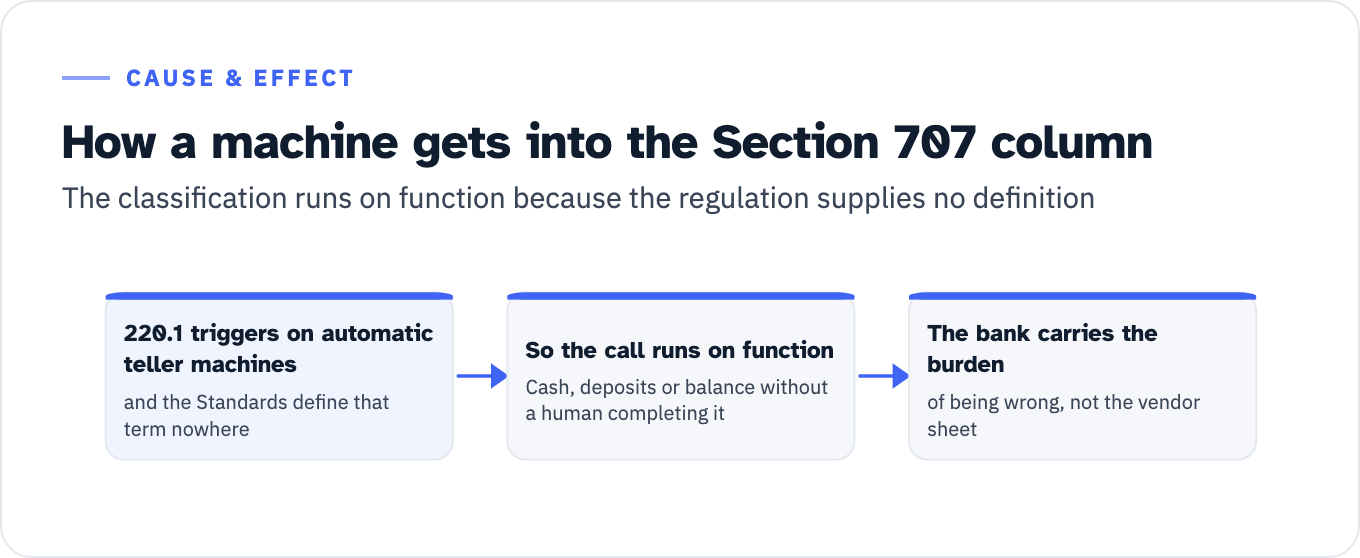
So the classification question is open, and the text does not close it. 220.1’s trigger word is “automatic teller machines,” and the 2010 Standards define that term nowhere: 106.5 Defined Terms runs from Accessible to Work Area Equipment with no entry for it. No federal accessibility source consulted for this article addresses the video teller at all, and the Access Board’s 2022 notice on self-service transaction machines writes “ATM” fifteen times without using the word “teller” once. What is left is a test on function rather than a verdict on product names. If a fixed unit dispenses cash, accepts deposits or reports a balance without a human completing the transaction, treat it as inside 220.1’s trigger and test it against 707. Reserve the non-ATM record for units that do none of those things. The hybrid is the hard case, a machine that runs video-assisted transactions while a teller is on the line and ordinary ATM transactions when none is, and no source says how to book it. The burden of being wrong sits with the bank, not with the vendor sheet. This article says “non-ATM machine” for a unit that comes out on the far side of that test.
Outside Section 707 is not outside the ADA. A bank is a public accommodation by name at 42 U.S.C. 12181(7)(F), and 28 CFR 36.303(a) carries the auxiliary aids duty whatever hardware delivers the service. One machine has numbers attached to it. The other has a duty attached to it, and your record is what stands where the numbers would be.
View the data as a list
- 220.1 triggers on automatic teller machines: and the Standards define that term nowhere
- So the call runs on function: Cash, deposits or balance without a human completing it
- The bank carries the burden: of being wrong, not the vendor sheet
Advisory 707, quoted, and exactly what it is worth
Here is the sentence the question turns on, published in the 2010 Standards on ada.gov and word for word again in the Access Board’s own edition:
Interactive transaction machines (ITMs), other than ATMs, are not covered by Section 707. However, for entities covered by the ADA, the Department of Justice regulations that implement the ADA provide additional guidance regarding the relationship between these requirements and elements that are not directly addressed by these requirements. […]
The advisory then points at Section 508, which by its own words reaches ITMs “purchased by the Federal government.” A private bank meets that standard only as a flow-down term when it sells to one.
Note what the advisory does not do. It carves out interactive transaction machines other than ATMs while leaving “ATM” undefined, so it settles nothing for a machine whose standing under that word is the question being asked.
Two provisions say that text binds nobody. 28 CFR 36.406(b) states that advisory notes, appendix notes and figures in the 1991 and 2010 Standards “explain or illustrate the requirements of the rule; they do not establish enforceable requirements.” 36 CFR 1191.1(a), Note 1, says the advisory sections “provide guidance only and do not contain mandatory requirements.” It is weaker than a rule and stronger than a stray opinion: both agencies publish it as part of the Standards they wrote and adopted.
Corroboration comes from the Access Board itself. In its 2022 advance notice on self-service transaction machines it wrote that “the Board’s ADA and ABA Accessibility Guidelines apply only to ATMs and fare machines that are fixed or built-in, but not to those that are moveable,” and that “the Board intends to apply the technical requirements from the ADA and ABA Accessibility Guidelines for ATMs and fare machines to SSTMs and self-service kiosks” (87 FR 57662, 57664). An agency does not propose extending requirements that already reach.
That notice is an ANPRM and nothing has followed it: between 22 September 2022 and 18 August 2026 the Access Board published 20 Federal Register documents and none concerns self-service transaction machines. A claim in circulation that the Board issued a proposed rule on self-service equipment on 24 May 2024 matches no document in the Federal Register API.
The gate in front of all of it: fixed or built-in
28 CFR 36.406(b) opens with the sentence that decides whether any of this applies: “The 1991 Standards and the 2010 Standards apply to fixed or built-in elements of buildings, structures, site improvements, and pedestrian routes or vehicular ways located on a site.” The Access Board passage quoted above says the same thing about these machines by name.
So a wheeled cabinet or a countertop unit sits outside 220.1 and outside 707 whatever it dispenses. It is not outside the ADA: for a machine on that side of the gate, 36.303, 36.304 and 36.211 are the whole regime, which is the record described at the end of this article. Settle fixed or built-in first, because every step below assumes it.
What Section 707 requires of an ATM
The specification is short and every line of it is testable. 707.5 opens flatly: “Machines shall be speech enabled.” Instructions, prompts, input verification, error messages “and all displayed information for full use” have to be accessible to and independently usable by individuals with vision impairments. Speech has to be “delivered through a mechanism that is readily available to all users, including but not limited to, an industry standard connector or a telephone handset.” The connector and the handset are illustrations, not the only two permitted mechanisms. Three exceptions follow: security-masked output, advertisements carrying no transaction information, and unsupported speech synthesis.
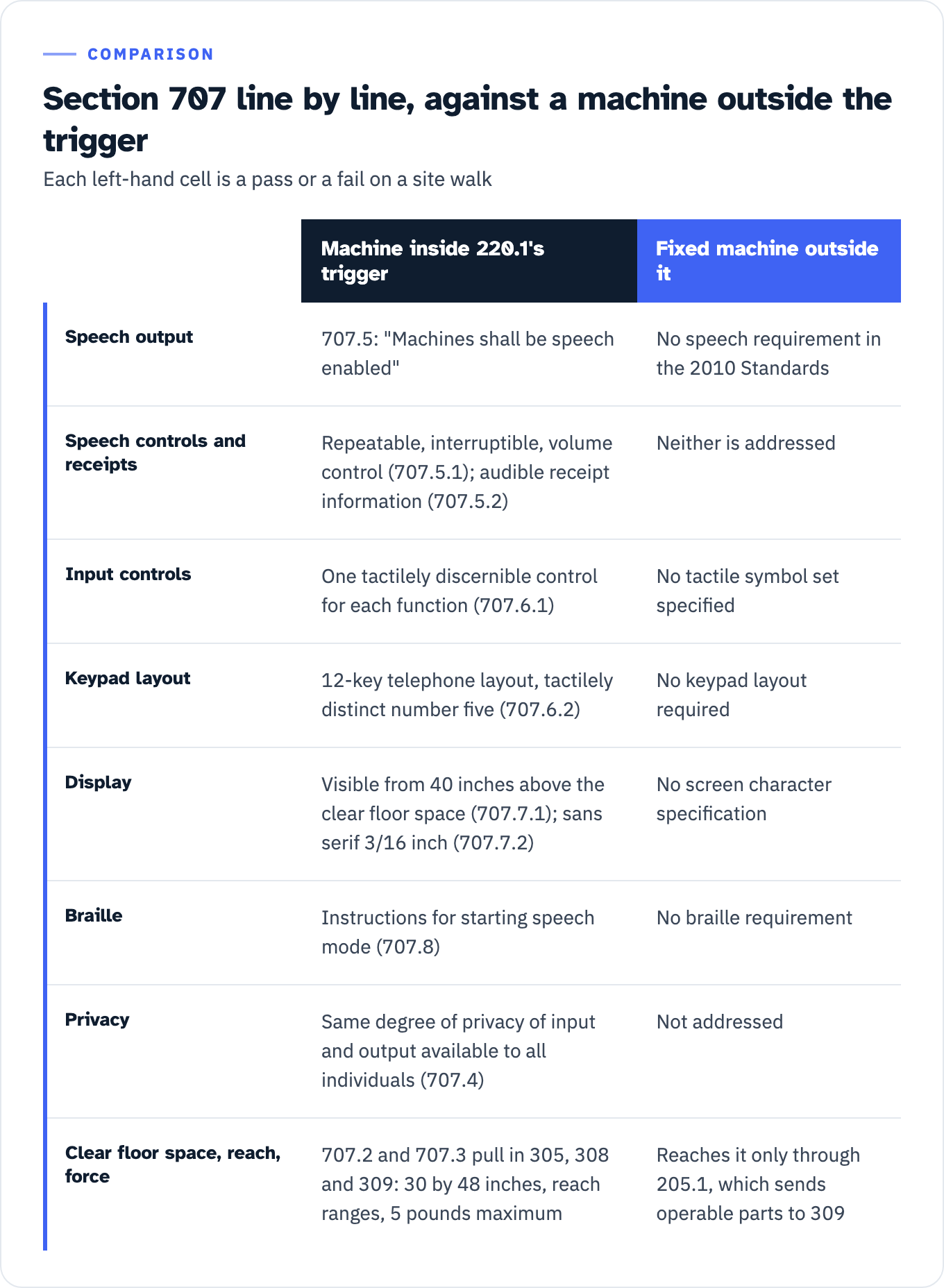
Underneath sit the numbers, each a pass or a fail on a site walk. Speech repeatable and interruptible, with volume control (707.5.1). Audible receipt information where receipts are provided (707.5.2). One tactilely discernible input control for each function (707.6.1), and numeric keys in a 12-key ascending or descending telephone keypad layout with a tactilely distinct number five (707.6.2). Function keys contrasting light on dark or dark on light (707.6.3.1), carrying tactile symbols fixed by name (707.6.3.2). A display visible from 40 inches above the center of the clear floor space (707.7.1), in sans serif characters 3/16 inch minimum on the uppercase letter I (707.7.2). Braille instructions for starting speech mode (707.8). Clear floor space and operable parts arrive through 707.2 and 707.3, which pull in 305, 308 and 309: 30 by 48 inches minimum, operable parts within the reach ranges at 308, one-handed operation at 5 pounds maximum. Read 308 before the site walk: its unobstructed range is 15 to 48 inches, but a machine set into a wall surround or behind a counter is the obstructed case, and 308.2.2 and 308.3.2 set lower maxima that fall further as reach depth grows.
Privacy is its own subsection and it prescribes no mechanism. 707.4 reads: “Automatic teller machines shall provide the opportunity for the same degree of privacy of input and output available to all individuals.” Blanking the screen while speech runs appears only in the advisory to 707.4, as something speech output users “can benefit from,” so a machine that reaches the same result another way still complies.
For a machine that is not an ATM, the column is short. The 2010 Standards set no scoping provision, no speech requirement, no privacy requirement, no keypad layout, no tactile symbol set, no screen character specification and no braille requirement for it. What survives is 205.1, which sends “operable parts on accessible elements, accessible routes, and in accessible rooms and spaces” to 309 and states no exception for transaction machines. That carries the reach range, the clear floor space and the 5 pound activation force across to a fixed non-ATM machine. Treat it as what the text supports rather than as settled: the advisory to 205.1 gives an expressly non-exhaustive list of controls and names a transaction machine neither way.
View the data as a table
| Machine inside 220.1’s trigger | Fixed machine outside it | |
|---|---|---|
| Speech output | 707.5: “Machines shall be speech enabled” | No speech requirement in the 2010 Standards |
| Speech controls and receipts | Repeatable, interruptible, volume control (707.5.1); audible receipt information (707.5.2) | Neither is addressed |
| Input controls | One tactilely discernible control for each function (707.6.1) | No tactile symbol set specified |
| Keypad layout | 12-key telephone layout, tactilely distinct number five (707.6.2) | No keypad layout required |
| Display | Visible from 40 inches above the clear floor space (707.7.1); sans serif 3/16 inch (707.7.2) | No screen character specification |
| Braille | Instructions for starting speech mode (707.8) | No braille requirement |
| Privacy | Same degree of privacy of input and output available to all individuals (707.4) | Not addressed |
| Clear floor space, reach, force | 707.2 and 707.3 pull in 305, 308 and 309: 30 by 48 inches, reach ranges, 5 pounds maximum | Reaches it only through 205.1, which sends operable parts to 309 |
Counting machines: at least one of each type, at each location
220.1 uses two more terms and defines neither. What counts as a “type” of machine? What counts as a “location”? The enforceable text is silent, so a bank counting its machines is working from something else.
That something else is Advisory 220.1: “If a bank provides both interior and exterior ATMs, each such installation is considered a separate location. Accessible ATMs, including those with speech and those that are within reach of people who use wheelchairs, must provide all the functions provided to customers at that location at all times. For example, it is unacceptable for the accessible ATM only to provide cash withdrawals while inaccessible ATMs also sell theater tickets.”
That gloss is unenforceable by the two provisions above, and following it is still the defensible choice: no competing published reading exists, and its function-parity half restates something 36.303 would reach anyway. Just do not let a project plan call it what the regulation requires. It is what the published advisory says the regulation means.
The drive-up exceptions are the other place counting goes wrong. A drive-up only machine drops the clear floor space at 707.2, drops 309.2 and 309.3 through the exception at 707.3, and drops the 40 inch display sightline at 707.7.1. Everything else stays. Speech output, audible receipts, privacy, tactile input controls, keypad layout, function keys, screen characters and braille instructions carry no drive-up exception at all.
The safe harbor splits an ATM in half
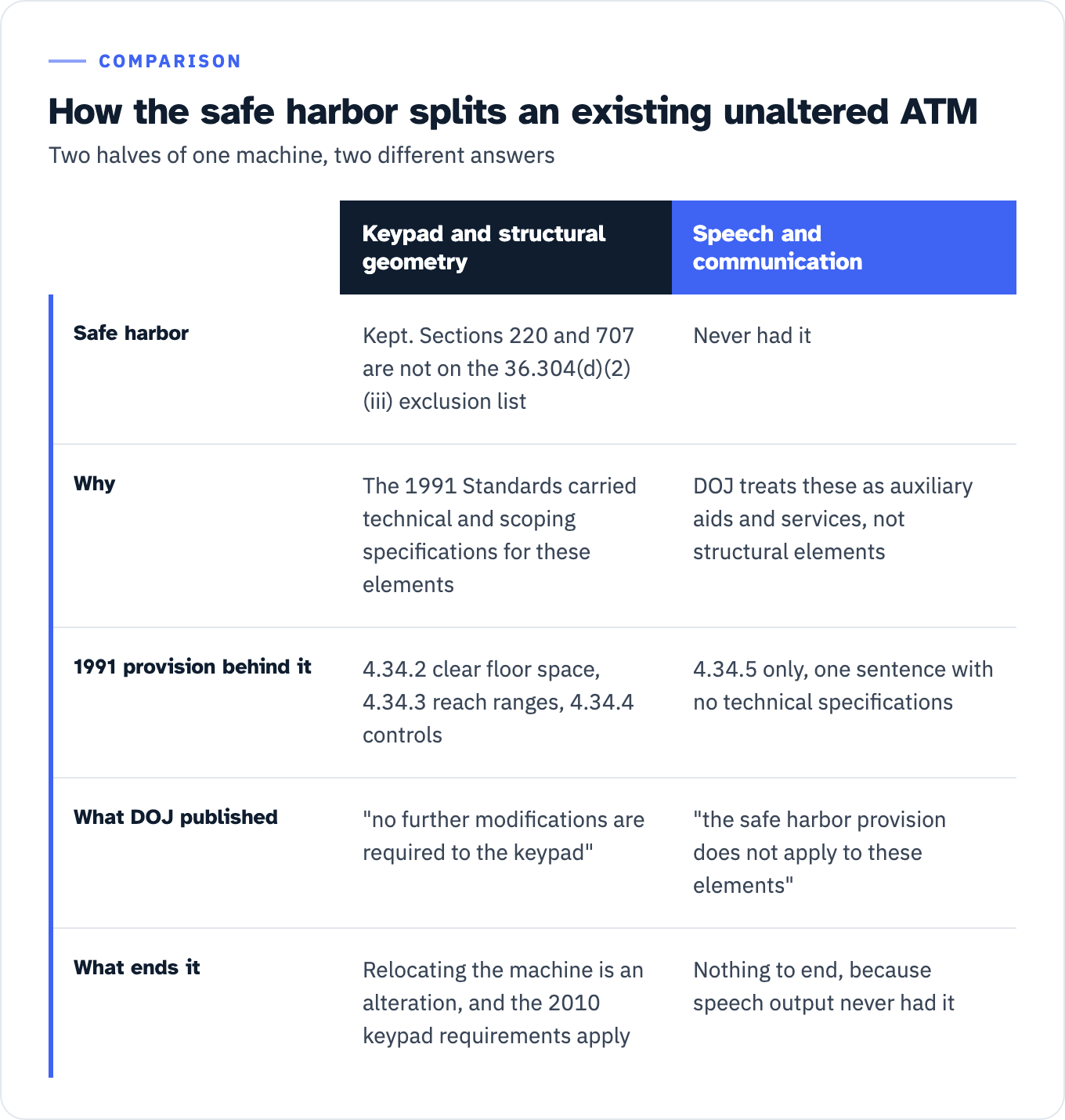
28 CFR 36.304(d)(2)(i) says elements not altered on or after 15 March 2012 that comply with the 1991 Standards “are not required to be modified in order to comply with the requirements set forth in the 2010 Standards.” The list at 36.304(d)(2)(iii) of elements excluded from that safe harbor runs from residential facilities through amusement rides, boating, exercise equipment, golf, play areas, saunas and pools, and sections 220 and 707 are not on it. The same provision states the operative test: the harbor fails for elements “for which there are neither technical nor scoping specifications in the 1991 Standards.” So it is claimed element by element against a named 1991 provision, not for an ATM as a whole: 4.34.2 for clear floor space, 4.34.3 for reach ranges, 4.34.4 for controls. DOJ’s small business primer states the keypad case outright: “If an existing ATM complies with the 1991 Standards, no further modifications are required to the keypad” (ADA Update: A Primer for Small Business).
The communication half gets a different answer. In the guidance published with the 2010 Title III rule, DOJ wrote: “The Department consistently has taken the position that the communication-related elements of ATMs are auxiliary aids and services, rather than structural elements … Thus, the safe harbor provision does not apply to these elements.”
Keypad geometry keeps the safe harbor. Speech output never had it, and there was no 1991 speech specification to comply with in any case: the 1991 Standards covered communication at these machines in a single sentence, at 4.34.5, and DOJ’s summary of the change says they “do not contain any technical specifications.” The same primer closes the other door: “if you relocate a fixed ATM, which is considered an alteration, you will now have to meet the keypad requirements in the 2010 Standards.”
View the data as a table
| Keypad and structural geometry | Speech and communication | |
|---|---|---|
| Safe harbor | Kept. Sections 220 and 707 are not on the 36.304(d)(2)(iii) exclusion list | Never had it |
| Why | The 1991 Standards carried technical and scoping specifications for these elements | DOJ treats these as auxiliary aids and services, not structural elements |
| 1991 provision behind it | 4.34.2 clear floor space, 4.34.3 reach ranges, 4.34.4 controls | 4.34.5 only, one sentence with no technical specifications |
| What DOJ published | ”no further modifications are required to the keypad" | "the safe harbor provision does not apply to these elements” |
| What ends it | Relocating the machine is an alteration, and the 2010 keypad requirements apply | Nothing to end, because speech output never had it |
What a bank documents for the machines 707 does not reach
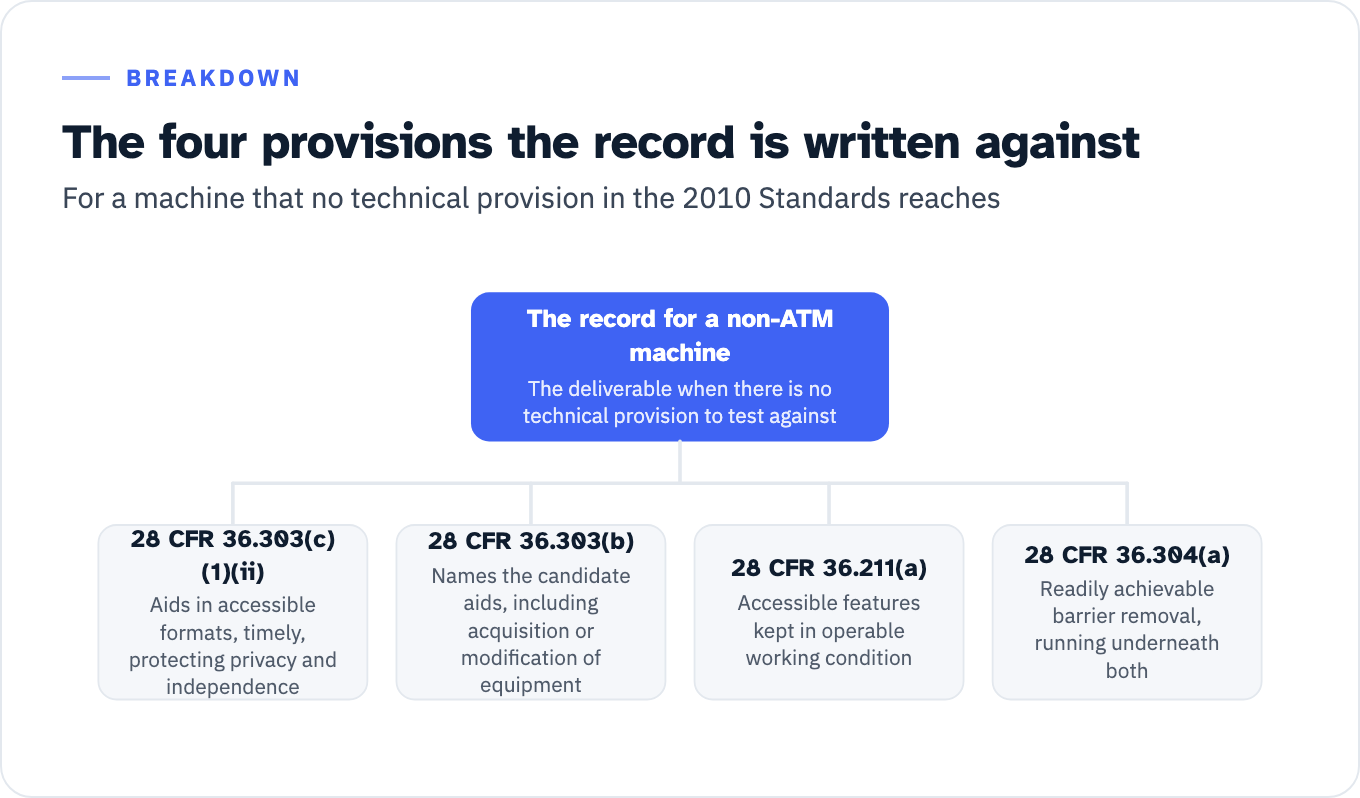
With no technical provision to test against, the record is the deliverable, and four provisions say what belongs in it.
28 CFR 36.303(c)(1)(ii) is the hook that reaches a non-ATM machine when 707.5 does not. It leaves the choice of aid with the operator, since “the ultimate decision as to what measures to take rests with the public accommodation, provided that the method chosen results in effective communication.” Then it sets the test: aids and services “must be provided in accessible formats, in a timely manner, and in such a way as to protect the privacy and independence of the individual with a disability.” Privacy and independence, at a machine that takes a PIN and reads a balance out loud. At a video teller, where a live employee sees and hears the customer throughout, that clause is the acceptance criterion to write against: how a customer who needs speech output, or who cannot speak to the teller, finishes the transaction without the aid itself putting the balance in earshot of the queue.
36.303(b) names the candidate aids, including “accessible electronic and information technology” and, as printed, “Acquisition or modification of equipment or devices,” so the aid can be the machine rather than a staff workaround. 28 CFR 36.211(a) requires accessible features “of facilities and equipment” to be kept in operable working condition, which makes a dead headphone jack on a compliant ATM a maintenance obligation with teeth. The allowance at 36.211(b) is narrow: it covers “isolated or temporary interruptions in service or access due to maintenance or repairs,” which is a jack reported last night, not a jack that has been dead all quarter. 28 CFR 36.304(a) keeps readily achievable barrier removal running underneath both.
One more line belongs in the file, from the advisory to 103 Equivalent Facilitation: outside transit facilities “there is no process for certifying that an alternative design provides equivalent facilitation,” and the responsibility for demonstrating it “in the event of a challenge rests with the covered entity.” Nobody can certify the video teller. If a vendor response says the unit meets Section 707, ask which subsections and by what test.
A workable per-location record has six columns: the machine, whether it is fixed or built-in, whether it meets 220.1’s trigger on the function test above and the reasoning for that call, the functions it offers, the auxiliary aid provided for each communication function, and the date and method by which that aid was last verified to work. Where the same class of hardware is bought under a federal contract, a different regime applies, and those branches are worked through in kiosk ADA compliance: RFP requirements and acceptance tests.
View the data as a list
The record for a non-ATM machine: The deliverable when there is no technical provision to test against
- 28 CFR 36.303(c)(1)(ii): Aids in accessible formats, timely, protecting privacy and independence
- 28 CFR 36.303(b): Names the candidate aids, including acquisition or modification of equipment
- 28 CFR 36.211(a): Accessible features kept in operable working condition
- 28 CFR 36.304(a): Readily achievable barrier removal, running underneath both
What is not known
No published decision applying Section 707 to a machine that is not an ATM turned up in the research for this article. That is narrower than “no court has held,” and it is as far as the searching went.
No federal source counts these machines. The Community Reinvestment Act data requirement at 12 CFR 25.42(a)(4) has a large bank record its remote service facility locations, opening and closing dates and hours, plus an indicator for whether each is “deposit-taking, cash-advancing, or both.” That is not a census separating interactive teller machines from ATMs. No source consulted here states a deployment count, or what share of installed machines delivers working speech output.
The enforcement record is thin and indirect. In its 2011 settlement with the United States, Wells Fargo represented that its “approximately 12,100 ATMs allow for equal access for individuals with disabilities” and that by 15 March 2012 all of them “will comply with all applicable regulations, including those for ATMs published in the Federal Register on September 15, 2010” (Settlement Agreement, DJ # 202-11-239). Read that for what it is: a party representation inside a settlement that disclaims any admission of liability, about ATMs rather than about the machines this article is asking about. It is the closest thing to an exposure signal found here.
State and local accessibility codes were not surveyed for this article. A bank estate crosses them, and the federal record described above is not the whole record.
DOJ said it would fix the equipment gap and then did not. The guidance published with the 2010 rule recorded that the Department “plans to initiate a rulemaking to address these issues in the near future.” That notice opened on 26 July 2010 and was withdrawn on 26 December 2017, the Department stating that “there are currently no specific provisions in the ADA regulations that include standards governing the accessibility of equipment and furniture that are not fixed.” Nothing has followed it.
Finally, a trap on ada.gov itself. The ADA Title III Technical Assistance Manual still covers ATMs at III-7.5185 against the 1991 reach-range provision and calls that provision “under review by the Architectural and Transportation Barriers Compliance Board, and is the subject of current rulemaking.” The guidelines that review produced were published in 2004. The page carries no superseded banner.
What to do this week
- Inventory the machines at each location and settle two things about each before anything else: whether it is fixed or built-in, and what it actually does. A fixed unit that dispenses cash, accepts deposits or reports balances without a human completing the transaction goes in the 707 column and gets tested there. Write the reasoning down for every call, because the trigger’s term is undefined and the vendor label decides nothing.
- For every machine in the 707 column, test the subsections that carry no drive-up exception first, starting with speech output and its user controls.
- For every machine in the other column, write the effective communication record instead, measured against 36.303(c)(1)(ii).
- Keep speech output out of any safe harbor argument. The keypad on an unaltered pre-2012 ATM is protected where it complies with the 1991 provision that corresponds to it. The communication elements are not, and relocating the machine ends the protection for the keypad too.
How to classify a borderline unit, what a particular entity’s obligations are, and how to answer a demand letter are questions for your counsel, not for a testing report. What a testing report can settle is which requirements each machine currently fails when it is measured against 707, and what the record shows for the machines nobody can place.
If you want that inventory produced against your branch estate, with 707 results per machine and the effective communication record for the others, that is what ADACP’s financial services accessibility work covers. Send the machine list, the make and model of each unit and one location’s floor plan, and the first thing back is the list of machines whose column is empty.