
Equally effective alternate access plans after April 2027
 By David LoPresti August 1, 2026
 The folder of signed plans, and what 2027 does to it
A product failed its accessibility review and a department needed it anyway. Somebody wrote an Equally Effective Alternate Access Plan: product and version, the barriers, the affected user groups, a human workaround, a vendor timeline, two or three signatures. The purchase cleared. Do that for four years and you hold a folder of dated records, each stating that a named barrier exists in a named product your institution still pays for.
The date that folder has to survive is in the Code of Federal Regulations. 28 CFR 35.200(b)(1) reads:
Beginning April 26, 2027, a public entity, other than a special district government, with a total population of 50,000 or more shall ensure that the web content and mobile apps that the public entity provides or makes available, directly or through contractual, licensing, or other arrangements, comply with Level A and Level AA success criteria and conformance requirements specified in WCAG 2.1, unless the public entity can demonstrate that compliance with this section would result in a fundamental alteration in the nature of a service, program, or activity or in undue financial and administrative burdens.
Paragraph (b)(2) sets 26 April 2028 for smaller entities and special district governments. Both dates moved out a year on 20 April 2026, by an interim final rule effective on publication that took comments through 22 June 2026 (91 FR 20902), a history covered in the companion piece on the four new federal compliance dates.
Nothing about the plan’s own legal status changes on the date. Sections 35.201 through 35.205 entered the CFR with the 2024 final rule, 89 FR 31320, and the two Justice Department answers below were published in that same document. What changes on 26 April 2027 is that § 35.200(b)(1) starts to bite. DOJ was asked to let public entities answer an inaccessible product with an equally effective alternative method of access, and refused. It was asked to require the exact fields your plan contains, and declined that too.
Where “equally effective” comes from
The phrase is older than any campus using it. 34 CFR 104.4(b)(2), the Section 504 regulation the Department of Education has carried since 45 FR 30936 (9 May 1980), says aids, benefits and services “to be equally effective, are not required to produce the identical result or level of achievement” but must afford equal opportunity “to obtain the same result, to gain the same benefit, or to reach the same level of achievement, in the most integrated setting appropriate to the person’s needs.” DOJ’s 2013 settlement with Louisiana Tech University, DJ #204-33-116, copied that sentence into Exhibit 1 almost word for word, swapping “handicapped” for “disabled.”
What 2013 added was the procedure, and it carries a condition that is easy to lose. Exhibit 1 provides that where compliance is not technically possible or would cause a fundamental alteration or undue burdens, “exceptions to the policy may be granted by an appropriate official,” that “requests for exceptions must be in writing,” and that “whenever an exception is granted, the University must develop a plan to provide equally effective alternate access to the information or service of the technology to students, prospective students, and applicants.” The exception comes first, in writing, from an official; the plan is its consequence. The Office for Civil Rights restated that sequence with SUNY at Albany in 2017.
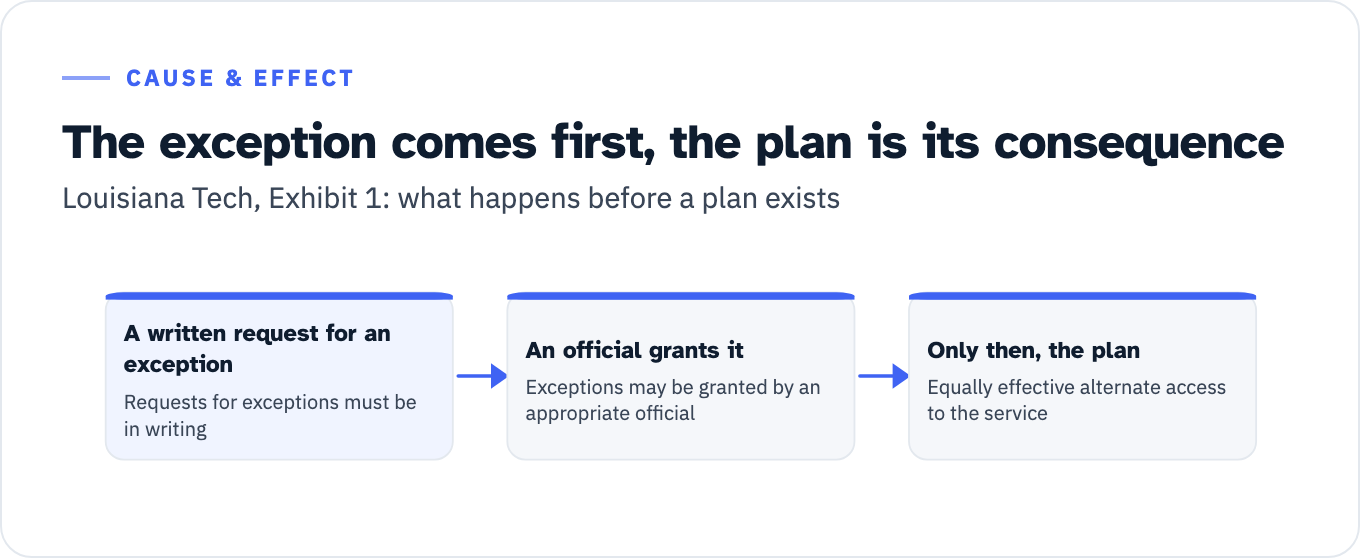
View the data as a list
- A written request for an exception: Requests for exceptions must be in writing
- An official grants it: Exceptions may be granted by an appropriate official
- Only then, the plan: Equally effective alternate access to the service
The four campus pages examined here split on whether they kept the order. The University of Illinois Chicago files the plan inside an exception review, and NC State requires coordinator approval “before ICT resource procurement can commence.” The University of Iowa and UConn present the plan as the instrument itself. None cites Louisiana Tech; the one documented link between any two is UConn’s References section, which credits Iowa.
The two answers DOJ published in April 2024
The first is at 89 FR 31394:
First, commenters suggested that public entities should be permitted to provide what they called an “accommodation” or an “equally effective alternative method of access” when web content or mobile apps are not accessible. Under the approach these commenters envisioned, people with disabilities would need to pursue an interactive process where they discussed their access needs with the public entity and the public entity would determine how those needs would be met. The Department believes that adopting this approach would undermine a core premise of subpart H of this part, which is that web content and mobile apps will generally be accessible by default.
The middle sentence sets the scope: what DOJ turned down is a request-driven interactive process standing in for conformance. Three other passages close the surrounding ground. At 89 FR 31376 commenters asked DOJ to let public educational institutions provide an equally effective method of alternative access “in lieu of directly accessible, WCAG 2.1 Level AA-conforming versions of materials.” DOJ replied that the segregation rationale behind its conforming alternate version rule reaches that request too: “the same rationale would apply to public educational institutions that wish to provide an equally effective method of alternative access to individuals with disabilities.” At 89 FR 31355 it wrote that the obligation is not met “by a public entity merely providing an accessibility disclaimer or statement explaining how members of the public can request accessible web content or mobile apps.” At 89 FR 31384, on phone support as equivalent facilitation, it held that “the Department no longer believes telephone lines can realistically provide equal access to people with disabilities.”
The second answer, at 89 FR 31386, describes the artifact almost field for field:
The Department received a comment suggesting that the regulatory text should require a public entity claiming the undue burdens limitation to identify the inaccessible content at issue, set a reliable point of contact for people with disabilities seeking to access the inaccessible content, and develop a plan and timeline for remediating the inaccessible content. The Department declines to take this suggested approach because it would be a departure from how the limitation generally applies in other contexts covered by title II of the ADA.
DOJ added that it “encourages public entities to engage in practices that would improve accessibility and ensure transparency,” then named the practices it meant: an accessibility statement telling the public how to report problems, and a procedure for acting on what gets reported. Both are public-facing, and neither is the identify-content, point-of-contact, plan-and-timeline package it had just declined to require.
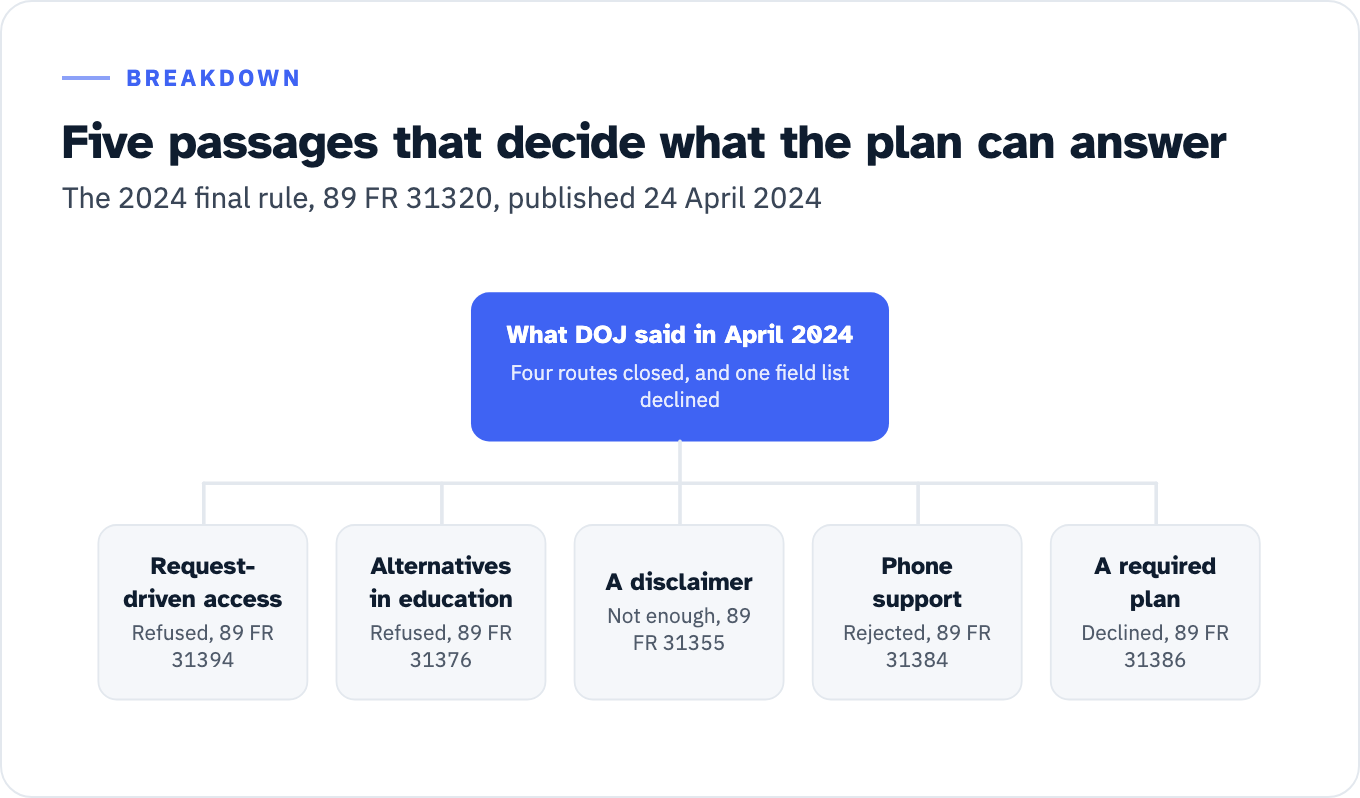
View the data as a list
What DOJ said in April 2024: Four routes closed, and one field list declined
- Request-driven access: Refused, 89 FR 31394
- Alternatives in education: Refused, 89 FR 31376
- A disclaimer: Not enough, 89 FR 31355
- Phone support: Rejected, 89 FR 31384
- A required plan: Declined, 89 FR 31386
So the plan is neither required nor forbidden, and it was not named among the practices DOJ encourages. It is an internal record with no regulatory status, sitting beside a technical standard it does not satisfy. That is not a reason to shred it. It is a reason to stop reading it as an answer to § 35.200 and start reading it as raw material for a different record.
Field by field
The fields do not share a fate.
| Field, as the plan writes it | Verdict at 26 April 2027 | Deciding provision |
|---|---|---|
| Product name, version, vendor contact, and whatever conformance documentation exists | Keeps working | 28 CFR 35.200(a); 89 FR 31345 on contractual arrangements |
| Known barriers and the criteria they fail | Keeps working, and gains weight | 28 CFR 35.200(b)(1); 89 FR 31385 |
| Impacted user groups (blind, low vision, cognitive) | Changes function, from justification to dated admission | 28 CFR 35.205; 89 FR 31387 |
| Proposed alternatives and human workarounds | Stops working as a compliance answer | 28 CFR 35.200(b)(1); 89 FR 31376; 89 FR 31355; and where the plan is request-driven, 89 FR 31394 |
| Product-specific accessibility statement | Stops working as compliance, keeps working as transparency | 89 FR 31355; 89 FR 31386 |
| Resources required to deliver the workaround | Changes scope, from department line item to entity-wide | 28 CFR 35.204 |
| Vendor remediation steps and timeline | Keeps working, and hardens | 28 CFR 35.200(a); 89 FR 31345 |
| Annual review at renewal | Keeps working | 89 FR 31386, the limitation can “vary over time”; NC State and San Francisco State annual-review rules |
| Signature chain | Changes | 28 CFR 35.204; 89 FR 31385 |
| ”where possible, will NOT require an individual to request the alternative access” (UIC) | Keeps working; the rule’s premise is unconditional where UIC’s is qualified | 89 FR 31394 |
The vendor rows survive because the rule reaches content provided “directly or through contractual, licensing, or other arrangements,” and DOJ said at 89 FR 31345 that where entities act through third parties “they are not relieved of their obligations under subpart H.” The barriers row gains weight for the same reason it once justified the purchase: after the date, a list of failed criteria is the work order. The workaround row, the field the whole artifact was built around, is the one that stops, and it is worth being exact about why. A plan built the way UIC builds it, which supplies the alternative “where possible” without waiting for a request, is not the request-driven process DOJ refused at 89 FR 31394. It fails on narrower ground: § 35.200(b)(1) admits only the departures written into §§ 35.201 through 35.205, an alternate access plan is not among them, and at 89 FR 31376 DOJ extended its segregation rationale to exactly this substitution in the education sector. The no-request version survives 89 FR 31394 and still loses on the text of § 35.200(b)(1).
The impacted-groups row deserves a sharper reading than it invites. It is tempting to treat a list of affected disability groups as evidence against a § 35.205 minimal-impact claim. Where the plan records barriers to core functionality, that claim is not available anyway, because the plan is then the entity’s own record that the impact is not minimal: San Francisco State writes a plan when barriers “prevent users from accessing essential functionality (not for minor WCAG issues).” Iowa sets a looser trigger, calling an EEAAP “appropriate for virtually any tool or technology” including where “accessibility documentation is incomplete, out-of-date, or unavailable,” and a plan filed on that basis records no such admission. What the field supplies is a dated admission of who is shut out and since when, good against every provision in the subpart.
One field cannot be given a verdict. San Francisco State’s seven components include a “Quality & Risk Assessment” whose best outcome requires that a plan “Meets all six legal criteria (Equally Effective).” Those criteria are not enumerated anywhere on the page, so guessing at the list would be inventing law.
The departures the rule does allow
Subpart H does contain provisions that depart from the technical standard. DOJ enumerated them at 89 FR 31374-75, in a passage addressed to public educational institutions, as “a series of mechanisms that are designed to make it feasible for these institutions to comply”: the delayed compliance dates in § 35.200, the exceptions in § 35.201, conforming alternate versions and equivalent facilitation in §§ 35.202 and 35.203, the fundamental alteration and undue burdens limitations in § 35.204, and the approach to measuring compliance in § 35.205. That is five items covering six sections, and the first item is the delayed date itself, which is spent on 26 April 2027. Four items are left, spread across the five sections in the table below. A shorter list at 89 FR 31394 drops § 35.203 and refers to § 35.205 obliquely, as “the compliance approach discussed here”; that page is also where DOJ describes what it has allowed as “several departures from the technical standard.” No version of the list contains an alternate access plan.
| Door | What it requires | What it does not do |
|---|---|---|
| § 35.201 exceptions | Content falls in one of five listed categories: archived web content, preexisting conventional electronic documents, third-party posted content, individualized secured documents, preexisting social media posts | Does not displace the entity’s existing effective-communication obligations, which may still require supplying the content accessibly on individual request (89 FR 31322; 28 CFR 35.160) |
| § 35.202 conforming alternate versions | Available “only where it is not possible to make web content directly accessible due to technical or legal limitations” | Not a general substitute; DOJ warns that relying on it where unnecessary “could result in segregation of people with disabilities” |
| § 35.203 equivalent facilitation | Alternatives must “result in substantially equivalent or greater accessibility and usability” | Does not cover phone support in place of a conforming site (89 FR 31384) |
| § 35.204 fundamental alteration or undue burdens | A determination by the head of the entity or a designee, after considering all entity resources, “accompanied by a written statement of the reasons” | Does not excuse the entity from attaining partial compliance, which DOJ expects “in many circumstances” (89 FR 31385) |
| § 35.205 minimal impact | Demonstrate the nonconformance would not affect four listed abilities “in a manner that provides substantially equivalent timeliness, privacy, independence, and ease of use” | DOJ: § 35.205 “does not alter a public entity’s general obligations under subpart H of this part nor is it intended as a blanket justification for a public entity to avoid conforming with WCAG 2.1 Level AA from the outset” (89 FR 31387) |
The last door is the one the field is currently pointed at, and it will not hold the weight. The California State University system has renamed the artifact a Temporary Alternate Access Plan, “Formerly, Equally Effective Alternate Access Plan (EEAAP),” and its Chancellor’s Office ATI page states that “the legal framework, including ADA Title II §35.205, allows institutions to remain compliant even when ICT products are not fully accessible,” and the sentence continues, after a dash, “provided that alternative access measures are in place and do not impose a disparate burden on users with disabilities.” San Francisco State’s campus page is blunter: “Starting April 24, 2026, per ADA Title II §35.205, all ICT must be fully accessible.”
Two problems, both checkable. First, CSU’s proviso and CSU’s section number describe different things. Alternative access measures that keep a disparate burden off users are a § 35.200(a) and § 35.160 idea, and that duty does survive the date. Section 35.205 asks a different question, whether the nonconformance itself has minimal impact, and DOJ’s worked example at 89 FR 31387 holds that an assisted workaround defeats the claim, because a person who needs help from someone without a disability, or who must hand personal information to that person, has had their timeliness, privacy, independence and ease of use affected. An alternative access measure is evidence against a § 35.205 claim rather than support for one. Second, April 24, 2026 was superseded on 20 April 2026. Both pages still carried it when checked on 24 August 2026.
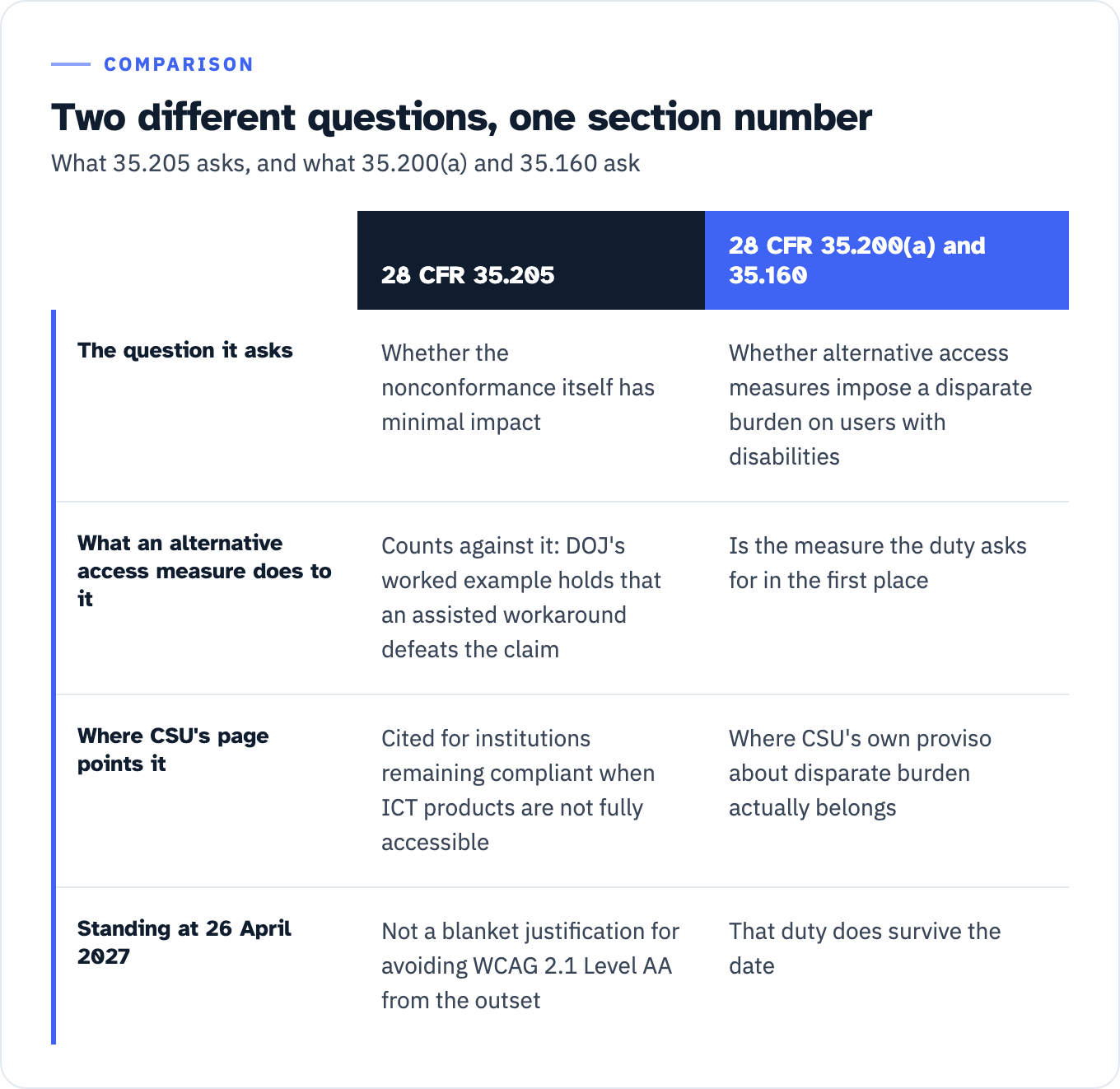
View the data as a table
| 28 CFR 35.205 | 28 CFR 35.200(a) and 35.160 | |
|---|---|---|
| The question it asks | Whether the nonconformance itself has minimal impact | Whether alternative access measures impose a disparate burden on users with disabilities |
| What an alternative access measure does to it | Counts against it: DOJ’s worked example holds that an assisted workaround defeats the claim | Is the measure the duty asks for in the first place |
| Where CSU’s page points it | Cited for institutions remaining compliant when ICT products are not fully accessible | Where CSU’s own proviso about disparate burden actually belongs |
| Standing at 26 April 2027 | Not a blanket justification for avoiding WCAG 2.1 Level AA from the outset | That duty does survive the date |
This is not a gotcha at CSU’s expense. The most accurate sentence on either page is CSU’s own: TAAPs “are now explicitly positioned as temporary risk-management tools and do not indicate accessibility compliance under ADA Title II (effective April 24, 2026).” Even the best sentence on the page carries the stale date, and it says the opposite of what the § 35.205 sentence further down the page claims.
What a § 35.204 determination actually requires
If a barrier genuinely cannot be cured by the date, § 35.204 is the door, and it is a real one:
The decision that compliance would result in such alteration or burdens must be made by the head of a public entity or their designee after considering all resources available for use in the funding and operation of the service, program, or activity, and must be accompanied by a written statement of the reasons for reaching that conclusion.
The provision’s final sentence adds that the entity must still take “any other action” that stays on the right side of the line and ensures individuals with disabilities receive the benefits or services “to the maximum extent possible.” Five elements define the record that replaces the plan.
- The service, program, or activity, named. The unit of analysis is the service, not the software license.
- The resources considered, at entity level: “all resources available for use in the funding and operation” of that service, which is not the requesting department’s budget line.
- The written statement of reasons. DOJ declined to list the factors belonging in it and declined “to adopt any rebuttable presumptions about when the fundamental alteration or undue burdens limitations would apply” (89 FR 31386), so there is no checklist. The burden of proof sits on the entity.
- The signature. At 89 FR 31385 and 31386 DOJ restated a standing position: the decision “must be made by the head of the public entity or their designee,” who must be “a high level official, no lower than a Department head, having budgetary authority and responsibility for making spending decisions,” quoting its own appendix B at 708 (2022). This is longstanding Title II law, not a new hurdle.
- The record of everything done short of the line. DOJ’s view at 89 FR 31385 is that “most entities” asserting the limitation “will be able to attain at least partial compliance in many circumstances.”
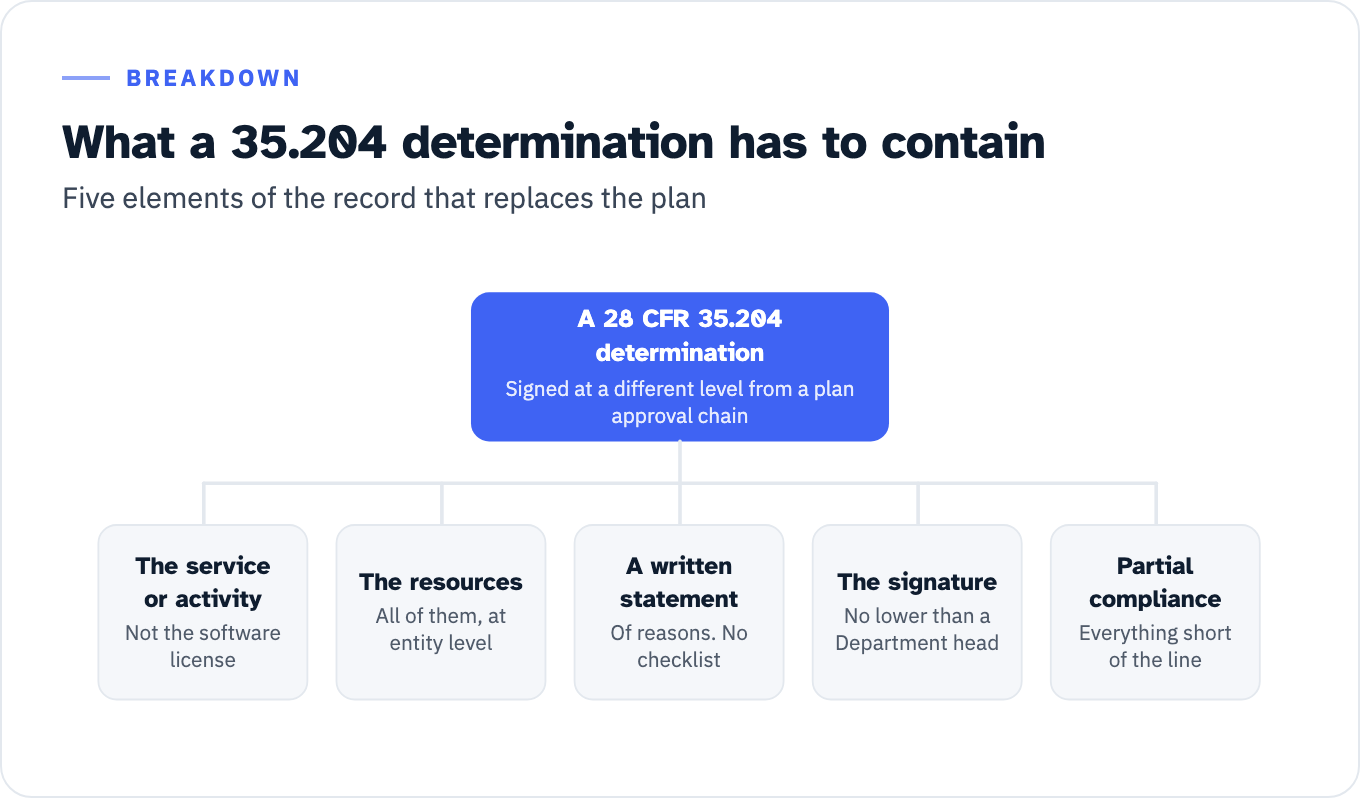
View the data as a list
A 28 CFR 35.204 determination: Signed at a different level from a plan approval chain
- The service or activity: Not the software license
- The resources: All of them, at entity level
- A written statement: Of reasons. No checklist
- The signature: No lower than a Department head
- Partial compliance: Everything short of the line
Set that against what institutions publish. San Francisco State routes a plan through a Department Chair or Manager, a Dean or Division VP, and the ADA Compliance Officer; NC State requires that “the reasons for and extent of the undue burden must be explained by the purchasing department.” Neither claims those approvals are a § 35.204 determination, and San Francisco State says the opposite in its Final Notes: “TAAPs do not exempt products from compliance.” Nobody got this wrong. The determination is a different document, signed at a different level, and it is what the file is missing. CSU has moved partway there: version 3.3 provides that continued use of a plan without vendor progress “now requires formal executive acknowledgment of ongoing accessibility risk.” One caution on timing: DOJ noted at 89 FR 31386 that “whether the limitation applies will also vary over time,” so a determination made in 2027 is a determination about 2027.
Sorting the folder
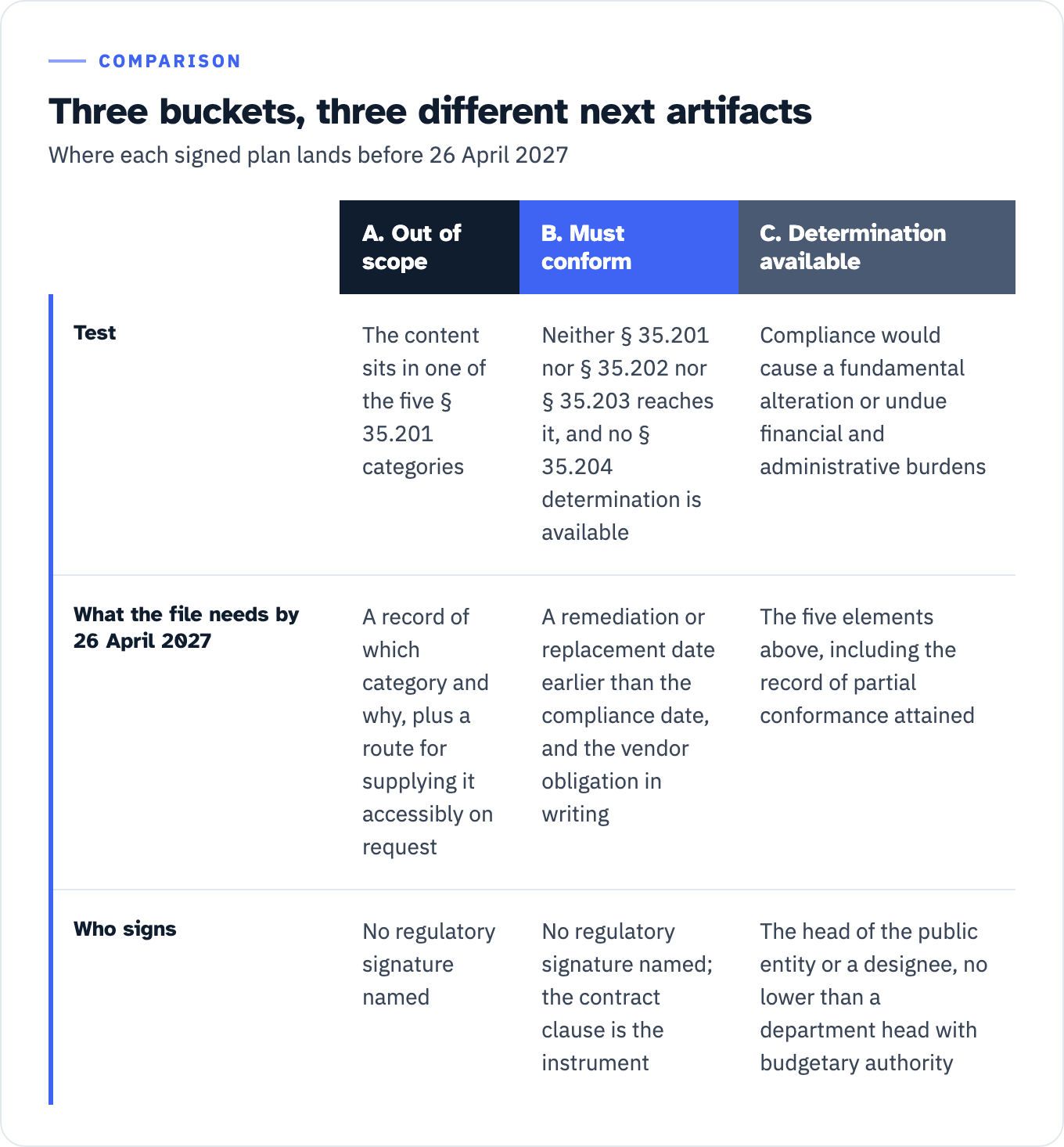
Every plan lands in one of three buckets, and each needs a different next artifact. For a licensed product the first bucket is narrow: § 35.201(c) excepts content posted by a third party “unless the third party is posting due to contractual, licensing, or other arrangements with the public entity,” which is the procurement case exactly, and the other four categories describe documents and social media posts rather than software. Bucket A reaches the documents a product emits, not the product.
View the data as a table
| A. Out of scope | B. Must conform | C. Determination available | |
|---|---|---|---|
| Test | The content sits in one of the five § 35.201 categories | Neither § 35.201 nor § 35.202 nor § 35.203 reaches it, and no § 35.204 determination is available | Compliance would cause a fundamental alteration or undue financial and administrative burdens |
| What the file needs by 26 April 2027 | A record of which category and why, plus a route for supplying it accessibly on request | A remediation or replacement date earlier than the compliance date, and the vendor obligation in writing | The five elements above, including the record of partial conformance attained |
| Who signs | No regulatory signature named | No regulatory signature named; the contract clause is the instrument | The head of the public entity or a designee, no lower than a department head with budgetary authority |
Bucket C is not a parking space: § 35.204 and DOJ’s partial-compliance expectation both require conformance up to the line plus maximum-extent-possible alternatives on top of the determination. A signed determination with an empty remediation record is a determination that has not been made.
No bucket empties by itself, either, because a duty survives conformance, subject to the same limitation the rest of this article describes. DOJ wrote at 89 FR 31385 that where an individual cannot access a service through content “that conforms to WCAG 2.1 Level AA, the public entity is still obligated under Sec. 35.200(a) to provide the individual an alternative method of access to that service, program, or activity unless the public entity can demonstrate that alternative methods of access would result in a fundamental alteration in the nature of a service, program, or activity or in undue financial and administrative burdens.” The next sentence adds that the entity “also must still satisfy its general obligations to provide effective communication, reasonable modifications, and an equal opportunity to participate in or benefit from the entity’s services, programs, or activities.” That surviving duty is what the plan was always closest to, and the one thing it cannot be scaled up to satisfy: it attaches to a person, not a product.
What is not settled
No opinion in the CourtListener database construes subpart H. An opinion search run on 21 August 2026 returned zero results for “equally effective alternate access,” zero for “equally effective alternative access,” and zero for “28 C.F.R. 35.200,” while the controls “28 C.F.R. 35.130” returned 29 hits and “undue financial and administrative burdens” returned 302, confirming the index was live. Three exact-phrase misses establish that those three strings are absent from one database’s opinion corpus on one date. They do not enumerate the case law, and CourtListener does not carry every unpublished district court order, which is where a dispute about the 2027 date would surface first.
DOJ has never described a compliant plan, because it declined to define one. The absence is deliberate and on the record at 89 FR 31386.
The 2027 date may move again. 91 FR 20902 is an interim final rule; comments closed 22 June 2026 and no final rule answering them had published as of 24 August 2026.
Who signs, and for how much. DOJ acknowledged at 89 FR 31386 “the difficulty of identifying the official responsible for this determination given the variety of organizational forms of public entities,” concluding only that “the appropriate relevant official may vary depending on the public entity.” Nor does anything say whether one determination can cover a portfolio: § 35.204 speaks of “the service, program, or activity,” and DOJ said each assessment “will vary depending on the entity, the time of the assessment, and various other facts and circumstances.”
How a public university computes total population. Section 35.104 routes an instrumentality to “the combined decennial Census population estimates” of the governments it is an instrumentality of. That path puts a state university above 50,000, which is why Iowa’s procurement notice tells vendors it will request a conformance plan “in a timely manner (before April 2027).” That is Iowa’s reading of its own status, worth attributing rather than assuming as general law.
What a signed plan proves. Every source cited here treats it as an internal record, and none addresses its evidentiary status. Section 504 also runs in parallel on its own track, and private institutions, which subpart H does not reach, have adopted the same artifact for reasons nothing here decides.
Where this stops
Whether a particular barrier rises to a fundamental alteration or an undue financial and administrative burden is a determination the regulation assigns to the head of the public entity, on the entity’s own budget record, with the burden of proof on the entity. That belongs to your institution and its counsel, along with the questions about retention and privilege. An accessibility vendor cannot make the determination and should not draft it.
What sits on this side of the line is the technical record the signer needs: what the barrier is, which success criteria it fails, who it affects, and what partial conformance is achievable before the date. That record feeds all three buckets, and it is the part that can be bought.
What to do with the folder this quarter
- Pull the plans and sort by renewal date. Anything renewing before 26 April 2027 is a decision you are making this year, deliberately or not.
- Run each through the three buckets. The bulk of the work is the B and C sort: whether a § 35.204 determination is genuinely available for this barrier, or whether the honest answer is a remediation date. Check § 35.201 for the documents a product emits, and do not treat that check as mechanical either: § 35.201(b) turns on whether preexisting documents are “currently used to apply for, gain access to, or participate in” a service, and the archived-content definition in § 35.104 has four parts that must all be met.
- For bucket B, retest the barrier list against WCAG 2.1 Level A and AA, the 5 June 2018 Recommendation the rule incorporates by reference rather than the later W3C edition. Barriers recorded three years ago were recorded against whatever the reviewer was using, and they are the input to the vendor conversation.
- For bucket C, start the § 35.204 record now, and find out who your “head of a public entity or their designee” is before you need the signature.
If you want step three delivered as a dated defect register with severity, steps to reproduce and a retest of the same sample, that is a WCAG audit and retest engagement. Send the product list and the existing plans, and the sample and calendar get scoped against your compliance date. The same work sits behind our education and government practices.