
Federal grant money does not make you a Section 508 entity
 By David LoPresti July 29, 2026
 The subaward term that says Section 508
You are drafting subaward terms for the next cycle, and the accessibility line says the subrecipient shall comply with Section 508. Someone downstream asks the only question that matters: which standard, at which level, tested how, and by when. Nobody in the chain can answer, because the clause was inherited rather than written.
GSA gives half the answer in one sentence on Section508.gov: “Since Section 508 of the Rehabilitation Act of 1973 only applies to federal agencies, the short answer is no.” The same page, reviewed June 2026, carries the other half, which has to travel with the first: “if your organization receives federal funding or assistance, your website is required to be accessible.”
The statute names its duty holder in its opening clause. 29 U.S.C. 794d(a)(1)(A) reads: “When developing, procuring, maintaining, or using electronic and information technology, each Federal department or agency, including the United States Postal Service, shall ensure, unless an undue burden would be imposed on the department or agency, that the electronic and information technology allows” access comparable to that available to people without disabilities. In the GPO text of 794d, retrieved 24 August 2026, the words recipient, grant and financial assistance appear zero times each.
The standards follow the statute. In 36 CFR part 1194, appendix A settles it at E101.1: “Compliance with these standards is mandatory for Federal agencies subject to Section 508 of the Rehabilitation Act of 1973, as amended (29 U.S.C. 794d).” E103.4 defines Agency as “Any agency or department of the United States as defined in 44 U.S.C. 3502, and the United States Postal Service.” A hospital, a school district, a community health center and a nonprofit are none of those, whatever their funding looks like.
One boundary before the map. What follows is regulatory text and its drafting consequence. Whether a term you have already signed is enforceable against you belongs to your counsel, not to your accessibility vendor.
Five relationships, five different rules
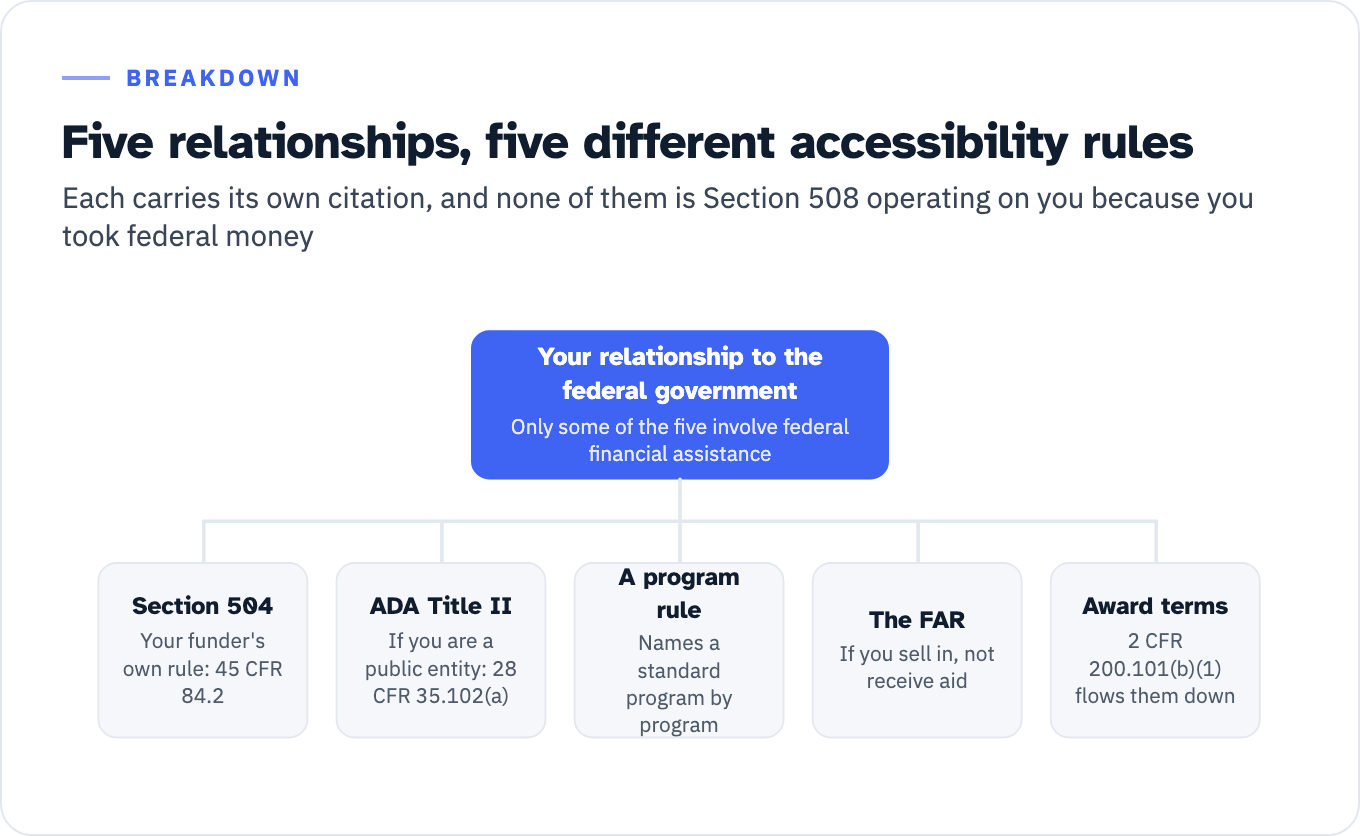
Five relationships with the federal government put an accessibility rule on you, and only some of them involve federal financial assistance. Each has a citation, and none of them is section 508 of the Rehabilitation Act operating on you because you took federal money. Two of them can still put the Access Board standards in your file, one as a procurement term and one as a condition on a particular funding stream. Which relationship you are in decides which standard your award is measured against, and that is what the drafting sections below turn on.
View the data as a list
Your relationship to the federal government: Only some of the five involve federal financial assistance
- Section 504: Your funder’s own rule: 45 CFR 84.2
- ADA Title II: If you are a public entity: 28 CFR 35.102(a)
- A program rule: Names a standard program by program
- The FAR: If you sell in, not receive aid
- Award terms: 2 CFR 200.101(b)(1) flows them down
Section 504, through your funding agency’s own regulation. Each agency writes its own. On applicability, the HHS and Education rules read close to parallel. 45 CFR 84.2 applies the HHS part “to each recipient of Federal financial assistance from the Department and to the recipient’s programs or activities that involve individuals with disabilities in the United States.” 34 CFR 104.2 applies the Education part “to each recipient of Federal financial assistance from the Department of Education and to the program or activity that receives such assistance.” Same statute, and reach that is close enough that the interesting difference is not who is covered but what each rulebook then requires, which is the next section. Note how far the word reaches: 45 CFR 84.10 defines Recipient to include any entity “to which Federal financial assistance is extended directly or through another recipient.” A subrecipient is bound by the funding agency’s 504 rule on its own, before anyone drafts a flow-down clause.
ADA Title II, if you are a public entity. 28 CFR 35.102(a) applies part 35 “to all services, programs, and activities provided or made available by public entities,” and says nothing about federal money in either direction. 28 CFR 35.200(b) sets WCAG 2.1 Level A and AA from 26 April 2027 for a public entity, other than a special district government, with a total population of 50,000 or more, and a year later for everyone else.
A program statute or program regulation that names a standard. This is the channel that does deliver the Access Board standards, program by program rather than governmentwide. Two live examples are below.
The FAR, if you are selling into a federal agency rather than receiving assistance. FAR 39.203(a) requires that “acquisitions for ICT supplies and services shall meet the applicable ICT accessibility standards at 36 CFR 1194.1,” absent an exception or exemption. That obligation arrives through a contract, not through assistance.
The award terms, and what flows down. 2 CFR 200.101(b)(1): “The terms and conditions of Federal awards (including this part) flow down to subawards to subrecipients unless a particular section of this part or the terms and conditions of the Federal award specifically indicate otherwise.”
Notice what the grants rulebook itself does with Section 508. In 2 CFR part 200 at issue date 18 August 2026, the phrase appears exactly once, in Appendix I, and the duty runs the other way: in developing a notice of funding opportunity, “Federal agencies must … For electronic NOFOs and other information about them, comply with Section 508 of the Rehabilitation Act of 1973 (29 U.S.C. 794d).” The agency owes 508 on the solicitation. Nothing in part 200 passes that standard to the applicant.
Where HHS and Education split
Here is the finding a solicitation will not tell you. HHS wrote the Section 508 Standards into its Section 504 regulation as a defined term, and then used that term in no requirement at all.
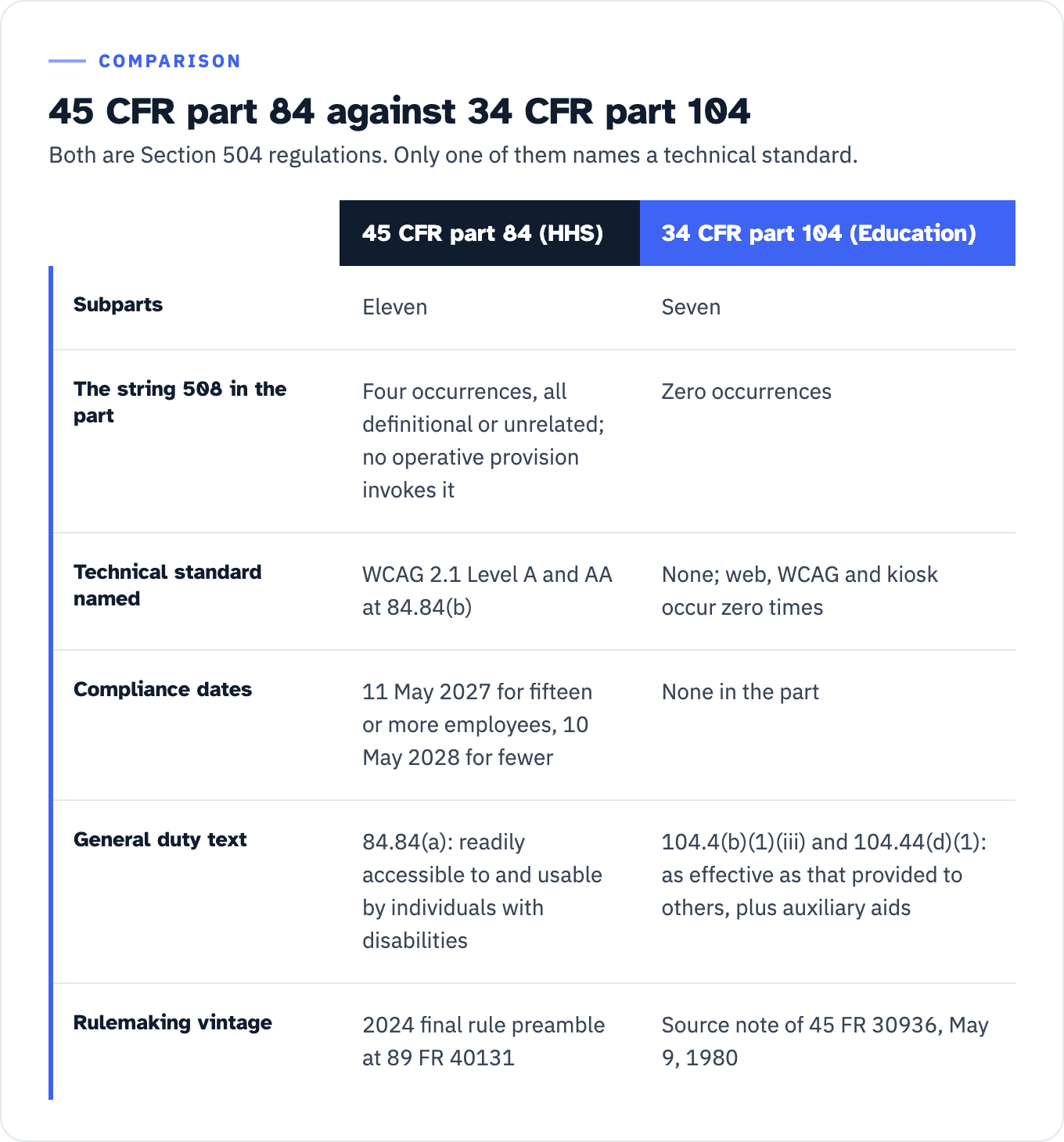
In 45 CFR part 84 as retrieved from the eCFR versioner at issue date 18 August 2026, the string “508” occurs four times. Two are cross references to section 508(c)(2) of the ADA, about wheelchairs in federal wilderness areas. The other two sit inside a single definition at 45 CFR 84.10: “Section 508 Standards means the standards for Information and Communications Technologies (ICT) promulgated at 36 CFR part 1194 by the U.S. Access Board per section 508 of the Rehabilitation Act (29 U.S.C. 794d as amended).” No operative provision of part 84 invokes it. The department said as much in the preamble to its 2024 final rule, at 89 FR 40131: “The Department also declines to adopt the Access Board’s section 508 standards, which are harmonized with WCAG 2.0, for the same reasons it declines to adopt WCAG 2.0.”
What HHS required instead is subpart I. 45 CFR 84.84(a) states the general duty, that a recipient “shall ensure that the following are readily accessible to and usable by individuals with disabilities,” covering web content and mobile apps the recipient provides “directly or through contractual, licensing, or other arrangements.” Paragraph (b) supplies the metric and the dates: WCAG 2.1 Level A and AA from 11 May 2027 for a recipient with fifteen or more employees, and from 10 May 2028 for a recipient with fewer, subject to fundamental alteration and undue burden. Write the version down as precisely as the rule does: 45 CFR 84.10 defines WCAG 2.1 as “the Web Content Accessibility Guidelines (WCAG) 2.1, W3C Recommendation 05 June 2018,” and 84.84(b)(3) incorporates that document by reference. W3C has since republished WCAG 2.1 three times, most recently as a W3C Recommendation dated 06 May 2025, and (b)(3) freezes the rule at the 2018 edition.
The Department of Education’s Section 504 regulation has no equivalent. 34 CFR part 104 carries a source note of 45 FR 30936, May 9, 1980, and seven subparts against HHS’s eleven. In the part as retrieved at issue date 24 July 2026, these strings occur zero times: web, WCAG, kiosk, internet, mobile app, and 508.
View the data as a table
| 45 CFR part 84 (HHS) | 34 CFR part 104 (Education) | |
|---|---|---|
| Subparts | Eleven | Seven |
| The string 508 in the part | Four occurrences, all definitional or unrelated; no operative provision invokes it | Zero occurrences |
| Technical standard named | WCAG 2.1 Level A and AA at 84.84(b) | None; web, WCAG and kiosk occur zero times |
| Compliance dates | 11 May 2027 for fifteen or more employees, 10 May 2028 for fewer | None in the part |
| General duty text | 84.84(a): readily accessible to and usable by individuals with disabilities | 104.4(b)(1)(iii) and 104.44(d)(1): as effective as that provided to others, plus auxiliary aids |
| Rulemaking vintage | 2024 final rule preamble at 89 FR 40131 | Source note of 45 FR 30936, May 9, 1980 |
That is a count of regulation text on a stated date, not an absence of obligation, and reading it the second way is the mistake this article exists to prevent. The same retrieval contains 66 occurrences of “accessib”, 12 of “auxiliary aid” and 2 of “effective communication”. 34 CFR 104.4(b)(1)(iii) forbids a recipient, “directly or through contractual, licensing, or other arrangements,” from providing “a qualified handicapped person with an aid, benefit, or service that is not as effective as that provided to others,” in the 1980 vocabulary the rule still uses, and 34 CFR 104.44(d)(1) requires a postsecondary recipient to take the steps necessary to ensure “that no handicapped student is denied the benefits of, excluded from participation in, or otherwise subjected to discrimination because of the absence of educational auxiliary aids for students with impaired sensory, manual, or speaking skills.” An undated general duty is harder to price than a success criterion, not lighter. And where an Education recipient is also a public entity, the technical standard arrives from 28 CFR 35.200 anyway. What Education’s Office for Civil Rights does through complaint resolution is not established by anything retrieved here, which is why nothing above characterizes it.
Two rules that hand a recipient the Access Board standards
Neither is Section 508 applying to a recipient. Both are program rules that name the 508 standards as their content. The distinction is not that the duty is lighter. It is that the duty is narrower: each one reaches the activities or the system the program pays for rather than the grantee’s whole digital estate, and each is policed by the program’s own machinery rather than by a civil rights rule.
The first is the Assistive Technology Act. A state applying for the assistive technology grant must assure, at 29 U.S.C. 3003(d)(5)(G), that “activities carried out in the State that are authorized under this chapter, and supported by Federal funds received under this chapter, will comply with the standards established by the Architectural and Transportation Barriers Compliance Board under section 508 of the Rehabilitation Act of 1973 (29 U.S.C. 794d).” The assurance binds the supported activities, not the grantee at large. Then compound it: 29 U.S.C. 3002(13) defines the Secretary for that Act as “the Secretary of Health and Human Services, acting through the Administrator of the Administration for Community Living.” 45 CFR 84.82 applies subpart I “to all programs or activities that receive Federal financial assistance from the Department,” so where the AT Act lead agency is also the body receiving that assistance, it sits inside subpart I too. Check rather than assume: under 29 U.S.C. 3003(c)(1)(A) the Governor designates the lead agency and may designate a separate implementing entity to carry out the state activities. Where they are one body, that body carries two standards from one department: the Access Board standards for its supported activities, WCAG 2.1 Level A and AA for its web content and mobile apps.
The second is Medicaid, and it is a funding condition rather than a civil rights duty. 42 CFR 433.112(a) makes federal financial participation available “at the 90 percent rate” for a mechanized claims processing and information retrieval system “only if the APD is approved by CMS prior to the State’s expenditure of funds for these purposes.” That advance planning document approval is the gate, and it names who checks. Paragraph (b) lists the conditions the system must meet, and (b)(12) is one of them: “The agency meets accessibility standards established under section 508 of the Rehabilitation Act, or standards that provide greater accessibility for individuals with disabilities, and compliance with Federal civil rights laws.” Note the alternative in the middle of that clause. It permits something better than the 508 standards without saying who judges “greater”, and nothing retrieved here answers that. A health care recipient looking for a third source of a standard will not find one in Section 1557 either: 45 CFR 92.204(b) sends websites and mobile applications back to “the requirements of section 504 of the Rehabilitation Act, as interpreted consistent with title II of the ADA,” and part 92 contains zero occurrences of “508” and zero of “WCAG”.
What two grant notices from the same day actually say
Two Education Department notices inviting applications, both published on 25 June 2025, ask for accessibility in different words and send applicants to different bodies of law.
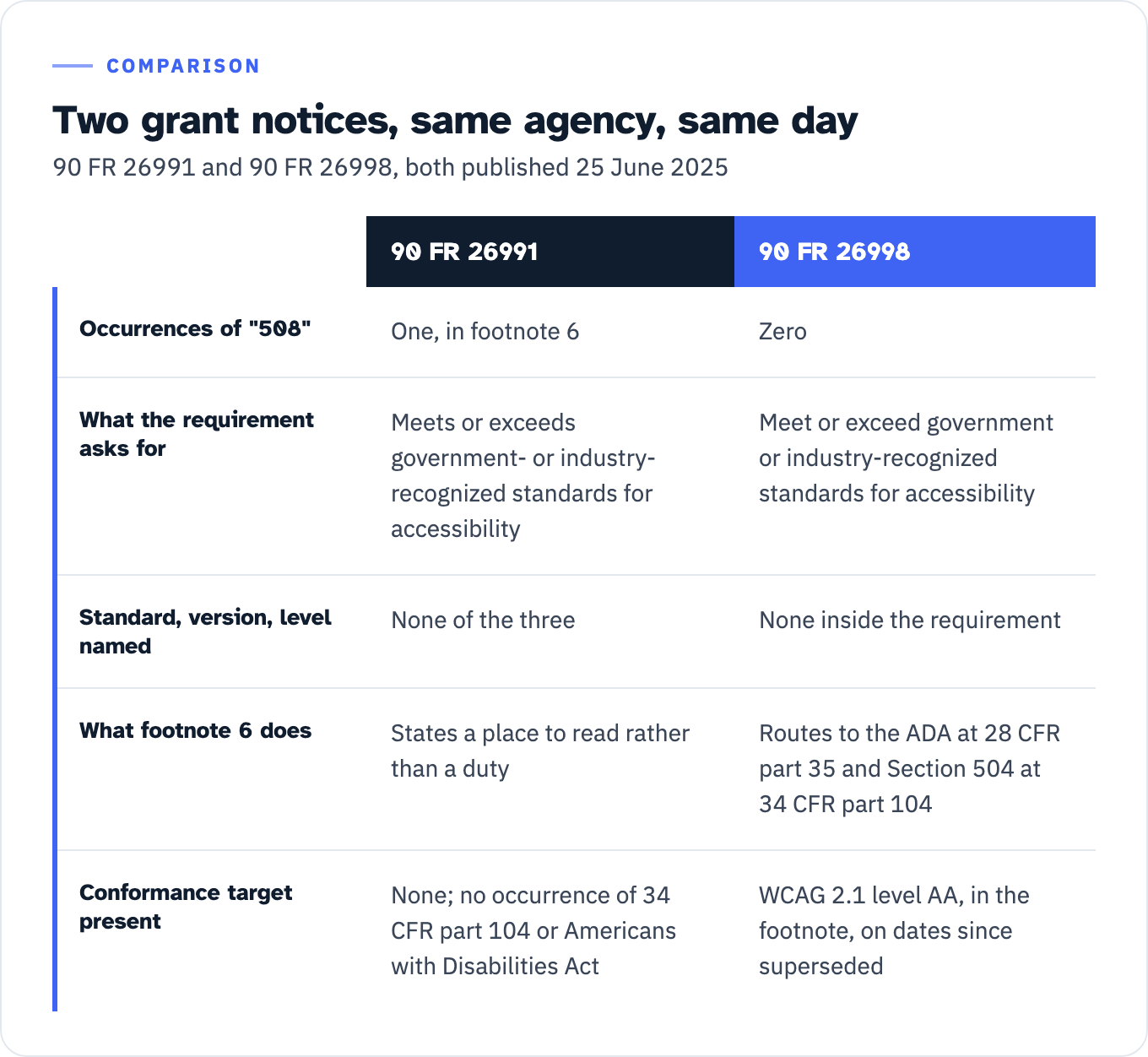
90 FR 26991 carries two accessibility requirements against the same undefined standard: a “high-quality website, with an easy-to-navigate design, that meets or exceeds government- or industry-recognized standards for accessibility,” and a dissemination plan describing “How the project will evaluate and correct all digital products and external communications to ensure they meet or exceed government or industry-recognized standards for accessibility.” Neither names a standard, a version or a level. The notice’s single occurrence of “508” is footnote 6, and it hangs off a third requirement, about processes and funds “to provide access for project staff, contractors, and partners, who require digital accessibility accommodations.” It states a place to read rather than a duty: “For information about digital accessibility and accessibility standards from Section 508 of the Rehabilitation Act, visit https://sites.ed.gov/idea/topic-areas/#Accessibility-Creating-Content.” Searched in full, the notice contains no occurrence of “34 CFR part 104” and none of “Americans with Disabilities Act”.
90 FR 26998 asks a related question in its own words: “How the project will ensure that all digital products and all external communications are routinely evaluated for and, if necessary, remediated to meet or exceed government or industry-recognized standards for accessibility.” The two requirement sentences share that trailing clause; the rest of the wording differs. This notice contains zero occurrences of “508”. Its footnote 6 hangs off requirement “(d) Accessible products and resources,” routes applicants to the Americans with Disabilities Act at 28 CFR part 35 and to Section 504 at 34 CFR part 104, and then names a target, in the footnote rather than in the requirement: “Starting in either April 2026 or April 2027 (depending on the size of the school district), Title II of the Americans with Disabilities Act will require that public entities, including public schools, ensure that web content and mobile apps made available by the public entities are accessible in compliance with the Web Content Accessibility Guidelines (WCAG) 2.1, level AA.”
Check that footnote against the rule before you copy it anywhere. Those were the dates 28 CFR 35.200 carried when the notice published; the provision now reads “Beginning April 26, 2027” for the larger public entities and “Beginning April 26, 2028” for the rest. Accessibility language lifted out of a 2025 solicitation and pasted into a 2026 subaward brings superseded dates with it.
View the data as a table
| 90 FR 26991 | 90 FR 26998 | |
|---|---|---|
| Occurrences of “508” | One, in footnote 6 | Zero |
| What the requirement asks for | Meets or exceeds government- or industry-recognized standards for accessibility | Meet or exceed government or industry-recognized standards for accessibility |
| Standard, version, level named | None of the three | None inside the requirement |
| What footnote 6 does | States a place to read rather than a duty | Routes to the ADA at 28 CFR part 35 and Section 504 at 34 CFR part 104 |
| Conformance target present | None; no occurrence of 34 CFR part 104 or Americans with Disabilities Act | WCAG 2.1 level AA, in the footnote, on dates since superseded |
Same agency, same day, two requirement sentences that share only their closing clause, and no conformance target inside either requirement. The one target that appears sits in a footnote about a different statute, and it is out of date. The standard your award is measured against is set by the rule that reaches you, not by the notice.
What to write in the terms this cycle
2 CFR 200.332 gives a pass-through entity two places to put an accessibility requirement, and they behave differently.
View the data as a list
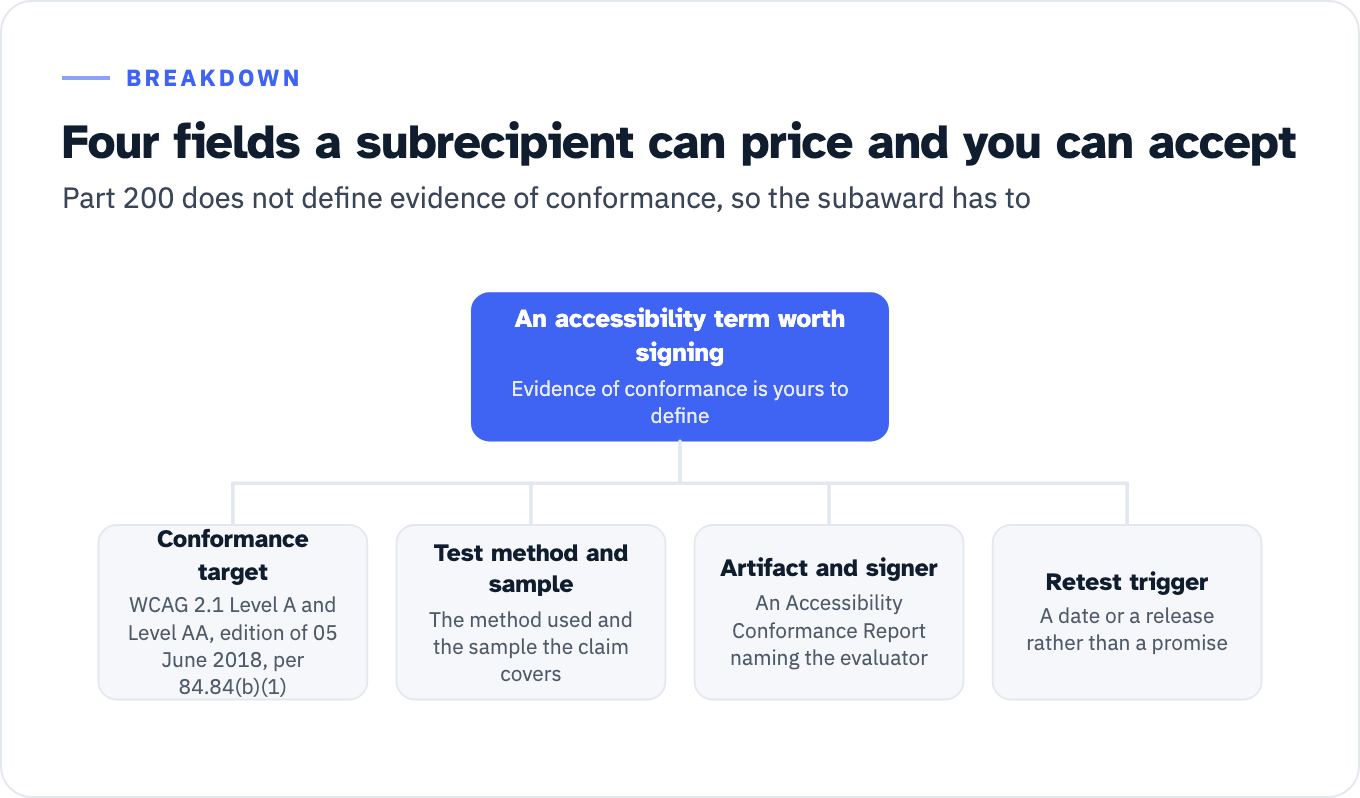
An accessibility term worth signing: Evidence of conformance is yours to define
- Conformance target: WCAG 2.1 Level A and Level AA, edition of 05 June 2018, per 84.84(b)(1)
- Test method and sample: The method used and the sample the claim covers
- Artifact and signer: An Accessibility Conformance Report naming the evaluator
- Retest trigger: A date or a release rather than a promise
Paragraph (b)(2) requires the subaward to include “All requirements of the subaward, including requirements imposed by Federal statutes, regulations, and the terms and conditions of the Federal award”. If 45 CFR 84.84 binds you, it binds the subaward through this row, and what belongs there is the citation, not the word accessible. Paragraph (b)(3) is the discretionary row, and its opening sentence carries the condition that governs how far you may go: “Any additional requirements that the pass-through entity imposes on the subrecipient for the pass-through entity to meet its responsibilities under the Federal award.” A conformance level or an evidence requirement you add has to be tied to your own responsibilities, and for an HHS pass-through 45 CFR 84.84 is that responsibility.
Subpart I is larger than 84.84(b), and a clause drafted against the WCAG sentence alone will be argued on the rest of it. 45 CFR 84.83 covers kiosks and carries no compliance date, 45 CFR 84.85 excepts five categories of content including archived web content and third-party content absent a contractual or licensing arrangement, and 45 CFR 84.88 puts the burden of proving fundamental alteration or undue burden on the recipient and assigns the decision to the head of the recipient or a designee. Our companion piece on the 2026 deadline extensions itemizes those exceptions and both rules’ dates.
Evidence of conformance is yours to define, because part 200 does not define it. Paragraph (e) requires you to “Monitor the activities of a subrecipient as necessary to ensure that the subrecipient complies with Federal statutes, regulations, and the terms and conditions of the subaward,” then lists four steps you must take while monitoring, the first being “Review financial and performance reports.” Neither of those categories is an accessibility test artifact. Four fields make one something a subrecipient can price and you can accept: the conformance target as 84.84(b)(1) states it, the “Level A and Level AA success criteria and conformance requirements specified in WCAG 2.1,” with the edition 84.10 defines, “W3C Recommendation 05 June 2018”; the test method and the sample the claim covers; the artifact and who signs it, such as an Accessibility Conformance Report naming the evaluator; and the retest trigger, a date or a release rather than a promise. That is the evidence a Section 508 conformance program produces for a federal buyer, and a subaward with no named artifact is accepted on assertion.
A clause already signed that says “Section 508” and stops there names no version, no level, no test and no artifact. At the next amendment, (b)(3) lets a pass-through entity add a requirement tied to its own responsibilities under the Federal award. What the clause as signed obliges the subrecipient to do until then is a question for your counsel. Underneath all of it sits 2 CFR 200.331, which tells the pass-through entity to “use judgment in classifying each agreement as a subaward or a procurement contract” because “the substance of the relationship is more important than the form of the agreement.” The same section makes the pass-through entity “responsible for making case-by-case determinations,” so that call is yours, and it decides whether the downstream agreement carries award terms or procurement terms at all.
What is not settled
The HHS dates are current CFR text, not a settled endpoint. They arrived by interim final rule, 91 FR 25496, published 11 May 2026 with comments due 6 July 2026. No further rulemaking document has published under RIN 0945-AA30. The one later Federal Register item naming that RIN is HHS’s semiannual regulatory agenda of 14 August 2026, 91 FR 52992, which carries the rulemaking at Office for Civil Rights final rule stage and flags a Section 610 review; the companion piece linked above prints what that agenda contemplates next. In the interim final rule itself, at 91 FR 25501, the department wrote the sentence that decides how to read the extension: “Regardless of the compliance dates, recipients have an ongoing obligation to ensure that their programs and activities offered using web content and mobile apps are accessible to individuals with disabilities in accordance with their other obligations under section 504.”
Which obligations are dated matters too. The WCAG requirement at 84.84(b) has the compliance dates; the general requirement at 84.84(a) and the kiosk provision at 84.83 carry none. No decision construing “readily accessible to and usable by” in the web context under either 45 CFR 84.84 or 28 CFR 35.200 turned up in the research for this article.
Three smaller gaps are worth knowing before you draft against them. The fifteen-employee line that picks between the 2027 and the 2028 date is not defined in the rule, which does not say whose employees are counted or how part-time staff, contractors and volunteers are treated. Until it does, the conservative subaward drafts to the earlier date or writes its own definition of the count. How the Assistive Technology Act assurance is enforced is not established by anything retrieved here, nor is whether the standards it names are the current Revised 508 Standards or the original ones retained at appendix D for legacy ICT. And a Federal Register search of Education Department documents since 2022 turned up no rule or proposed rule creating a web accessibility subpart: the department’s one 2026 action touching 34 CFR part 104 removed an appendix.
None of that changes the drafting answer. Identify the funding agency, read that agency’s own 504 regulation, and if you are a public entity or a school or college check Title II separately, because it reaches you whether or not the grant does. Then write the citation into the subaward instead of the number 508.