
ADA Title II and Section 504: the four new compliance dates
 By David LoPresti July 26, 2026
 The deadline in your plan moved before it arrived
If your remediation schedule still ends on April 24, 2026, or on May 11, 2026, neither date ever came due. Both were moved in the spring of 2026 by interim final rules that took effect before the deadline they were moving. The Justice Department’s rule published and took effect on April 20, four days before the date it moved. The Department of Health and Human Services rule took effect on May 7 and published on May 11, which was itself the deadline being moved. Neither agency ran a proposed rule first. Both took comments afterward.
The result is not one new date. It is four. An organization that is a public entity under Title II of the ADA and also a recipient of HHS financial assistance, a county that runs its own health department for instance, is now sorted onto two tracks by two unrelated measurements, and each track has its own large-entity and small-entity date. This article reads the four dates out of the amended regulation, shows which content the extension does not help with because it was already excepted, states what each agency put on the record for the change, and prints the sentence DOJ put beside the extension on its own August 2026 agenda.
One boundary, stated once. Whether your organization is a “public entity” or a “recipient,” and whether a fundamental alteration or undue burden defense is open to you, are legal questions for your counsel. What follows is the regulatory text and the record around it.
The four dates, as the CFR now reads
Every date below was read from the eCFR versioner for the issue in force on August 19, 2026, not from a secondary summary.
28 CFR 35.200(b)(1) now reads:
Beginning April 26, 2027, a public entity, other than a special district government, with a total population of 50,000 or more shall ensure that the web content and mobile apps that the public entity provides or makes available, directly or through contractual, licensing, or other arrangements, comply with Level A and Level AA success criteria and conformance requirements specified in WCAG 2.1
The sentence then carries the fundamental alteration and undue burden proviso taken up at the end of this article. Paragraph (b)(2) repeats it for the other cohort, opening “Beginning April 26, 2028, a public entity with a total population of less than 50,000 or any public entity that is a special district government.” The credit line printed under the section is the receipt: “[AG Order No. 5919-2024, 89 FR 31337, Apr. 24, 2024, as amended by AG Order No. 6742-2026, 91 FR 20912, Apr. 20, 2026]”.
One term in that sentence is narrower than it looks. WCAG 2.1 is incorporated by reference at a single fixed edition. 28 CFR 35.200(b)(3) names the W3C Recommendation of 5 June 2018 and prints that address; 45 CFR 84.84(b)(3) pins the same edition. The undated address at w3.org/TR/WCAG21/ now serves a later text, the W3C Recommendation of 6 May 2025, which is not what either regulation incorporates. WCAG 2.2 is a separate W3C Recommendation, and neither rule incorporates it.
The change itself is two lines of instruction in the DOJ interim final rule, 91 FR 20912:
Section 35.200 is amended by: a. In paragraph (b)(1), removing the text “April 24, 2026” and adding in its place the text “April 26, 2027”; and b. In paragraph (b)(2), removing the text “April 26, 2027” and adding in its place the text “April 26, 2028”.
Two date substitutions, and nothing else in subpart H. The technical standard, the exceptions, the conforming alternate version rule and the duties provision all stand as adopted in 2024.
The Section 504 side works the same way. 45 CFR 84.84(b)(1) now opens “Beginning May 11, 2027, a recipient with fifteen or more employees,” and (b)(2) opens “Beginning May 10, 2028, a recipient with fewer than fifteen employees.” Its credit line reads “[89 FR 40193, May 9, 2024, as amended at 91 FR 25507, May 11, 2026]”, and the HHS interim final rule made the same two substitutions. Both agencies call every move one year: DOJ is “extending both compliance dates by one year” (91 FR 20907), and HHS “extends by one year the compliance dates included in Sec. 84.84(b)(1) and (2)” (91 FR 25501).
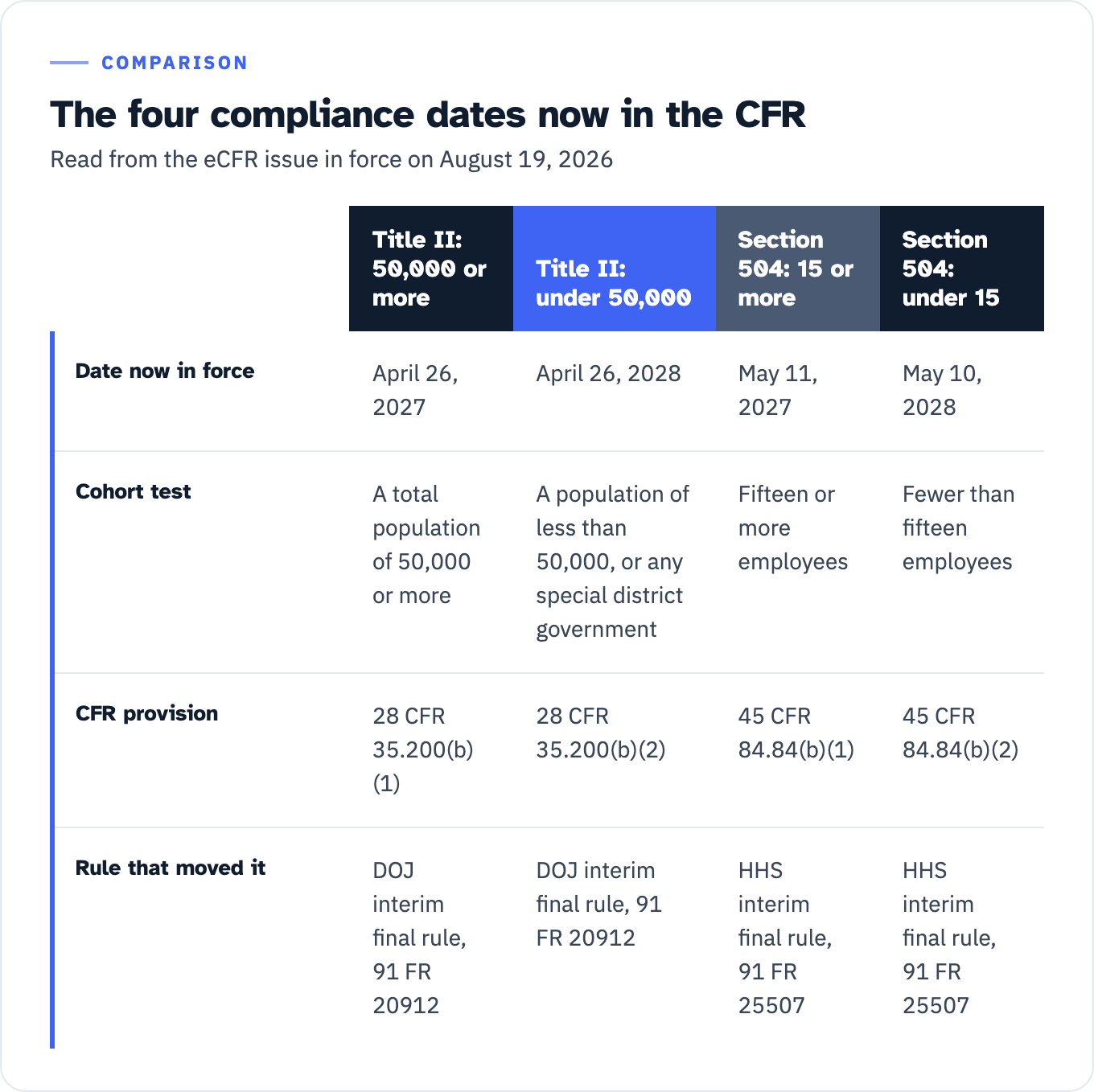
View the data as a table
| Title II: 50,000 or more | Title II: under 50,000 | Section 504: 15 or more | Section 504: under 15 | |
|---|---|---|---|---|
| Date now in force | April 26, 2027 | April 26, 2028 | May 11, 2027 | May 10, 2028 |
| Cohort test | A total population of 50,000 or more | A population of less than 50,000, or any special district government | Fifteen or more employees | Fewer than fifteen employees |
| CFR provision | 28 CFR 35.200(b)(1) | 28 CFR 35.200(b)(2) | 45 CFR 84.84(b)(1) | 45 CFR 84.84(b)(2) |
| Rule that moved it | DOJ interim final rule, 91 FR 20912 | DOJ interim final rule, 91 FR 20912 | HHS interim final rule, 91 FR 25507 | HHS interim final rule, 91 FR 25507 |
Two clocks, and two unrelated cohort tests
The two rules do not merely run on different calendars. They sort covered organizations by different things, so an organization on both tracks cannot answer “which cohort am I in” once.
DOJ sorts by population. “Total population” is defined at 28 CFR 35.104 as “the population estimate for that public entity as calculated by the United States Census Bureau in the most recent decennial Census,” with separate routes for independent school districts, for instrumentalities and commuter authorities, and for the National Railroad Passenger Corporation. The most recent decennial Census is the 2020 Census, and that is the count the definition names, not a later annual estimate.
A special district government is carved out of that test. The same section defines one as a public entity “authorized by State law to provide one function or a limited number of designated functions with sufficient administrative and fiscal autonomy to qualify as a separate government and whose population is not calculated by the United States Census Bureau in the most recent decennial Census or Small Area Income and Poverty Estimates,” and expressly excludes “a county, municipality, township, or independent school district.” DOJ’s 2024 preamble names what it had in mind: “a mosquito abatement district, utility district, transit authority, water and sewer board, zoning district, or other similar governmental entity that may operate with administrative and fiscal independence,” and says the definition is “drawn in part from the U.S. Census Bureau definition” (89 FR 31342), which is where to start if you are unsure which side of the line you sit on. A special district government goes to April 26, 2028 whatever its size, because there is no figure to test it against.
HHS sorts by headcount. The line at 45 CFR 84.84(b) is fifteen employees, and 45 CFR 84.82 states the scope in one sentence: “This subpart applies to all programs or activities that receive Federal financial assistance from the Department.”
Work an example through both. A county of 60,000 people runs its health department as a department of the county and takes HHS money. The county has a decennial Census figure of 50,000 or more, so 35.200(b)(1) applies and the ADA date is April 26, 2027; it has fifteen or more employees, so 84.84(b)(1) applies and the Section 504 date is May 11, 2027. Now deliver the same clinic services through a hospital district instead, with its own taxing and budget authority and no Census population of its own. The Section 504 date does not move. The ADA date moves out a full year, to April 26, 2028, because 35.200(b)(2) sends every special district government there. DOJ chose that result knowingly: “although special district governments may sometimes serve a large population,” they are “authorized to provide a single function or a limited number of functions” and “may have more limited or specialized budgets” (89 FR 31356).
HHS was alert to the mismatch in 2024. Its own preamble, quoted back in the 2026 rule at 91 FR 25503, says it coordinated with DOJ to “eliminate or minimize instances where recipients that are also public entities under title II will be held to different standards.” After both extensions there are still four dates and two cohort tests.
What the extra year does not reach
The extension moved a date. It did not widen the exceptions, and some of the content people expect the extra year to cover was already outside the rule.
28 CFR 35.201 lists five exceptions to 35.200: archived web content, preexisting conventional electronic documents, third-party content, individualized password-protected or otherwise secured conventional electronic documents, and preexisting social media posts. 45 CFR 84.85 carries the same five, with “recipient” for “public entity” and the definitions taken from § 84.10. Three limits set what those exceptions are worth.
First, the preexisting-documents exception is narrower than its opening words. 35.201(b) reads in full: “Conventional electronic documents that are available as part of a public entity’s web content or mobile apps before the date the public entity is required to comply with this subpart, unless such documents are currently used to apply for, gain access to, or participate in the public entity’s services, programs, or activities.” 45 CFR 84.85(b) carries the same carve-out, keyed to “the recipient’s programs or activities.” A form, an application or an enrollment PDF that is still in use sits outside the exception no matter when it was posted.
Second, “conventional electronic documents” is a closed list: 28 CFR 35.104 defines it as content in “portable document formats (“PDF”), word processor file formats, presentation file formats, and spreadsheet file formats.” Exceptions (b) and (d) reach only those four families. An HTML page, a video, an app screen and a web form are not conventional electronic documents, so no amount of age puts them inside 35.201(b).
Third, three of the five exceptions are anchored to the compliance date rather than to a fixed calendar date, and that is where the extension does reach them. 35.201(b) keys to “the date the public entity is required to comply with this subpart,” and 35.201(e) covers social media posts “posted before” that same date. Archived web content is defined at 35.104 as content “created before the date the public entity is required to comply with subpart H of this part,” retained “exclusively for reference, research, or recordkeeping,” not “altered or updated after the date of archiving,” and “organized and stored in a dedicated area or areas clearly identified as being archived.” When the required compliance date moved to April 26, 2027, the cut-off in all three provisions moved with it.
That reading follows from the text. Neither interim final rule discusses the § 35.201 or § 84.85 exceptions, and no source found for this article quantifies how much of any organization’s content sits inside them, so anyone offering you a percentage is not reading it off a rule. The one sentence in the DOJ rule that speaks to the day-to-day effect on documents points the other way: “the one-year extension will mean that an individual with a disability may need to request accessible versions of certain electronic documents from a public entity and wait for those requests to be fulfilled” (91 FR 20908).
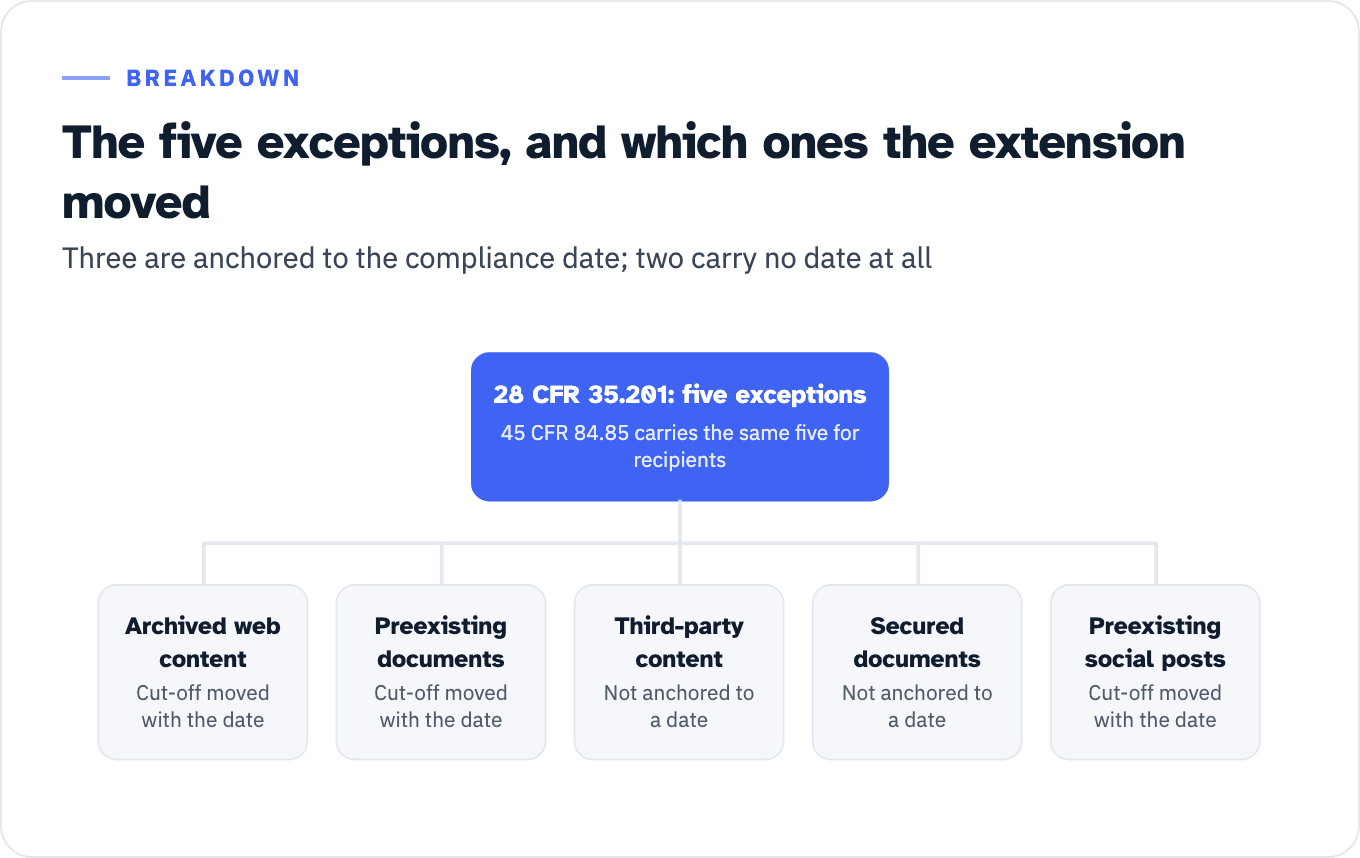
View the data as a list
28 CFR 35.201: five exceptions: 45 CFR 84.85 carries the same five for recipients
- Archived web content: Cut-off moved with the date
- Preexisting documents: Cut-off moved with the date
- Third-party content: Not anchored to a date
- Secured documents: Not anchored to a date
- Preexisting social posts: Cut-off moved with the date
How these rules were made, and what is now being litigated
Both are interim final rules with a request for comments, which means each took effect without prior notice and comment. DOJ states the authority at 91 FR 20908: “The Department issues this IFR without prior public notice and comment pursuant to 5 U.S.C. 553(b)(B), and without a delayed effective date pursuant to 5 U.S.C. 553(d)(1).” It opened the 60-day comment period afterward “as a voluntary matter” (91 FR 20909).
HHS claimed more. It issued its rule “pursuant to two separate and independent exceptions in the Administrative Procedure Act” (91 FR 25501). The first is 5 U.S.C. 553(a)(2), which exempts rules “relating to agency management or personnel or to public property, loans, grants, benefits, or contracts”; HHS reasoned that “the categories of exempt activities in section 553(a)(2) encompass everything contained in the Department’s definition” of Federal financial assistance at 45 CFR 84.10, so the exemption covers the whole rulemaking. The second is good cause under 553(b)(B). DOJ’s parallel action appears inside that second argument, as “an added basis to find that notice and comment is impracticable, unnecessary, and/or contrary to the public interest” (91 FR 25502).
DOJ’s stated reasons sit in a section headed “Need for This Interim Rule.” After recounting correspondence from higher education associations, school district associations and the Small Business Administration’s Office of Advocacy, it concludes that it “overestimated the capabilities (whether staffing or technology) of covered entities to comply with the rule in the time frames provided” (91 FR 20906). It then states that “The risk of litigation is more significant for reasons not specifically addressed in the 2024 final rule,” and names three. First, fair notice: the incorporated 2018 text “links to dynamically changeable websites,” and “These dynamic compliance assessment standards do not provide notice of what the regulation requires of public entities because the standards may change at any time without notice.” Second, “international actors may attempt to access websites and file litigation to enforce the 2024 final rule,” litigation that “may be funded by international actors to intentionally disrupt government operations in the United States.” Third, covered entities “have been generating substantial amounts of content that would be covered by the 2024 final rule using generative AI that is potentially inaccessible” (91 FR 20906 to 20907).
| DOJ, RIN 1190-AA82 | HHS, RIN 0945-AA30 | |
|---|---|---|
| Federal Register document | 2026-07663, 91 FR 20902 | 2026-09266, 91 FR 25496 |
| Filed | April 17, 2026, 8:45 am | May 7, 2026, 4:15 pm |
| Effective | April 20, 2026 | May 7, 2026 |
| Published | April 20, 2026 | May 11, 2026 |
| Comments due | June 22, 2026 | July 6, 2026 |
| Deadline it moved | April 24, 2026 | May 11, 2026 |
| Rule type | Interim final rule; request for comments | Interim final rule; request for comments |
Both rules are challenged in one case. National Federation of the Blind v. Department of Justice, No. 1:26-cv-02007-RDB, was filed in the District of Maryland on May 21, 2026 against DOJ, HHS and their agency heads. Count I alleges failure to observe required procedure under 5 U.S.C. 706(2)(D), because the agencies “failed to provide notice and an opportunity for public comment on the IFRs in any manner prior to their issuance.” It pleads that the good cause exception “is inapplicable to the IFRs,” and that the 553(a)(2) exception “is inapplicable to the HHS IFR because HHS has, as a matter of policy, waived applicability of that exception,” pointing to a 1971 statement of policy at 36 FR 2532.
Counts II and III attack the rules as arbitrary and capricious under 706(2)(A), and they aim at the three reasons quoted above. Against DOJ the complaint alleges the Department “failed to meaningfully consider the harmful impacts on people with disabilities of extending the compliance dates,” that “the same information was available to DOJ at the time of the DOJ Final Rule,” that “DOJ’s claim that the extension will promote accessibility lacks any evidentiary basis, as does its concern about supposed foreign actors who might sue non-complying governments under the DOJ Final Rule,” and that the rule’s “characterization of the DOJ Final Rule’s incorporation of the WCAG 2.1 standard is also inaccurate.” Count III makes the parallel attack on HHS. The prayer for relief asks the court to “Hold unlawful, vacate, and/or set aside the IFRs under 5 U.S.C. § 706.”
Read all of that as pending allegation, because that is all it is. On the public docket as checked on August 21, 2026, there was no ruling on the merits, no preliminary injunction motion and no summary judgment decision. The case is being briefed rather than sitting still: on June 29, 2026 the court granted the parties’ joint motion for a briefing schedule (ECF 11, signed by Judge Richard D. Bennett), though the schedule itself is behind PACER and was not read for this article. The last entry, July 13, 2026, is an order granting the defendants’ own motion to strike a stipulation on a protective order they had filed three days earlier. CourtListener prints its own caveat that items on the page come from PACER and RECAP and may not be current.
Two things follow. The dates in the CFR today are the operative dates, because both rules are in force. And a plan that treats the 2027 dates as settled has an open case underneath it, one in which the relief sought is vacatur of the rules that created those dates. The dates those rules replaced, April 24, 2026 and May 11, 2026, have already passed.
What both agencies say comes next
This is the part a search result will not give you. Entry 278 of DOJ’s regulatory agenda of August 14, 2026, at 91 FR 53016, carries RIN 1190-AA82, the extension, and this sentence:
The Department is considering whether to extend the deadlines for implementation of the final rule then publish a Notice of Proposed Rulemaking (NPRM) to reconsider whether some of the regulatory provisions imposed by the April 24, 2024 rule could be made less burdensome.
Its printed timetable has two rows: “Interim Final Rule” against a date of 07/00/26 with no Federal Register citation, and “NPRM” against “To Be Determined.” Read both as printed. DOJ’s own agenda gives July for a rule that published on April 20, 2026, and gives no date at all for the reconsideration.
The HHS agenda entry for RIN 0945-AA30 says the same: HHS “contemplates later publishing a Notice of Proposed Rulemaking (NPRM) to reconsider whether some of the regulatory provisions imposed by the May 9, 2024 rule could be made less burdensome.” Its timetable prints one row, the interim final rule, and no NPRM row at all.
The same posture sits inside both rules. DOJ says it “will consider issuing an NPRM” during the extension period, and then, at 91 FR 20908:
If the Department does not issue such an NPRM and if circumstances suggesting further delays of this deadline do not exist, the Department fully anticipates implementing the regulation at the new deadline.
HHS’s parallel passage at 91 FR 25501 is nearly identical, down to the same two conditions. Notice what that sentence promises: implementation at the new deadline if the agency does not issue an NPRM and if no circumstances suggesting further delay exist. That is a conditional, not a commitment, and both conditions sit inside the agency’s own control.
As of August 21, 2026, a Federal Register search on each RIN returns exactly one document, the interim final rule itself. No response to comments has published, and no NPRM has issued.
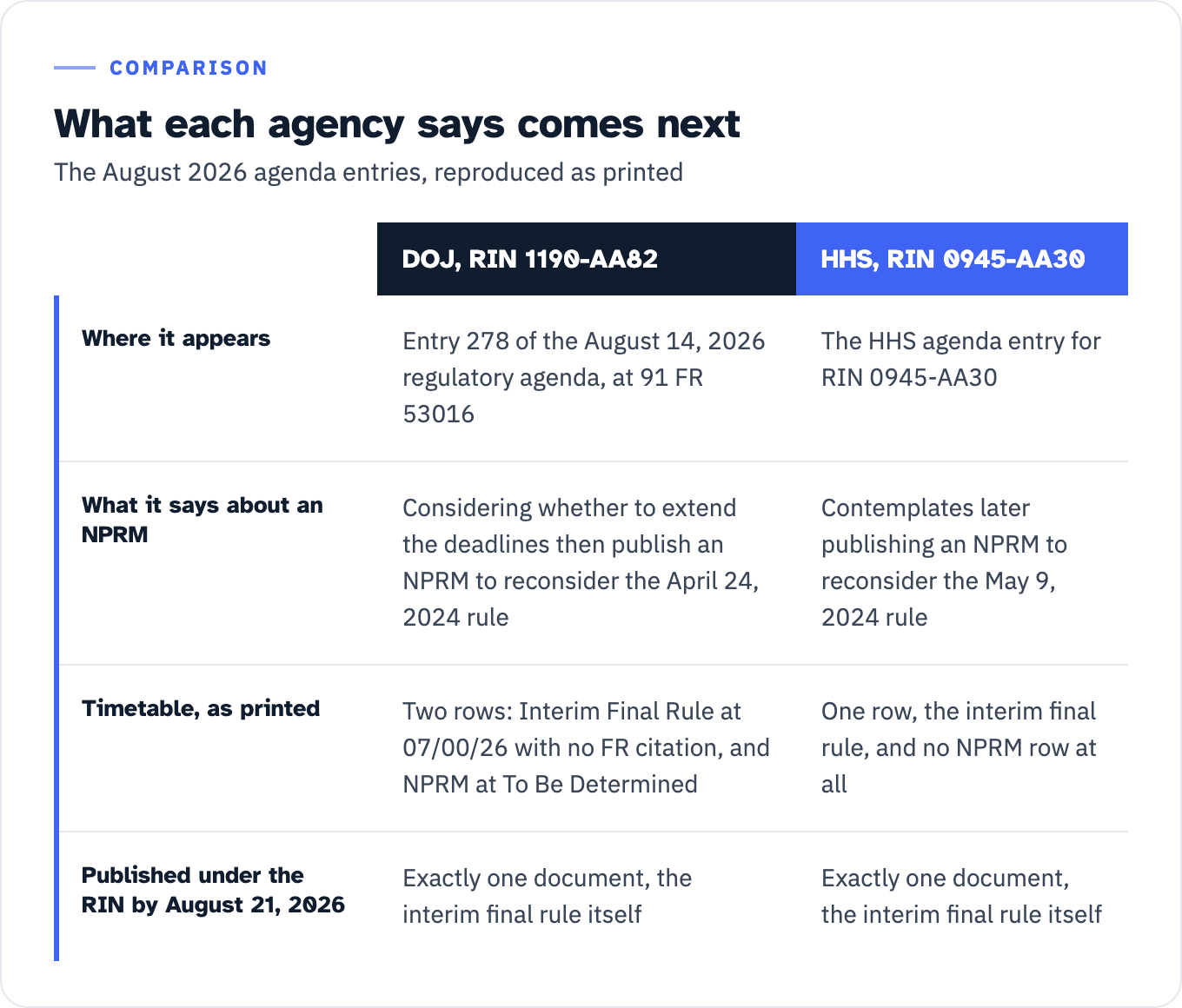
View the data as a table
| DOJ, RIN 1190-AA82 | HHS, RIN 0945-AA30 | |
|---|---|---|
| Where it appears | Entry 278 of the August 14, 2026 regulatory agenda, at 91 FR 53016 | The HHS agenda entry for RIN 0945-AA30 |
| What it says about an NPRM | Considering whether to extend the deadlines then publish an NPRM to reconsider the April 24, 2024 rule | Contemplates later publishing an NPRM to reconsider the May 9, 2024 rule |
| Timetable, as printed | Two rows: Interim Final Rule at 07/00/26 with no FR citation, and NPRM at To Be Determined | One row, the interim final rule, and no NPRM row at all |
| Published under the RIN by August 21, 2026 | Exactly one document, the interim final rule itself | Exactly one document, the interim final rule itself |
An extension moves a deadline, it does not move a plaintiff
The general nondiscrimination duties predate the web subpart by decades and neither interim final rule touched them. 28 CFR 35.130(a): “No qualified individual with a disability shall, on the basis of disability, be excluded from participation in or be denied the benefits of the services, programs, or activities of a public entity, or be subjected to discrimination by any public entity.” 28 CFR 35.160 separately requires communications with people with disabilities to be “as effective as communications with others.” 45 CFR 84.68(a) is the Section 504 analogue.
DOJ says so in the paragraph that closes its case for the extension: “Regardless of the compliance dates, covered entities have an ongoing obligation to ensure that their services, programs, and activities offered using web content and mobile apps are accessible to individuals with disabilities in accordance with their existing obligations under title II of the ADA” (91 FR 20908).
DOJ also explains why it moved the date rather than announcing it would not enforce: “Because of the private right of action, the Department does not have the option to take no enforcement action or offer a statement of policy regarding its intent to not enforce the rule” (91 FR 20909). At 91 FR 20906 it writes that “Congress created a private right of action in title II. Exercising this right, private litigants could recover injunctive relief and attorneys’ fees from public entities for noncompliance with the 2024 final rule,” citing Barnes v. Gorman, 536 U.S. 181, 185 (2002) and 42 U.S.C. 12205.
An extension of the technical compliance date is therefore an extension of one specific exposure: the claim that your site does not conform to WCAG 2.1 Level A and AA on the date the rule names. It is not a pause on the effective-communication claim, and not a pause on any state law. No published decision applying 28 CFR 35.200 or 45 CFR 84.84 turned up in the research for this article, which is unsurprising, since neither compliance date has arrived. If someone shows you case law under these sections, check the citation; it is more likely to be a general Title II or effective-communication case.
What to do with the year
Three things follow from the text rather than from anyone’s advice.
Fix the date that applies to you in writing, with the cohort test you used and the figure you tested against: a 2020 decennial Census population figure for a Title II entity, the definition rather than a figure for a special district government, a headcount against fifteen for an HHS recipient. If you are both, record both dates.
Treat the shifted exception window as a documentation task, not a reprieve. The archived-content definition at 35.104 has four prongs. The content was created before the compliance date, or reproduces paper or other physical media created before it; it “is retained exclusively for reference, research, or recordkeeping”; it “is not altered or updated after the date of archiving”; and it “is organized and stored in a dedicated area or areas clearly identified as being archived.” Content that merely sits untouched in a folder meets at most two of the four, and the fourth prong is a statement about how your CMS is organized, which you can fix before either date.
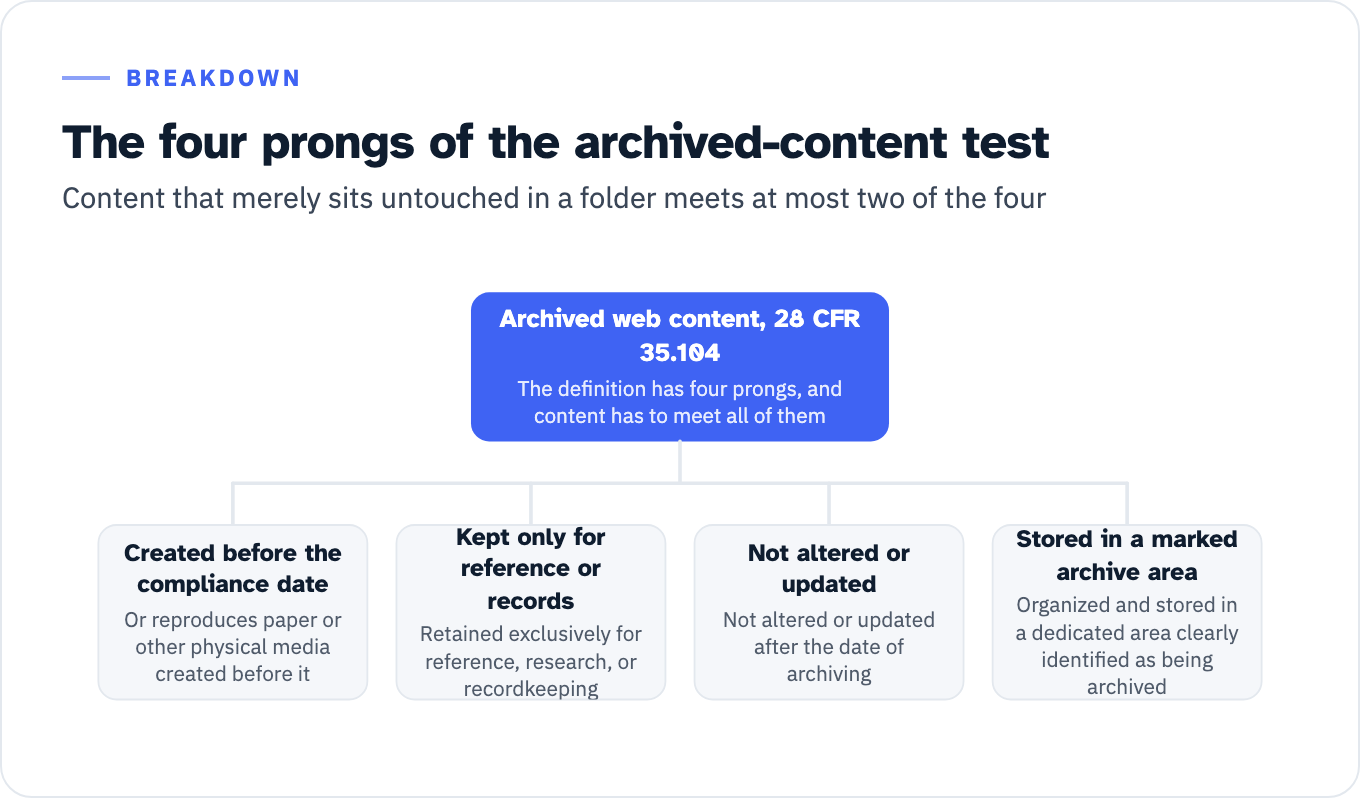
View the data as a list
Archived web content, 28 CFR 35.104: The definition has four prongs, and content has to meet all of them
- Created before the compliance date: Or reproduces paper or other physical media created before it
- Kept only for reference or records: Retained exclusively for reference, research, or recordkeeping
- Not altered or updated: Not altered or updated after the date of archiving
- Stored in a marked archive area: Organized and stored in a dedicated area clearly identified as being archived
Do not read 28 CFR 35.205 as a tolerance band. It deems an entity compliant only where noncompliance has “such a minimal impact on access” that a disabled user can still reach the same information and conduct the same transactions “in a manner that provides substantially equivalent timeliness, privacy, independence, and ease of use.” That is a narrow finding about a specific defect, not a budget for open issues. 28 CFR 35.204 puts the burden of proving fundamental alteration or undue burden on the public entity, requires the decision to “be made by the head of a public entity or their designee,” and requires it to be “accompanied by a written statement of the reasons for reaching that conclusion.” 45 CFR 84.88 is the parallel provision for recipients, reading “the head of a recipient or their designee” and carrying the same written-statement requirement.
HHS has changed its stated expectation about that defense. At 91 FR 25500 it wrote that it “intended the fundamental alteration and undue burden defenses to apply only to rare situations,” but “now believes that significant numbers of small State and local governments, FQHCs, and other recipients may persuasively argue that full conformance would amount to a fundamental alteration or undue burden.” That is a forecast about how the defense will be pleaded, not a change to the defense. The burden, the decision-maker and the written statement in 84.88 read exactly as they did in 2024, and whether that statement is worth signing belongs to your counsel and your executive, neither of whom will thank you for raising it in the last quarter before the date.
A closing note on secondary sources. DOJ’s own fact sheet on the 2024 web rule now says entities must meet WCAG 2.1 Level AA “within three or four years of when the rule was published on April 24, 2024,” and opens by naming April 26, 2027 and April 26, 2028. The 2 June 2025 capture of the same page reads “within two or three years.” DOJ updated the body and left the date stamp reading April 08, 2024, so the stamp tells you nothing about whether a page is current. Check the dates in the text against the CFR instead.
If you need the evidence that shows how far your site sits from WCAG 2.1 Level A and AA before either 2027 date, that is what an ADA website compliance engagement produces. Title II entities will find the scoping questions handled on the government accessibility page, and Section 504 recipients on the healthcare accessibility page.