

Twenty exhibits, four months, and the lawyer who could not read them
In July 2014 the Justice Department signed a settlement with the Orange County Clerk of Courts in Florida. The complainant was a blind lawyer representing the plaintiff in a case before the Ninth Judicial Circuit. He alleged that he “was denied full and equal access to electronic court documents” because the Clerk “failed to provide him with documents in an accessible format despite repeated requests.” DOJ’s own findings, made after investigation, are narrower and more concrete: at least one of the defendant’s motions “included over twenty exhibits, the majority of which were filed in an inaccessible PDF format,” and those exhibits “were not provided to the Complainant in an alternative accessible format readable by his screen reader technology for over four months” (settlement agreement, DOJ Complaint #204-17M-440).
The last line is the one addressed to your firm: “Ultimately, after many months of delay, opposing counsel gave the Complainant accessible copies of the exhibits.”
Read the rest of that findings section, because it holds the fact that makes the case worth a filer’s time. A filer-side format rule already existed. DOJ found that “the Clerk of Courts adopted ECF implementation procedures that required electronic filings be submitted in portable document format (‘PDF’) and be fully searchable and optical-character-recognition (‘OCR’) compliant,” and that the Clerk “controlled the format in which documents were filed and could reject documents filed through the ECF System.” A rule assigned the format, the clerk could enforce it, and the exhibits went through anyway.
That agreement is not precedent. The Clerk “disputes that it has unlawfully discriminated against any person or violated title II of the ADA,” it required a payment of “$10,000 to the Complainant,” it ran three years from July 2014, and it has expired.
Now there is a federal rule on paper. Subpart H of 28 CFR part 35 sets a technical standard and a compliance date for state and local government web content, courts included. It puts no conformance duty on your filings. It puts one on the court. Where the request lands after that is not settled by any published source, and the 2014 Orange County record is the only picture this research turned up of how it went in a real case.
Whether to stipulate to accessible service, raise the point at a case management conference, or move for relief is a litigation judgment for your own lawyers. What follows is the rule text, two states’ filing rules, and what a firm can build on its own side of that line.
What the rule reaches, and on which date
28 CFR 35.200(a) requires that “A public entity shall ensure that the following are readily accessible to and usable by individuals with disabilities: (1) Web content that a public entity provides or makes available, directly or through contractual, licensing, or other arrangements.” State courts sit inside that: 42 U.S.C. 12131(1) reaches “any State or local government” and any instrumentality of one.
The definitions carry the weight for a filing. 28 CFR 35.104 provides that “Conventional electronic documents means web content or content in mobile apps that is in the following electronic file formats: portable document formats (“PDF”), word processor file formats, presentation file formats, and spreadsheet file formats.” A PDF on a court’s site is web content under this rule, not an attachment to it. The standard is WCAG 2.1 Level A and AA, which 35.104 pins by its status line, “W3C Recommendation 05 June 2018.”
Section 35.200(b)(1) starts the obligation on April 26, 2027 for a public entity with “a total population of 50,000 or more,” and 35.200(b)(2) starts it on April 26, 2028 below that threshold. Which date a court lands on is not the court’s choice: the “Total population” definition assigns an entity with no Census population of its own “the combined decennial Census population estimates for any State or local governments of which the public entity is an instrumentality or commuter authority.” A state court system takes its state’s population and lands on 2027; a clerk of court that is an instrumentality of a county under 50,000 lands on 2028. No verified source enumerates this court by court, so for a given clerk’s office it is a question to ask the office.
Both dates come from an interim final rule published April 20, 2026, which “solely extends the 2024 final rule’s compliance dates” (91 FR 20911). Comments closed June 22, 2026, and DOJ has published no response and no final rule. For the four dates across Title II and Section 504, see the compliance date breakdown.
Your filing is excepted. The portal is not.
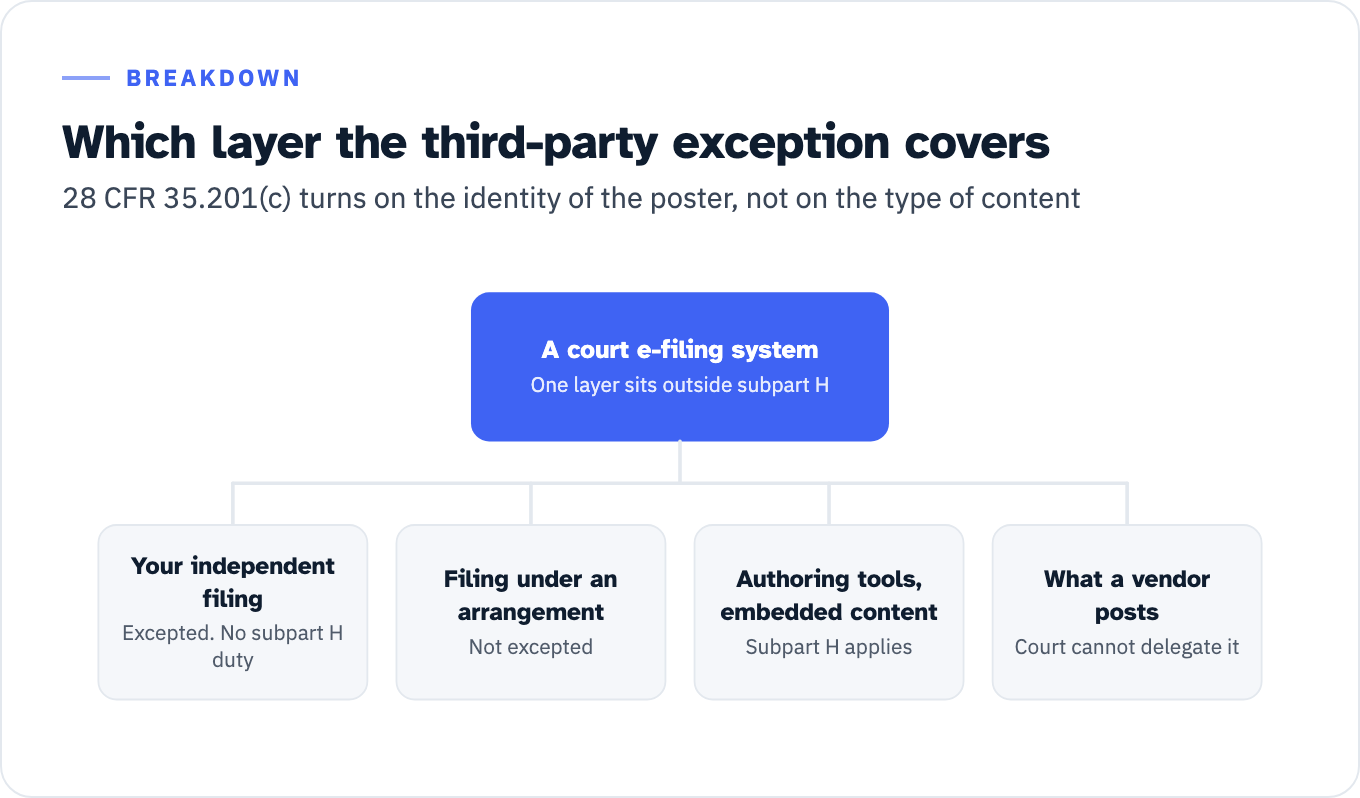
28 CFR 35.201(c) excepts “Content posted by a third party, unless the third party is posting due to contractual, licensing, or other arrangements with the public entity.”
The preamble to the 2024 rule leaves nothing to inference: “This exception applies to, among other third-party content, documents filed by independent third parties in administrative, judicial, and other legal proceedings that are available on a public entity’s web content or mobile apps” (89 FR 31367). The worked example on the next page is your firm, covering the case “where a public entity allows for legal filings through an online portal and a third-party attorney independently submits a legal filing on behalf of their private client.” DOJ describes that filer as “someone who does not have obligations under subpart H of this part” (89 FR 31368).
So no federal conformance duty attaches to the document you upload. The exception stops at the document and does not reach the machinery around it: “authoring tools, embedded content, and other similar functions provided by the public entity that facilitate third-party postings are not covered by this exception and must be made accessible in accordance with subpart H of this part” (89 FR 31368). Buying the portal from a vendor moves nothing, because “a public entity may not delegate away its obligations under the ADA” (89 FR 31367).
There is a second edge, and it is easy to fall off. DOJ notes that 35.201(c) “is the only exception in Sec. 35.201 that applies solely based upon the identity of the poster (whereas the other exceptions identify the type of content at issue)” (89 FR 31368). The test is who posted, not what the document is. A filing made under a contractual or licensing arrangement with the court sits outside the exception by its own terms, as does anything a vendor posts on the court’s behalf.
The line itself is older than the rule. The 2014 Orange County agreement drew it in paragraph 17: “The requirements of this paragraph do not apply to submissions by a third party in connection with an administrative, judicial, or legal proceeding that are available on either the Clerk of Courts’ or the State’s ECF System; these submissions are governed by the requirements of paragraph 16 above.” Paragraph 16 is the on-request accessible-copy obligation. Third-party filings were carved out of the format duty and routed to the request duty then, and that is where the 2024 rule puts them now.
View the data as a list
A court e-filing system: One layer sits outside subpart H
- Your independent filing: Excepted. No subpart H duty
- Filing under an arrangement: Not excepted
- Authoring tools, embedded content: Subpart H applies
- What a vendor posts: Court cannot delegate it
What DOJ says happens when a party asks for the filing
Here the loop closes, on the same preamble page as the exception:
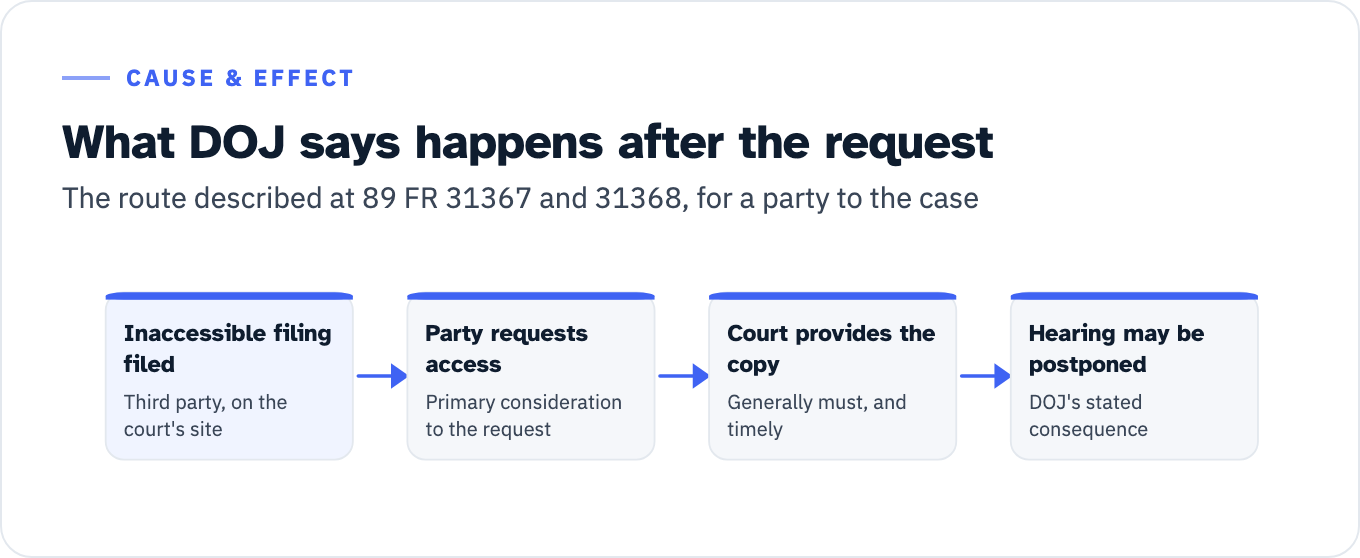
“if a person with a disability is a party to a case and requests access to inaccessible filings submitted by a third party in a judicial proceeding that are available on a State court’s website, the court generally must timely provide those filings in an accessible format.” (89 FR 31367)
DOJ supplies the consequence in its own example: the court “might need to postpone the hearing if the person with a disability was not provided filings in an accessible format before the scheduled hearing.” Notice what gives way. The exception protects the filing’s route into the record, and DOJ explains why: bouncing a filing back to a third party “could be a delay of an emergency or time-sensitive filing or even impeding access to the forum” (89 FR 31368). The calendar absorbs the cost, not the document.
The footnote DOJ hangs that duty on cites 35.130(b)(1)(ii), 35.130(b)(7) and 35.160, none of which mentions a filing. They are ordinary Title II, and the operative sentence for a requester is 35.160(b)(2): “In determining what types of auxiliary aids and services are necessary, a public entity shall give primary consideration to the requests of individuals with disabilities.” Auxiliary aids “must be provided in accessible formats, in a timely manner, and in such a way as to protect the privacy and independence of the individual with a disability.”
No period is attached to “timely” anywhere in the rule. The only number in any verified source is the expired Orange County agreement’s line that documents requested in an accessible format “should usually be provided within five business days,” which that agreement frames as a case-by-case judgment. That agreement is also the only verified source that says what the deliverable is. It defined an accessible electronic document as one complying with “the Web Content Accessibility Guidelines 2.0 level AA,” then added: “However, if an individual with a disability requests a different format, the Clerk of Courts shall give primary consideration to the requested format(s) of the individual with a disability.” The WCAG version is a decade out of date. The structure is not, and it tracks 35.160(b)(2): the requester’s stated format leads.
DOJ’s plain-language guidance puts the same scenario more weakly. The fact sheet on the web rule says that where “a third-party private law firm in the case submits documents to the state court’s website, the court could provide effective communication … by providing the documents to the person in a format that is accessible to them quickly upon request.” The preamble says “generally must”; the fact sheet says “could,” and carries a notice that guidance documents on the site “have no legally binding effect, and have no force or effect of law.” No source reconciles them.
The sector guidance points a third way. The National Center for State Courts tells courts that “Courts are typically not responsible for remediating documents filed by litigants” (NCSC FAQ), and Florida’s technology standard says custodians “are not responsible for adding ADA-compliance features to documents that they did not originate.” That can be squared with DOJ, since supplying one requester with an accessible copy is not the same as remediating the record copy for everyone, but no source states the reconciliation. Treat it as an open seam.
View the data as a list
- Inaccessible filing filed: Third party, on the court’s site
- Party requests access: Primary consideration to the request
- Court provides the copy: Generally must, and timely
- Hearing may be postponed: DOJ’s stated consequence
Two states, two different answers for the filer
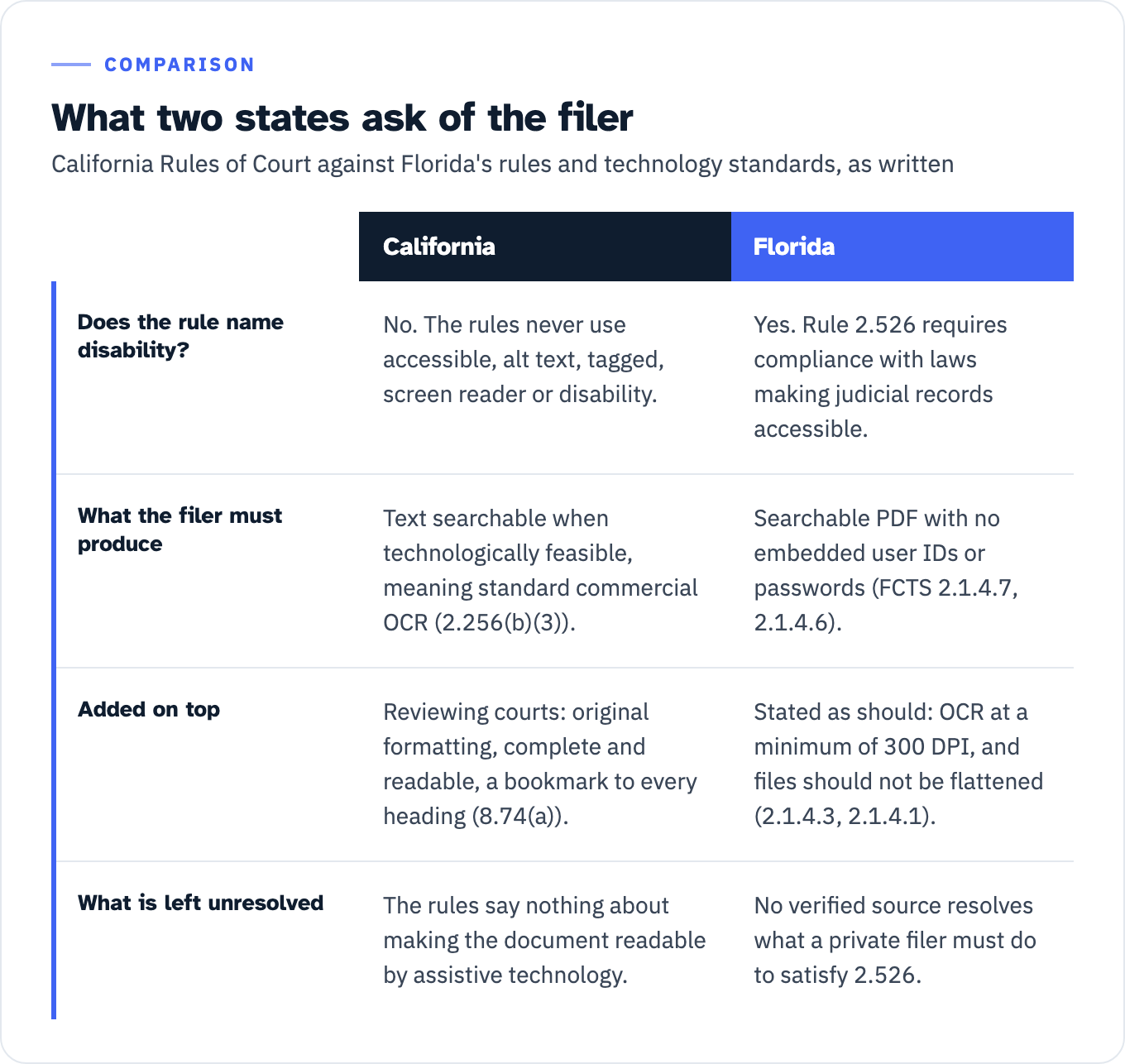
California imposes production requirements and never mentions disability. Rule 2.256(b) of the California Rules of Court lists the requirements a court’s adopted e-filing format must meet, and (b)(3) is that “The document must be text searchable when technologically feasible without impairment of the document’s image.” The Advisory Committee Comment sets the floor: “The term ‘technologically feasible’ does not require more than the application of standard, commercially available optical character recognition (OCR) software.”
In the reviewing courts, rule 8.74(a) speaks to the filer directly. Electronic documents “must be in text-searchable portable document format (PDF) while maintaining the original document formatting.” “The electronic filer is responsible for ensuring that any document filed is complete and readable.” And “Each electronic document must include an electronic bookmark to each heading, subheading, and the first page of any component of the document.” Neither rule’s text uses the words “accessible,” “alt text,” “tagged,” “screen reader” or “disability.” California tells a filer to make the document searchable, bookmarked, complete and readable, and says nothing about making it readable by assistive technology.
Florida names accessibility in the rule. What that requires of a filer is not spelled out. Florida Rule of General Practice and Judicial Administration 2.526 provides that any document that is or will become a judicial branch record and is transmitted in electronic form “must be formatted in a manner that complies with all state and federal laws requiring that electronic judicial records be accessible to persons with disabilities, including without limitation the Americans with Disabilities Act and Section 508 of the federal Rehabilitation Act of 1973 as incorporated into Florida law by section 282.603(1), Florida Statutes (2010)” (rules volume, page 183).
Follow that cross-reference and it runs out. Fla. Stat. 282.603(1) (current text; the rule pins the 2010 version) provides that “Each state agency shall develop, procure, maintain, and use accessible electronic information and information technology … that conforms to the applicable provisions set forth by s. 508 of the Rehabilitation Act of 1973,” subject to an undue-burden escape. Its duty runs to state agencies, and Fla. Stat. 282.0041(34) defines “State agency” as “any official, officer, commission, board, authority, council, committee, or department of the executive branch of state government; the Justice Administrative Commission; and the Public Service Commission.” A court is not on that list, and a private law firm is not either. Rule 2.526 reaches the filer’s document by its own terms, while the statute it names supplies no substantive content for the person the rule is addressed to. No verified source resolves what a private filer must do to satisfy 2.526.
The portal standards are more concrete about format. Rule 2.525(b)(1) requires attorneys to “file through the portal or other designated electronic court filing facility according to its instructions,” and the Florida Courts Technology Standards supply those instructions. Three items are stated as “must”: filed PDFs “must be searchable” (2.1.4.7), documents “must comply with the accessibility requirements of Fla. R. Gen. Prac. & Jud. Admin. 2.526” (2.1.4.8), and a compliant file “must be open and available to anyone or any software that processes the file. User IDs and passwords may not be embedded” (2.1.4.6). Two are stated as “should”: scanned documents “should be scanned using Optical Character Recognition” at “a minimum resolution of 300 DPI” (2.1.4.3), and files “should not be flattened” (2.1.4.1).
The standard attaches a general correction mechanism to that group. Deviation “may result in the submitted filing being moved to the Correction Queue by the Clerk with the filer being notified via e-mail and requested to correct the issue(s) with the document(s) and resubmit the filing.” No verified source records a Florida filing moved to that queue for an accessibility defect specifically, and the standard’s own stated handling of the closest mechanical case is not rejection: non-searchable PDFs “will be rasterized (i.e., converted into bitmap file format) as an approved PDF/A format” (2.1.4.7).
Two jurisdictions were verified here. The other forty-eight were not surveyed, and no source turned up in the research for this article that surveys all fifty. If you file elsewhere, start with that state’s e-filing rule and its portal technical standard, and search both for “accessib” and “disab.”
View the data as a table
| California | Florida | |
|---|---|---|
| Does the rule name disability? | No. The rules never use accessible, alt text, tagged, screen reader or disability. | Yes. Rule 2.526 requires compliance with laws making judicial records accessible. |
| What the filer must produce | Text searchable when technologically feasible, meaning standard commercial OCR (2.256(b)(3)). | Searchable PDF with no embedded user IDs or passwords (FCTS 2.1.4.7, 2.1.4.6). |
| Added on top | Reviewing courts: original formatting, complete and readable, a bookmark to every heading (8.74(a)). | Stated as should: OCR at a minimum of 300 DPI, and files should not be flattened (2.1.4.3, 2.1.4.1). |
| What is left unresolved | The rules say nothing about making the document readable by assistive technology. | No verified source resolves what a private filer must do to satisfy 2.526. |
What Title III adds for a law firm, and what it does not
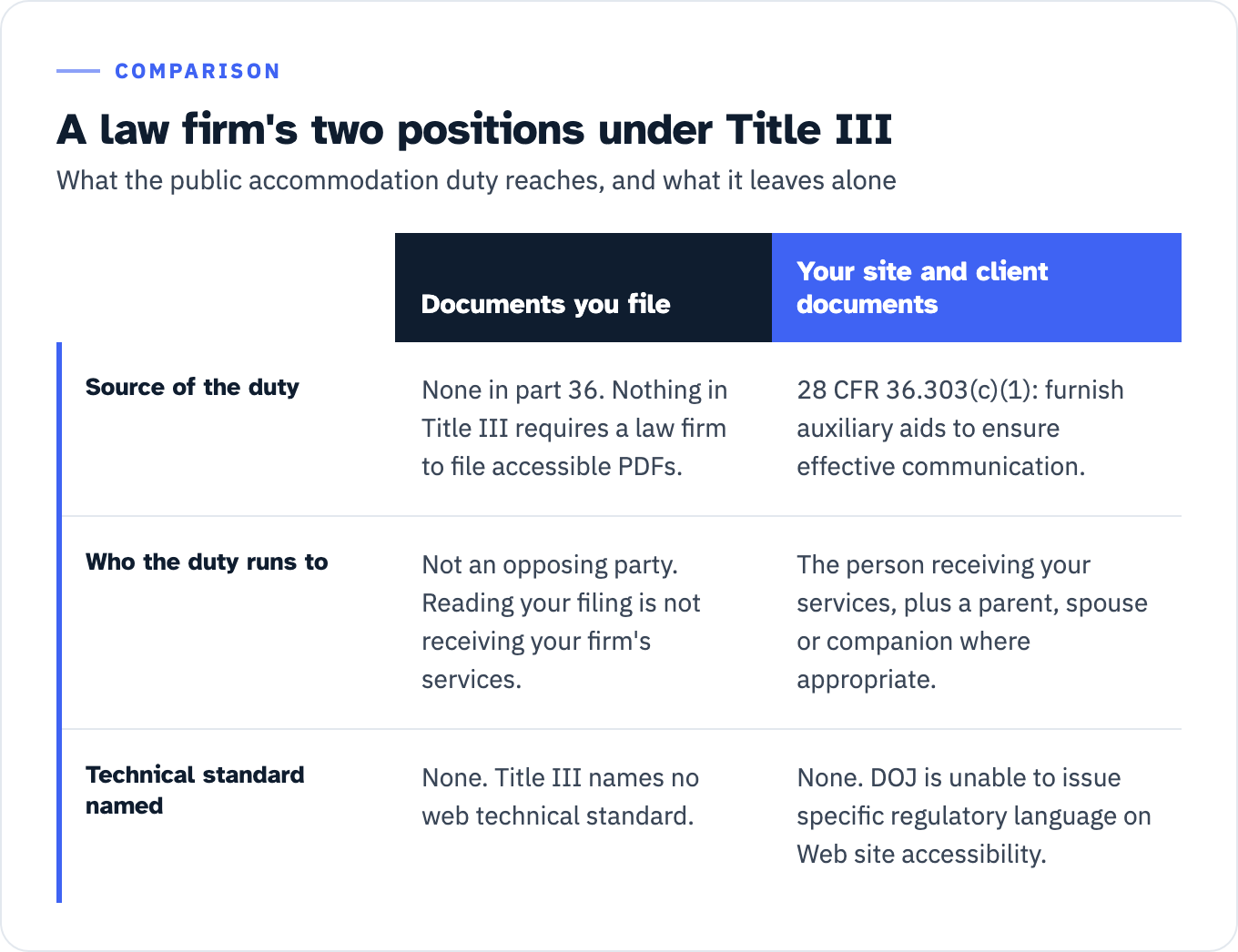
The office of a lawyer is an enumerated public accommodation. 42 U.S.C. 12181(7)(F) lists an “office of an accountant or lawyer” among service establishments, and 28 CFR 36.104 repeats the phrase word for word. 28 CFR 36.303(c)(1) requires that “A public accommodation shall furnish appropriate auxiliary aids and services where necessary to ensure effective communication with individuals with disabilities,” and 36.303(b)(2) lists “screen reader software” among the auxiliary aids for people who are blind or have low vision.
That duty has a defined audience, and it is not the docket. DOJ’s guidance on effective communication states that the rules “apply to communicating with the person who is receiving the covered entity’s goods or services as well as with that person’s parent, spouse, or companion in appropriate circumstances.” An opposing party reading a filing is not receiving your firm’s services. Nothing in Title III requires a law firm to file accessible PDFs. It reaches your own site, your client-facing documents, and your communications with clients and their companions.
Title III also names no web technical standard. The only WCAG reference in part 36 sits in Appendix A, the 2010 guidance, which records that the Department “is unable to issue specific regulatory language on Web site accessibility at this time.” DOJ withdrew its Title III web ANPRM (RIN 1190-AA61) in 2017, and the 2026 interim rule confirms that part 36 is “not addressed in this rulemaking” (91 FR 20904 n.13). A firm asking which version of WCAG binds its own website has no regulatory answer, only the version each rule actually names.
View the data as a table
| Documents you file | Your site and client documents | |
|---|---|---|
| Source of the duty | None in part 36. Nothing in Title III requires a law firm to file accessible PDFs. | 28 CFR 36.303(c)(1): furnish auxiliary aids to ensure effective communication. |
| Who the duty runs to | Not an opposing party. Reading your filing is not receiving your firm’s services. | The person receiving your services, plus a parent, spouse or companion where appropriate. |
| Technical standard named | None. Title III names no web technical standard. | None. DOJ is unable to issue specific regulatory language on Web site accessibility. |
Neither Title II nor Section 508 names the federal judiciary
Title II reaches “any State or local government” and its instrumentalities. Section 508 binds “each Federal department or agency, including the United States Postal Service.” Neither text names the federal judiciary. What the Judicial Conference applies to CM/ECF was not researched for this article, so treat that as the edge of the map rather than an answer.
What nobody can tell you yet
A search of published opinions on CourtListener returns no decision citing 28 CFR 35.200 or 28 CFR 35.201 at all. That is not because the rule is dormant. The 2024 rule’s “effective date was June 24, 2024” (91 FR 20903), and DOJ states that “Regardless of the compliance dates, covered entities have an ongoing obligation to ensure that their services, programs, and activities offered using web content and mobile apps are accessible to individuals with disabilities” (91 FR 20908). A court could construe 35.201(c) at any time. Nothing has surfaced yet in any source verified for this article, and the nearest enforcement action remains the expired 2014 agreement, which applied WCAG 2.0 Level AA rather than 2.1.
One adjacent question is settled, and it is not this one. What has been litigated about state courts and the ADA is Eleventh Amendment sovereign immunity, not filings: in Tennessee v. Lane, 541 U.S. 509, 533-34 (2004), the Court held “that Title II, as it applies to the class of cases implicating the fundamental right of access to the courts, constitutes a valid exercise of Congress’ § 5 authority to enforce the guarantees of the Fourteenth Amendment.” That decides whether a state can be sued for damages, not whether Title II applies. DOJ’s regulation applies either way.
What to do before April 2027
- Ask each court you file into which tier it is in, and what it will do with a request. The population that sets the date belongs to the government the court is an instrumentality of, and no published list resolves it. The second half matters more: if a party asks that court for an accessible copy of your filing, does the clerk produce it, or does the clerk call you?
- Fix the output where a verified rule already reaches it, and keep the jurisdictions straight. California, every e-filing: text searchable when technologically feasible, which the Advisory Committee Comment reads as standard commercial OCR (rule 2.256(b)(3)). California reviewing courts, additionally: text-searchable PDF that maintains the original formatting, complete and readable, with a bookmark to every heading, subheading and component (rule 8.74(a)). Florida portal: searchable is a “must” and so is the absence of embedded user IDs and passwords (FCTS 2.1.4.7, 2.1.4.6), while OCR at 300 DPI and not flattening the file are stated as “should” (2.1.4.3, 2.1.4.1). None of these is an accessibility standard. Each is a precondition for a document a screen reader can work with.
- Decide now who produces the accessible copy when a request lands, and check whether you can. Working from the source file rather than the flattened PDF on the docket is the cheaper path when your firm authored the document. It is not available for the fact pattern in the 2014 case, where the problem was exhibits: those arrive as someone else’s scans, with no source file to work from. Sealed, confidential and redacted filings are a separate problem again, and no source verified for this article addresses how a remediation workflow should handle them. Note also that 28 CFR 35.201(d) excepts from the court’s own duty documents that are “About a specific individual, their property, or their account” and “Password-protected or otherwise secured.” The triage order for a document backlog is the same either way.
If your firm is building that production process, document remediation turns an existing PDF into one a screen reader can read, and the legal and professional services page covers how this sits alongside a firm’s other obligations. If you are on the other side of the filing window, running a court or clerk’s office facing April 2027, the government page starts from the portal rather than the filing.