
VPAT ACR services for accessibility procurement
When a buyer asks for your VPAT, the deal is waiting on your answer. We test your product against the right accessibility standard, complete the VPAT in the edition your market requires, and deliver an Accessibility Conformance Report that procurement teams accept, because it is backed by independent, manual testing rather than self-assessment.
Free consultation
Tell us what you are working on, and we will reply to arrange a time that suits you.
Thank you, we have your request
We will reply by email to arrange a time for your free consultation.
Our VPAT services
VPAT testing
Independent evaluation of your product against the applicable success criteria, producing the evidence your ACR is built on, real testing methods, repeatable results, and clear criteria mapping.
Learn moreVendor guidance
Help responding to the recurring accessibility questions in RFPs and vendor assessments, answering consistently, avoiding overclaims, and aligning scope, evidence, and timelines with what buyers expect.
Learn moreWhat VPAT testing and vendor support involve
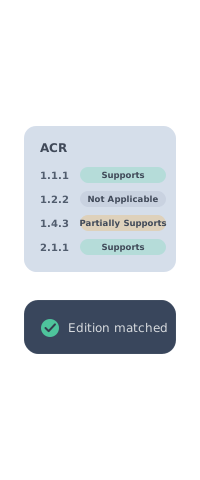
- The testing behind the report — a VPAT is a form; what gives it weight is the evaluation behind it. Testing covers your key user flows such as sign-in, onboarding, forms, search and checkout, plus the templates and shared components that repeat across the product, keyboard-only operation and focus behaviour, screen reader compatibility and reading order, and the visual requirements the standard sets. Each criterion then gets the conformance level the evidence supports, Supports, Partially Supports or Does Not Support, with a remark that explains the result rather than restating the criterion.
- Vendor and RFP support — sometimes the request is not to produce a VPAT but to answer forty accessibility questions by Friday. We help you triage what the buyer is actually asking for, set the scope and boundaries your documentation covers, keep the conformance language consistent across the ACR, the RFP response and the questionnaire, and position known gaps with a remediation plan rather than silence or an overclaim, so sales, legal and engineering give the buyer one answer instead of four.
What a VPAT is, and what it is not
A VPAT (Voluntary Product Accessibility Template) is the standardized reporting template, published by the Information Technology Industry Council, used to document how a product supports accessibility standards such as Section 508, WCAG, and EN 301 549. The completed document is an Accessibility Conformance Report (ACR): the template is the blank form, the ACR is the finished report your buyer reviews.
One thing it is not: a certification. No authority issues an accessibility certificate, and there is no official pass or fail badge. An ACR is a point-in-time account of how your product measures against a standard, and its credibility comes entirely from the testing behind it.
That is why our VPAT services build every ACR on real evaluation, criterion by criterion, with evidence, instead of a checkbox exercise. Buyers read these documents to assess risk, and what they read decides whether your product is approved, shortlisted, or set aside.
Self-reported ACRs are routinely rejected
Procurement reviewers can tell the difference between a self-assessment and findings from an independent evaluation. Without third-party testing, documentation lacks the credibility buyers require, and self-reporting is one of the most common reasons a report is bounced or flagged for a second look.
Strong ACR
Specific, evidence-based, completed by a third-party evaluator. Accurate conformance levels, remarks that explain each answer, and test evidence behind every row.
Weak ACR
Vague, boilerplate, or self-reported, with every row optimistically reading Supports. Invites follow-up questions, delay, or rejection.
Who needs a VPAT or ACR
- Software and SaaS vendors selling into government, higher education, healthcare, or enterprise, where an ACR is a standard condition of purchase.
- Vendors responding to an RFP or vendor review that requests accessibility documentation on a deadline.
- Teams whose existing accessibility documentation was questioned or returned for more detail during review.
- Product and compliance leads who need the report to reflect the product accurately, because an ACR that overstates conformance becomes a liability the moment a buyer verifies it.
Documentation aligned to your market requirements
The standard and edition on your report have to match where and how you sell. Whether your buyers require the Revised Section 508 standards, WCAG, or EN 301 549, the report has to line up with that procurement environment, a mismatched format or a gap in standard coverage slows evaluation and invites extra scrutiny.
Submitting the wrong edition tells a reviewer the requirement was not read closely. We confirm the edition your buyer actually expects before testing begins, and we produce the combined INT report when you sell into more than one market, so one engagement covers all of them.
VPAT 2.5 editions: Section 508, WCAG, EU and INT
- The 508 edition, for U.S. federal procurement under Section 508, measured against WCAG 2.0 Level A and AA.
- The WCAG edition, for buyers who reference WCAG directly, at 2.1 or 2.2 AA.
- The EU edition, for European public-sector procurement, mapped to EN 301 549.
- The INT edition, the international version combining 508, WCAG, and EN 301 549 for products sold across markets.
When VPAT / ACR documentation becomes a sales requirement
If you sell software into government, education, or enterprise, accessibility questions arrive on their schedule, not yours: in an RFP with a two-week deadline, in vendor onboarding, or in a renewal where the buyer compliance bar moved. Procurement teams use ACRs to compare vendors side by side, assessing risk exposure, compliance maturity, and transparency.
Documentation that is outdated, vague, or unsupported by real testing delays approvals and weakens your competitive position. An accurate report in the right edition does the opposite: it answers the question the reviewer was going to ask next, and the deal keeps moving.
Our audit-to-ACR process
A defined path from scope to a report you can hand a buyer, and keep current as your product ships.
Scope
We confirm the product, the platforms, and the VPAT edition your buyer requires, before any testing starts.
Test
Manual and assistive-technology evaluation against the applicable success criteria: the same testing that feeds a real audit, not a self-assessment checklist.
Map conformance
Each criterion is marked accurately as Supports, Partially Supports or Does Not Support, with specific remarks that explain the answer.
Report
We complete the ACR to the evidence, in the correct edition, with nothing inflated and nothing left vague for a reviewer to question.
Support the review
When buyers come back with follow-up questions or vendor-assessment forms, we help you answer them consistently.
Keep it current
After remediation or a release, we retest and refresh the report so it stays true to the product you are actually selling.
What you receive in a VPAT engagement
- A completed ACR in the correct edition (508, WCAG, EU, or INT), with each criterion marked accurately and supported by specific remarks.
- The manual and assistive-technology test results behind every conformance claim, including screen readers and keyboard-only testing.
- A prioritized list of the conformance gaps that most affect your report, so you know what to fix before or right after you submit.
- Remediation guidance your engineers can act on, and a retest to upgrade the ACR once fixes land.
- Support answering buyer follow-ups and vendor-assessment questions after the report is delivered.
- An update path that keeps the ACR aligned with your release cycle.
We are proud of our customers







Common questions about VPAT and ACR
How long does a VPAT take?
Can we complete the VPAT ourselves?
Will a VPAT make us compliant?
Which edition do we need — 508, WCAG, EU or INT?
What if testing finds serious gaps? Do we still send the report?
Do you help fix the gaps, or only document them?
How often does the ACR need to be updated?
Can you help us answer the follow-up questions from buyers?
Who reviews the report before it goes to the buyer?
Can we use our existing test results as the basis for the ACR?
Do you help with the buyer questionnaire as well as the report?
How much does a VPAT cost?
Can you help if my VPAT was rejected?
Do SaaS companies need a VPAT?
Who does this work

Mark Tudor has a thorough understanding of WCAG, accessibility testing methodologies and assistive technologies. You receive a completed ACR in the edition your market expects, with every criterion marked to the evidence from our own testing rather than to a self-assessment.
Get procurement-ready accessibility documentation
Tell us who is requesting the documentation and which standard they expect, and we will scope the testing and the ACR with you on one call.