

A defensible VPAT usually costs $1,850 to $4,450, and that total includes both the accessibility audit and the report itself. Where your project lands in that range depends mostly on scope, the VPAT edition you need, and whether the work is based on real manual testing or a cheap documentation exercise.
If you’re a CTO budgeting for an RFP response, a procurement review, or an enterprise sales cycle, the wrong question isn’t “how much does a VPAT cost?” It’s “how much will it cost us if the VPAT gets challenged, rejected, or exposes problems we should’ve caught earlier?”
A check-the-box VPAT is cheap for a reason. It cuts the work that makes the document credible. A procurement-ready Accessibility Conformance Report (ACR) is different. It comes from testing, evidence, and disciplined documentation. That’s what buyers trust, and that’s what legal and compliance teams can use.
The Real Cost of a VPAT Is the Cost of Inaction
A buyer is ready to move. Security review is done. Legal has few comments. Then procurement asks for your current ACR, and your team sends a stale document, a self-assessment, or nothing at all. That is where deals stall, risk rises, and your budget mistake becomes visible.
Treat VPAT cost as risk mitigation and revenue enablement. A defensible ACR helps you clear procurement faster, answer follow-up questions with evidence, and avoid making claims your team cannot support later. A cheap, check-the-box document does the opposite. It creates exposure at the exact point a buyer is scrutinizing your product.
The frame that matters is the alternative cost. Plaintiffs filed 3,117 website accessibility lawsuits in federal court in 2025, a 27% rise on 2024, out of 8,667 ADA Title III federal filings in total, according to Seyfarth Shaw’s annual tally — and that counts only federal court, not state filings or the demand letters that never reach a docket. Against that backdrop, the question is not whether an ACR has a price. The issue is not whether a VPAT has a price. The issue is whether your company pays now for defensible evidence or pays later through delays, remediation pressure, and preventable legal spend.
Cheap VPATs fail where it counts
Procurement teams do not care that your document was inexpensive. They care whether it is credible.
A weak ACR usually breaks down in three places:
- Buyer review: Remarks are vague, conformance claims are overstated, and product scope is incomplete.
- Internal review: Legal, compliance, and product leaders cannot trace claims back to actual testing evidence.
- Post-sale remediation: Engineering gets a list of issues without enough detail to fix them efficiently.
That failure pattern is expensive.
If the price was low because the testing was shallow, your company did not save money. It shifted cost into sales friction, rushed remediation, and a document that can fall apart under buyer, auditor, or legal review.
A procurement-ready ACR should do two jobs well. It should support sales by giving buyers a document they can evaluate seriously. It should support engineering by turning accessibility findings into a usable remediation plan. If it cannot do both, it is not worth defending.
For a broader business case, read the cost of ignoring WCAG and how non-compliance hits your bottom line.
What I recommend
If accessibility affects enterprise sales, public sector contracts, higher education, or any regulated buying process, fund the defensible version first.
Do not approve a document-only engagement unless your team already has current audit evidence that can stand up to scrutiny. Buy the work that reduces risk, supports revenue, and gives procurement a reason to say yes. That is the spend that holds up in a real buying process.
Understanding VPATs, ACRs, and the Audit Process
A CTO approves a low-cost “VPAT” to satisfy a deal requirement. Procurement reviews it, sees vague scope, generic remarks, and unsupported conformance claims, then asks for a real accessibility audit. The sale slows down, engineering gets pulled into rework, and the company pays twice.
That is the mistake to avoid.
The VPAT is the template. The ACR is the completed report your buyer, legal team, and procurement staff will evaluate. The template is free. The money goes into the audit, the evidence, and the judgment required to produce a document that can survive scrutiny.
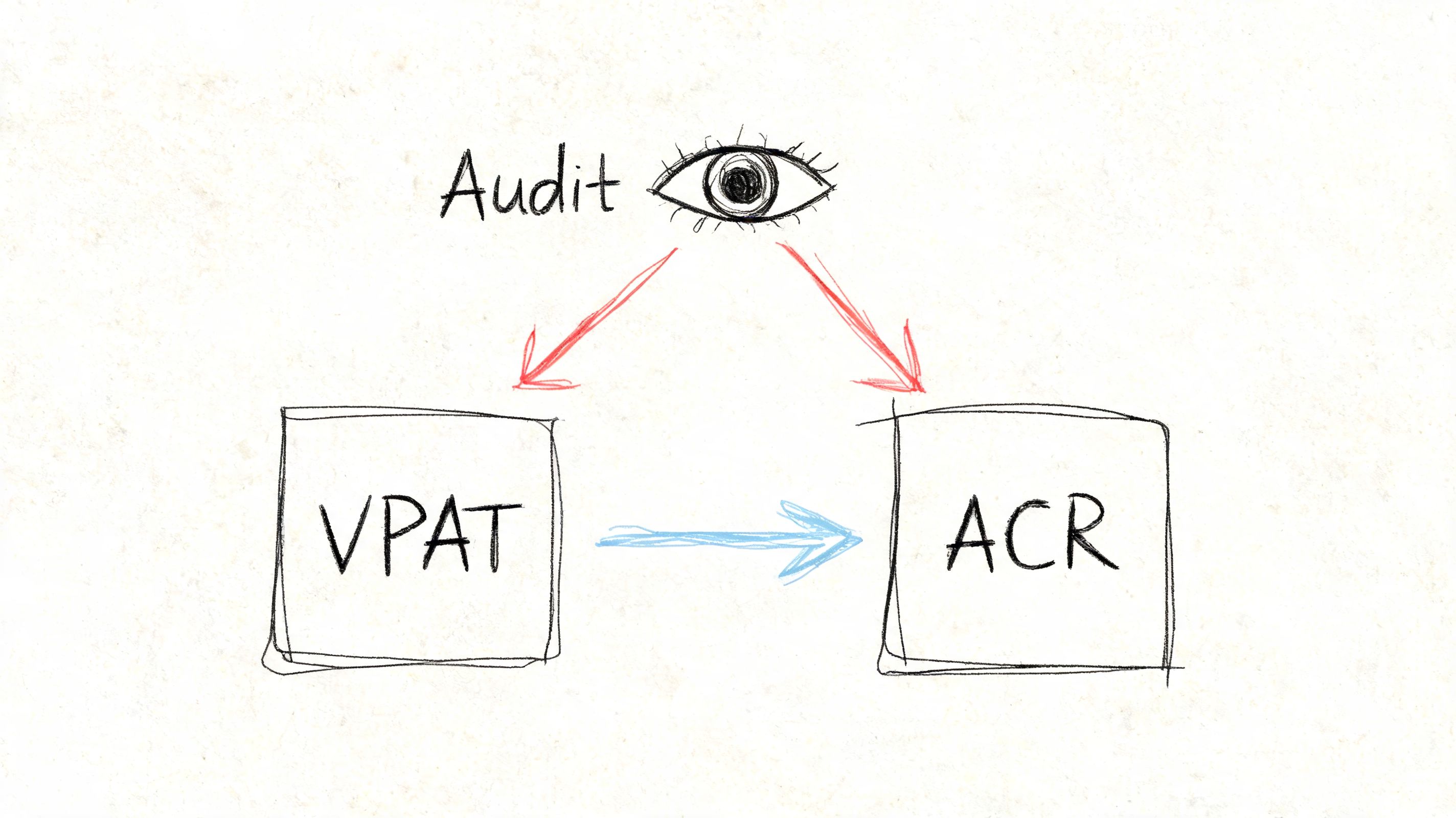
A VPAT template has no business value by itself
A blank template does not reduce risk. It does not help a buyer approve your product. It does not tell engineering what to fix.
A defensible ACR does all three. It ties conformance statements to actual testing, defines what was in scope, identifies where support is partial, and gives procurement enough specificity to treat the document as credible. That is why cheap, document-only offers create problems. They produce something that looks finished without giving your team the audit trail needed to defend it.
If you need a benchmark for what a formal engagement should include, review ADA Compliance Pros’ VPAT and ACR documentation services. Use that as a checklist when comparing vendors. You want to see audit scope, test methodology, reporting discipline, and remediation guidance. If a quote skips those details, the price is low for a reason.
The audit determines whether the ACR will hold up in procurement
Procurement teams do not care that you received a PDF. They care whether the claims in that PDF are believable.
A credible process includes manual testing, review of key user flows, platform-specific evaluation, and written remarks that explain support and limitations clearly. The vendor should ask hard questions about product boundaries, supported browsers, native versus web experiences, authenticated workflows, and third-party components. If that conversation never happens, the resulting ACR will be weak.
The business difference becomes evident. A check-the-box VPAT is a cost center. A defensible ACR supports revenue because it helps your team clear security and accessibility review with fewer follow-up questions.
What to get right before you spend money
Three decisions drive whether this work pays off:
- Define scope precisely. Separate the product, app, admin area, public site, and support content if they differ materially. One vague report creates avoidable exposure.
- Test the flows buyers care about. Login, navigation, forms, checkout, reporting, document exports, and core task completion matter more than a surface pass across random pages.
- Write for scrutiny. Clear remarks and honest “Partially Supports” findings are stronger than inflated claims that collapse under review.
Budget for the ACR you can defend, not the one you can get fastest. That is the version that reduces sales friction, gives legal fewer concerns, and keeps your team out of avoidable remediation cycles.
Core Components Driving Your Total VPAT Cost
A CTO usually sees the VPAT line item late. Procurement sees it early, and buyers judge it hard. If the report cannot survive follow-up questions, the lower price was wasted.
The audit drives the budget because the audit creates the evidence
A procurement-ready ACR is built on manual testing, not screenshots from a scanner, and that is why the audit rather than the document carries the budget. The report itself is a day of writing against findings that already exist. Producing those findings means walking every in-scope template with a keyboard, then with NVDA and JAWS, then checking the states a scanner cannot reach — error handling, focus management, live-region announcements. Self-audits are cheaper for the obvious structural reason: the team that wrote the component is grading its own work, and “Supports” is the path of least resistance on every ambiguous row.
Budget around that reality. Spend on testing, evidence, and reviewer judgment. Do not overspend on packaging.
If a quote is cheap because it skips assistive technology testing, trims authenticated workflows, or relies on boilerplate remarks, you are not buying a lower-cost ACR. You are buying sales friction and future rework.
What actually makes the cost go up
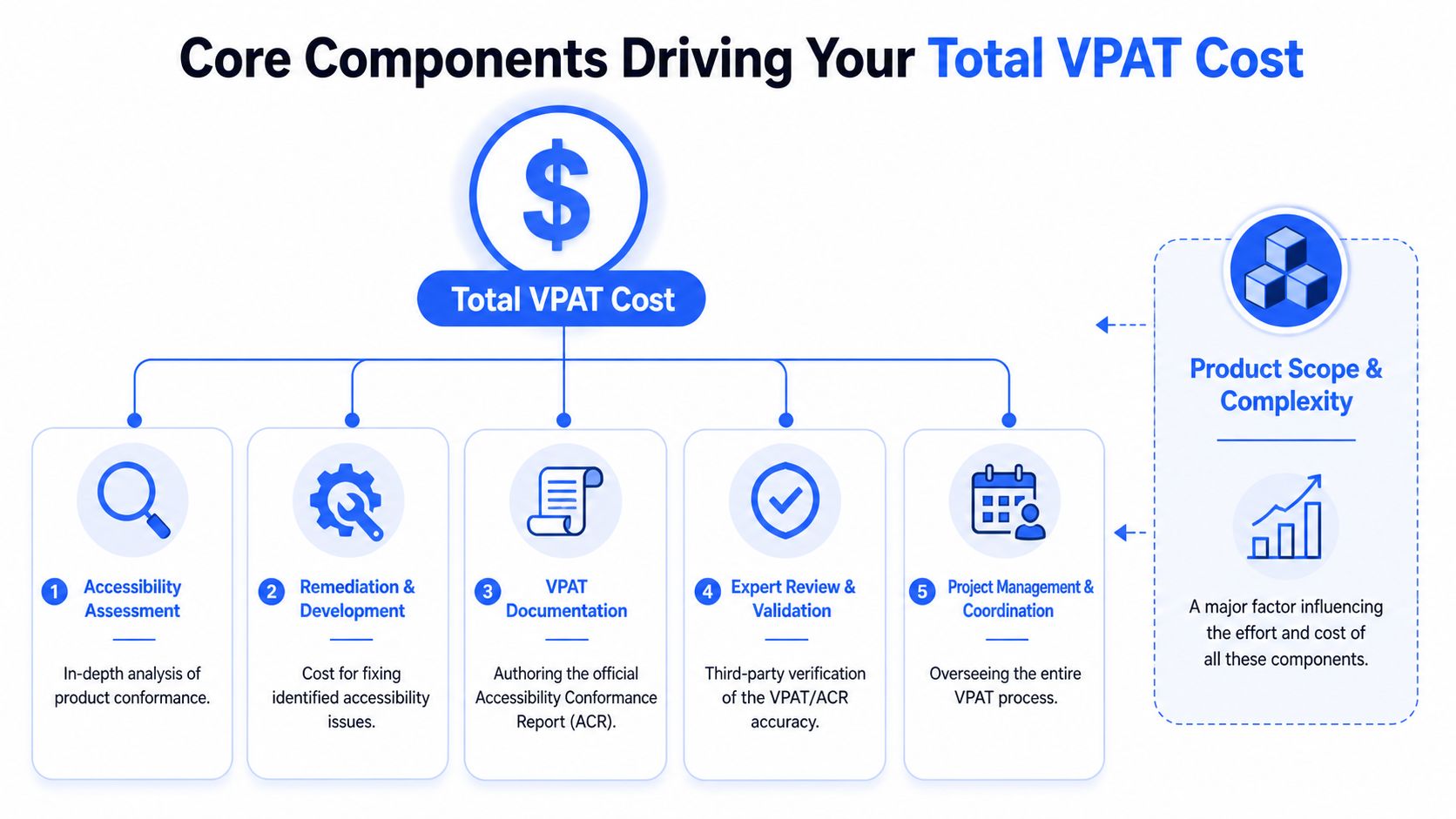
Five workstreams determine whether you end up with a weak document or one your sales team can use in a real procurement review.
- Accessibility assessment This is the largest cost driver. Reviewers test key screens, states, and workflows such as login, account setup, forms, data tables, modals, exports, and error recovery. Cost rises with product complexity, role-based experiences, native and web differences, and the number of components that behave differently across browsers or assistive technologies.
- Remediation guidance Issue lists alone are cheap and often useless. Engineers need findings they can act on. Good vendors explain the problem, the user impact, and the likely fix pattern so your team can reduce back-and-forth and avoid reopening the same defects.
- VPAT documentation Writing the ACR is not clerical work. The reviewer has to convert test results into accurate conformance language, choose where “Partially Supports” is the defensible answer, and write remarks that hold up under buyer scrutiny. That judgment is worth paying for because overclaimed support creates legal and commercial risk.
- Quality review Someone experienced needs to check that scope, findings, and conformance statements match. This review catches the mistakes that make procurement teams lose confidence fast, including vague remarks, unsupported claims, and sections copied from another product.
- Project coordination Access, environments, stakeholder review, revision rounds, and final signoff all cost time. Coordination gets expensive when teams cannot provide stable builds, test accounts, or clear scope boundaries. If you want to control spend, control the project.
The fastest ways to increase VPAT cost: broad scope, multiple user roles, authenticated flows, custom UI components, mobile apps, document exports, and a requirement to cover more than one procurement framework.
Where low-cost VPAT vendors cut the work you actually need
Cheap providers usually cut effort in places buyers care about most.
- Automated-only scans: useful for finding some obvious issues, but they do not test keyboard behavior, screen reader output, focus management, or task completion.
- Shallow sampling: a few public pages get reviewed while the product areas tied to revenue are ignored.
- Generic remarks: language that reads cleanly but says nothing specific about your product’s support or limitations.
- No engineering context: findings without enough detail for developers to fix them correctly.
- No retesting option: the report is issued once, then ages badly as the product changes.
Ask one blunt question when you compare vendors: are you paying for evidence that can survive procurement review, or for a document that looks finished?
The right spend here reduces risk and supports revenue. The wrong spend creates a PDF that satisfies no serious buyer. If you are weighing this against other budget items, compare automated training plans somewhere else in the stack. Do not treat VPAT work like a commodity purchase unless you are comfortable losing deals over a weak ACR.
VPAT Pricing Models and Typical Cost Ranges in 2026
A CTO gets a procurement request on Friday. The buyer wants a VPAT by Monday. One vendor quotes a few hundred dollars for a document. Another quotes several thousand for testing, issue validation, and an ACR that can survive legal and procurement review. Those are not equivalent purchases. One buys a form. The other buys evidence.
Budget VPAT work in two line items: the accessibility evaluation and the ACR drafting. Vendors often combine them in one proposal, but you still need to know what you are paying for. If the testing is weak, the document is weak, no matter how polished the PDF looks.
The cheapest price usually buys formatting, not defensibility
Standalone ACR drafting can be inexpensive if you already have current audit evidence, clear scope, and tested results for the product version in question. The document-only fee covers mapping findings to the right VPAT edition, writing accurate remarks, and reviewing the final report for consistency.
That model breaks fast if your underlying evidence is thin, old, or limited to automated scans. In that case, a low document price creates a high procurement risk. Buyers reject vague remarks, unsupported conformance statements, and reports that do not reflect real product workflows.
What pricing usually looks like in practice
Organizations typically encounter one of three buying models:
- Bundled audit plus ACR engagement
The right choice for first-time VPAT work, major product updates, or enterprise sales teams that need a procurement-ready document. You pay more because the vendor is testing the product, validating scope, drafting the report, and standing behind the result. - Standalone ACR documentation
Sensible only when you already have credible, recent audit findings. If your internal team cannot show what was tested, how it was tested, and which flows were covered, skip this option. - Remediation-first then ACR
Smart for products with known accessibility debt. Fix the serious failures first, then publish an ACR that reflects the product you want buyers to review.
Sample standalone VPAT ACR documentation costs by edition
| VPAT Edition | Primary Use Case | Typical Standalone Cost |
|---|---|---|
| WCAG Edition | Commercial web products and buyers asking for WCAG-focused reporting | Lower-cost document option |
| INT Edition | Products selling across U.S. federal, EU, and broader international procurement contexts | Higher-cost document option |
The edition affects price because it affects reporting scope. An INT report usually requires more careful mapping across multiple procurement frameworks, and that added effort should show up in the quote. If a vendor cannot explain the edition choice in plain English, do not let them write your ACR.
Price ranges also widen based on review depth, number of platforms, and whether the vendor includes retesting or revision rounds. Use this section as a budgeting frame, not a rate card. If you need help comparing providers, review these VPAT vendor selection criteria and provider differences before you approve a statement of work.
Optimize for procurement acceptance and revenue protection. The report price matters far less than the cost of a rejected deal.
A practical comparison is how L&D teams compare automated training plans. Entry pricing may cover a narrow need, but higher-stakes use cases require more review, more oversight, and better documentation. VPAT budgeting works the same way. Spend enough to get a document your sales, legal, and procurement teams can defend.
How to Budget and Select the Right VPAT Vendor
Vendor selection is where companies either buy a defensible asset or buy a problem that arrives later.
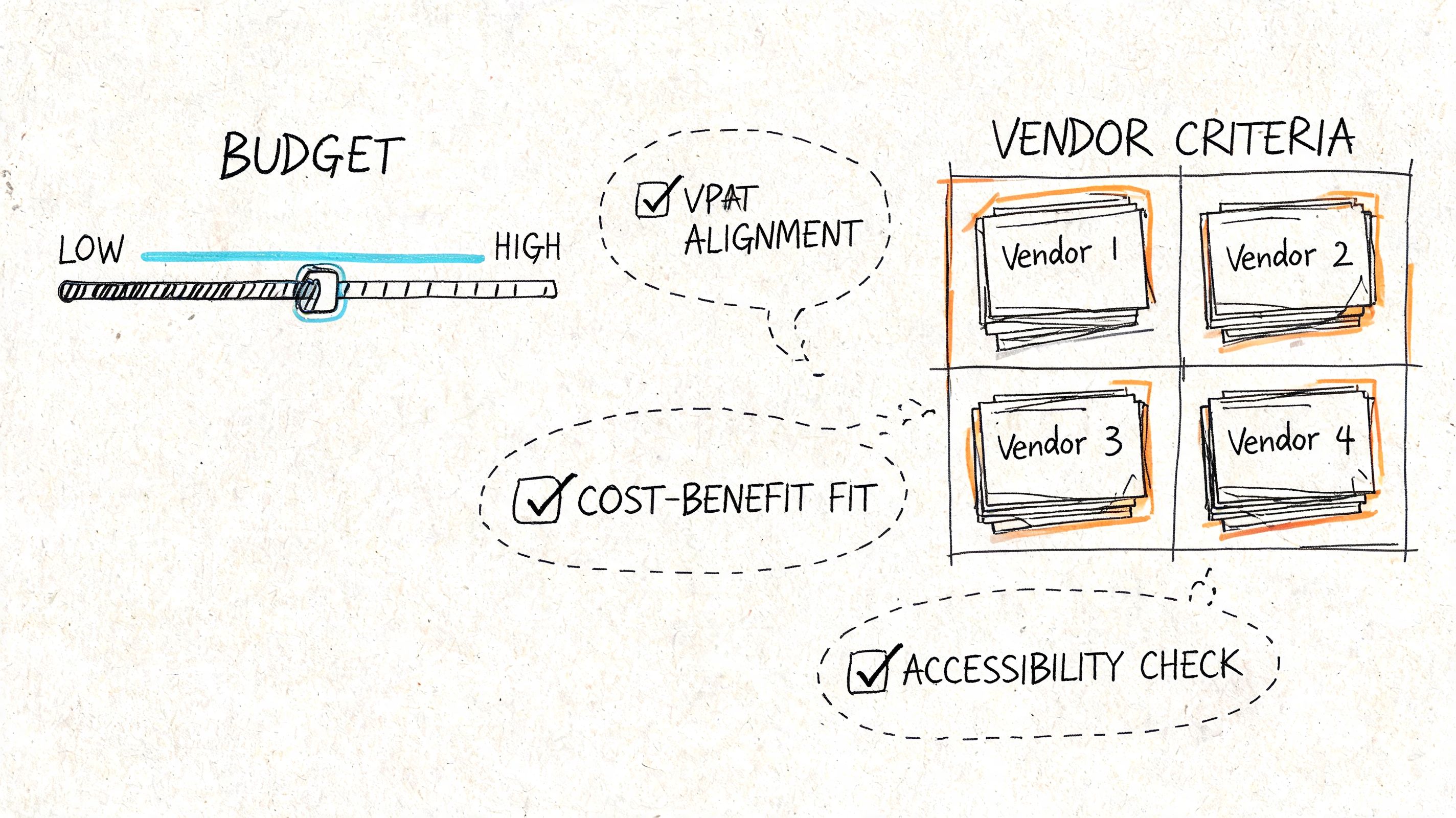
Budget for the full compliance cycle
Budgeting for VPAT cost should include more than the initial report. You should expect some combination of audit work, remediation planning, retesting, and final documentation review.
If your internal team needs help evaluating what a mature audit engagement looks like, resources like IMADO’s accessibility audit services are useful as a benchmark because they frame accessibility as a testing and remediation process rather than a quick document handoff.
A good vendor will ask detailed scoping questions early. They’ll want to know what platforms are in scope, which user journeys matter most, what procurement requirement triggered the request, and whether engineering wants remediation guidance tied to findings.
Questions that expose weak vendors fast
Use this checklist in procurement calls and sales demos.
- What testing do you perform manually? Ask whether they use keyboard testing, screen readers such as JAWS or NVDA, and workflow-based review.
- How do you determine conformance statements? You want a clear explanation of how they choose “Supports,” “Partially Supports,” and other entries.
- Who writes the ACR? The answer should involve experienced reviewers, not generic production staff.
- What does your remediation support look like? Findings should translate into engineering action.
- Do you retest fixes before finalizing or updating the report? If not, the document can age badly fast.
- Have you handled procurement-facing accessibility documentation before? They should understand how enterprise and government buyers review these reports.
Ask to see a redacted sample ACR. If the remarks are vague, repetitive, or obviously templated, walk away.
This short video is useful if your team needs a quick orientation before vendor conversations:
Red flags you should treat as deal breakers
Some warning signs are immediate disqualifiers.
- “We can deliver a VPAT instantly.” No credible vendor can evaluate meaningful scope instantly.
- “Our scanner does the audit.” Automated tools help, but they don’t replace expert testing.
- “We mark most items Supports unless something obvious breaks.” That’s reckless.
- “We don’t need product access.” Then they’re not assessing the actual experience.
- “Engineering can interpret the findings later.” That pushes cost and ambiguity onto your team.
If you’re comparing providers side by side, this guide to best VPAT providers in the US and how to choose the right one is a practical shortlist framework. Use it to pressure-test claims, process, and deliverables before you sign anything.
From Procurement to a Defensible ACR Your Next Steps
Your sales team is in final review with an enterprise buyer. Procurement asks one question: can your accessibility documentation hold up under review, or will it trigger more scrutiny, delays, and legal follow-up?
That is the decision point. A cheap VPAT gets you a file. A defensible ACR helps you keep the deal moving because it shows clear scope, credible testing, honest remarks, and a current view of product risk.
Treat the work as a budgeted risk-control process with four stages. Define scope tightly. Audit the actual product and user flows that buyers care about. Turn findings into specific remediation work your team can execute. Then retest and update the ACR so the final document matches the current product, not last quarter’s build.
Skip any one of those steps and the document weakens fast. Procurement reviewers notice vague scope. Accessibility specialists notice boilerplate remarks. Legal teams notice unsupported conformance statements.
Your next move should be practical. Assign an internal owner. Give the assessor direct product access. Involve engineering early enough to confirm environments, components, and release timing. Tie the ACR update to a remediation plan, not a one-time paperwork exercise.
Spend where scrutiny is highest. Pay for manual testing, precise remarks, and retest verification. Cut spend on rushed documentation that merely marks items as supported and leaves your team exposed when a buyer asks follow-up questions.
If you need a quote, ask for a procurement-ready ACR based on manual evaluation, documented findings, and verification after fixes. ADA Compliance Pros can help you determine whether you need a fresh audit, an ACR update, or both. The right VPAT cost is the amount required to produce a document your buyers can rely on and your company can defend.
Frequently Asked Questions About VPAT Costs
Can we create a VPAT in-house to save money
You can. That doesn’t mean you should.
An internal team can fill out the template, but a self-produced report is only credible if the underlying audit is rigorous, current, and objectively reviewed. Most in-house efforts fail because the team underestimates testing depth, overstates support, or writes remarks that won’t hold up in procurement.
Is the VPAT template itself free
Yes. The template is free. The paid part is the audit, analysis, and report preparation needed to turn that template into a usable ACR.
What’s the difference between a cheap VPAT and a defensible one
A cheap VPAT is usually a documentation exercise. A defensible ACR is an evidence-based report tied to real testing, clear scope, and precise conformance statements.
Should we buy the cheapest vendor if procurement just wants a document
No. Procurement may ask for a document, but reviewers often judge the quality of the document. If the report is weak, the fact that you submitted something won’t help much.
If you need a realistic quote and a straight answer on scope, ADA Compliance Pros can help you evaluate whether you need an audit, a new ACR, or both. The right VPAT cost isn’t the lowest number. It’s the amount required to produce documentation your buyers will accept and your team can stand behind.