
What ED OCR asked institutions to sign: four resolution agreements
 By David LoPresti August 20, 2026
 The document you actually get
A complaint about your website reaches the Department of Education’s Office for Civil Rights. Nothing is filed in court. What you negotiate instead is a resolution agreement: a signed contract with dated deadlines and a reporting obligation owed to a federal agency. Three of the four read here go further and name the standard and the job titles. It is a much more specific document than any court filing, and because OCR publishes some of them alongside the resolution letter that explains them, you can read what other institutions agreed to before anyone asks you to agree to anything.
This article reads four of them end to end, clause by clause, and reports what they contain and what they do not.
- University of Pennsylvania, OCR Docket No. 03-19-6931
- Santa Clara University, OCR Reference No. 09-17-2106
- University of Nevada-Reno, OCR Reference No. 10172016
- Heartland Educational Consortium, a Florida K-12 consortium, OCR Reference No. 04-16-4015
Four is the sample, and four is all it is. In its May 19, 2023 joint Dear Colleague letter with the Department of Justice, OCR wrote that it “has resolved and monitored more than 1,000 cases in recent years related to digital access that were triggered by complaints of discrimination by members of the public,” and that it launched 100 digital accessibility compliance reviews in May 2022 and, in less than a year, had resolved more than 50 of them. OCR’s own technology accessibility guidance page lists six notable case resolutions, and not one of the four read here is among them. That letter ends by pointing readers at OCR’s Recent Resolution Search, which says it provides resolution documents reached on or after October 1, 2013 and filters them by state and by type of discrimination. That is where a district or an agency in another sector can look for an agreement closer to its own facts. So this is a purposive sample of long, published documents, chosen because they are long and published. Nothing below is a rate, a trend, or a prediction about what OCR would ask for now.
One boundary, stated once. Whether to negotiate, what to concede, and how any of this bears on your own exposure are questions for your counsel. What follows is the operational content of four signed contracts, which is the part that sits on the accessibility side of the line.
The four documents, and how each case reached an agreement
Every one of the four agreements has a matching OCR resolution letter published at the same path, and the letters carry the case history the agreements omit.
| Case | Docket | Entity | How the case arose | Agreement date | Resolution letter | Length |
|---|---|---|---|---|---|---|
| University of Pennsylvania | 03-19-6931 | Private university | Directed investigation, no complainant | Signed August 21, 2019 per the resolution letter; the published agreement carries a conformed //s// signature over the Provost’s printed name with the date line left blank, and page 1 carries a 6/4/2019 stamp | September 19, 2019, Region III | 2 pages |
| Santa Clara University | 09-17-2106 | Private university | Complaint received December 14, 2016 | 05/09/2017 on the signature line; submitted to OCR May 10, 2017 | May 11, 2017, Region IX | 4 pages |
| Board of Regents of the Nevada System of Higher Education, for University of Nevada-Reno | 10172016 | Public university | Complaint received October 21, 2016 | December 30, 2016 on the signature line; submitted January 3, 2017 | January 19, 2017, Region X | 6 pages |
| Heartland Educational Consortium | 04-16-4015 | Public K-12 consortium, Florida | Complaint received March 24, 2016 | Signature block blank in the published copy; the letter records the signed agreement submitted October 31, 2016 | November 2, 2016, Region IV | 5 pages |
None of the four went to a completed investigation. Two of the letters name the provision that let the case close early. The Penn letter records that “On August 21, 2019, the University signed the enclosed resolution agreement (Agreement) to voluntarily resolve the directed investigation pursuant to Section 302 of OCR’s Case Processing Manual,” and the Nevada-Reno letter records that “Prior to the completion of OCR’s investigation, the University asked to resolve this complaint pursuant to Section 302 of OCR’s Case Processing Manual (CPM).” The other two describe the same thing without the citation: Santa Clara’s letter says that “Before OCR conducted additional investigation of the recipient’s website, the recipient expressed an interest in voluntarily resolving this case,” and Heartland’s says that “Prior to the conclusion of OCR’s investigation, the Consortium expressed an interest in voluntarily resolving this case.” In the Case Processing Manual effective February 19, 2025, Section 302 is still the provision for resolving allegations mid-investigation, and it says the terms “must be tied to the allegations and the evidence obtained during the investigation.” The 2017 and 2019 letters cite a Section 302 that was in force then, and this article does not claim the wording was identical.
Read the agreement, not the letter. Each of the four letters disclaims itself in near-identical terms. Three say the letter “sets forth OCR’s determination in an individual OCR case.” Penn’s, being a directed investigation rather than a complaint, says “in an individual OCR directed investigation.” All four then add: “This letter is not a formal statement of OCR policy and should not be relied upon, cited, or construed as such.” The agreement is the operative contract. The distinction is not academic: the Santa Clara letter summarizes that university’s training obligation as covering “all appropriate personnel authorized to approve or add new content to the website,” while the agreement it summarizes reaches procurement officials and everyone responsible for auditing web content, none of whom necessarily approve or add anything.
The 19 words that appear in three of the four
Here is the clause the article is built on, from Santa Clara’s agreement at paragraph 6:
Training. Starting no later than 60 calendar days from the date of this Agreement, and annually thereafter until such time as OCR closes its monitoring of this Agreement, the Recipient, will deliver website accessibility training to all appropriate personnel, including, but not limited to: content developers, webmasters, procurement officials, and all others responsible for developing, loading, maintaining, or auditing web content and functionality. After OCR closes monitoring of this agreement, training shall be continued on a schedule designed to maintain website accessibility consistent with, or superior to, that which is required under federal law.
The stray comma after “the Recipient” is in the original. From the phrase “content developers” to the phrase “web content and functionality” is a 19-word string, and that string appears character for character in the Nevada-Reno agreement at paragraph 7 and in the Heartland agreement at paragraph 7. Those three agreements came out of three different OCR regional offices: San Francisco, Seattle and Atlanta. Nothing read for this article publishes a template containing that sentence, so the source of the shared wording is not on the public record. What is on the record is that the same 19 words bound a private university in California, a public university in Nevada and a K-12 consortium in Florida.
The framing around the shared string is where the three differ, and the differences are operational.
- Santa Clara starts the clock at 60 calendar days from the agreement date, repeats annually until OCR closes monitoring, and then keeps going “on a schedule designed to maintain website accessibility consistent with, or superior to, that which is required under federal law.” The obligation outlives the agreement.
- Nevada-Reno starts at 75 calendar days and repeats “annually thereafter” with no stated end, and adds a content requirement: “The training will include information about how to comply with the Benchmarks for Measuring Accessibility set forth above.” The curriculum is tied to the standard the agreement names.
- Heartland is drafted as a completion deadline rather than a start date: “Within one hundred twenty (120) days from the date of this Agreement, the Consortium will complete website accessibility training annually for all appropriate personnel.” It then names its sources, pinning the obligation to two W3C URLs.
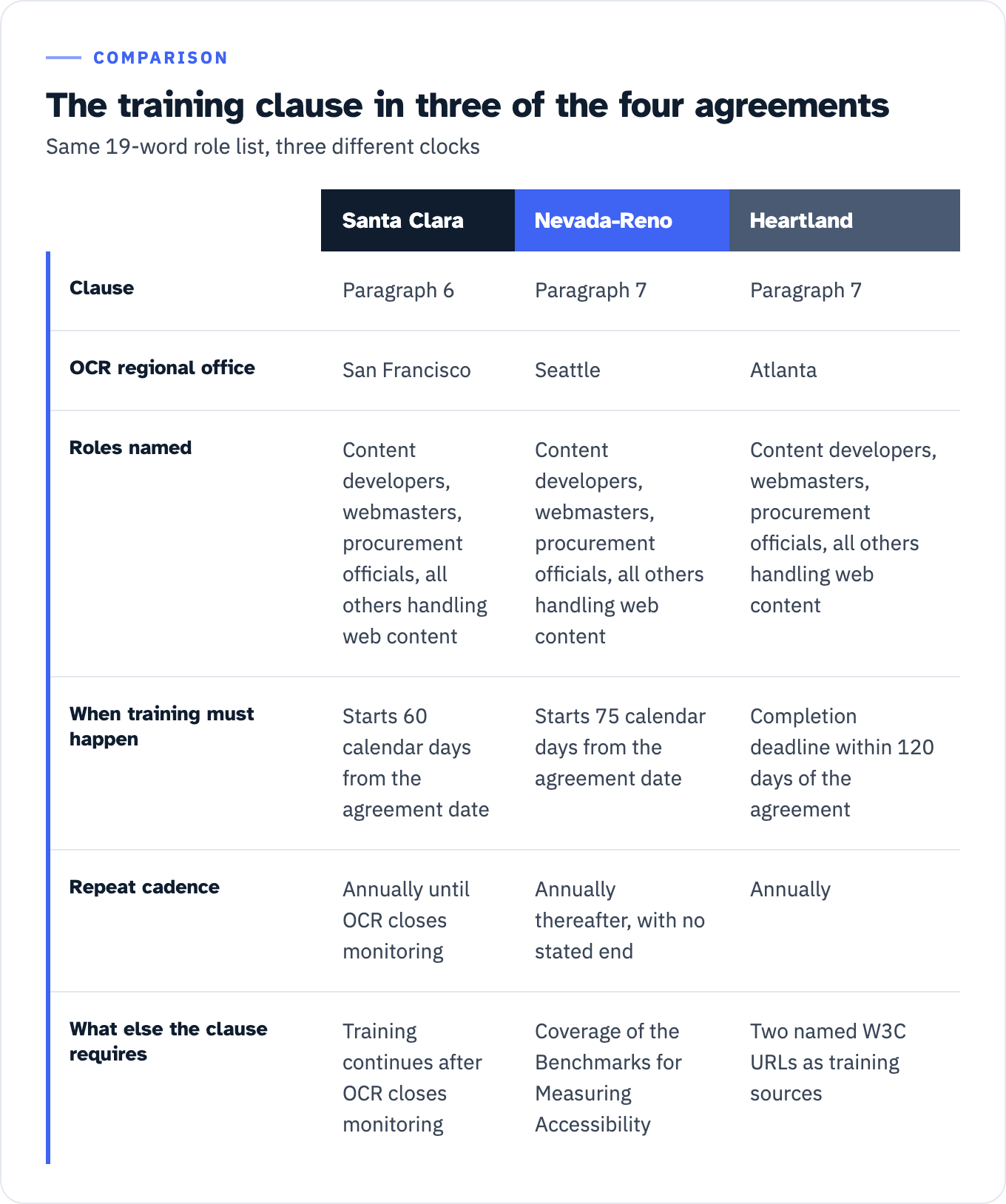
View the data as a table
| Santa Clara | Nevada-Reno | Heartland | |
|---|---|---|---|
| Clause | Paragraph 6 | Paragraph 7 | Paragraph 7 |
| OCR regional office | San Francisco | Seattle | Atlanta |
| Roles named | Content developers, webmasters, procurement officials, all others handling web content | Content developers, webmasters, procurement officials, all others handling web content | Content developers, webmasters, procurement officials, all others handling web content |
| When training must happen | Starts 60 calendar days from the agreement date | Starts 75 calendar days from the agreement date | Completion deadline within 120 days of the agreement |
| Repeat cadence | Annually until OCR closes monitoring | Annually thereafter, with no stated end | Annually |
| What else the clause requires | Training continues after OCR closes monitoring | Coverage of the Benchmarks for Measuring Accessibility | Two named W3C URLs as training sources |
Two things in that role list are worth stopping on. The first is that procurement officials sit in the same sentence as content developers in all three, even though buyers do not author pages. The agreements never explain why. The adjacent clause is suggestive on its own: Nevada-Reno’s paragraph 2 puts vendor content inside scope expressly, applying the requirement to “the university’s online content and functionality developed by, maintained by, or offered through a third-party vendor or through the use of open sources,” and requiring the university to be “setting up systems of accountability and verifying claims of accessibility by vendors or open sources.” Verifying a vendor’s accessibility claim is procurement work, and it is the job the vendor flow-down obligation puts on the buying side of the house.
The second is Heartland’s sequencing. That agreement makes the Consortium’s own webmaster the Auditor, and it opens the audit clause with a condition: “After completion of the training detailed below in provision 7, the Consortium’s webmaster will serve as the Auditor.” The same person is a trainee under paragraph 7 and the evaluator under paragraph 3, and the audit cannot start until the training is done. That is the clearest statement in the four that the training has to reach the person who will judge the result. Our own breakdown of what each role has to be able to do starts from the same premise.
What counts as proof the training happened
The clause that turns training from an intention into a record is the documentation clause. Nevada-Reno’s paragraph 7(a):
a) Reporting: Until such time as OCR closes its monitoring of this agreement, the university will submit to OCR on a quarterly basis documentation that the training required by this agreement has been delivered. The documentation will include a list of invitees and attendees and their position titles, a description of the delivered training content, and the presenters’ credentials for providing such training.
Three artifacts, and only one of them is a sign-in sheet. Invitees as well as attendees, with position titles, so the file shows who was asked and not only who showed up. A description of what was actually delivered. And the presenters’ credentials, which means the person who taught the class is part of the evidence. All three agreements with a training clause require the same three items. The cadence differs: Nevada-Reno reports quarterly, Santa Clara and Heartland per session, in each case until OCR closes monitoring.
What the four documents never contain is any number attached to the training. There is no headcount, no minimum duration, no pass mark, and no measure of effectiveness. None of the documentation submitted under these clauses is published, so nothing here says whether the training worked.
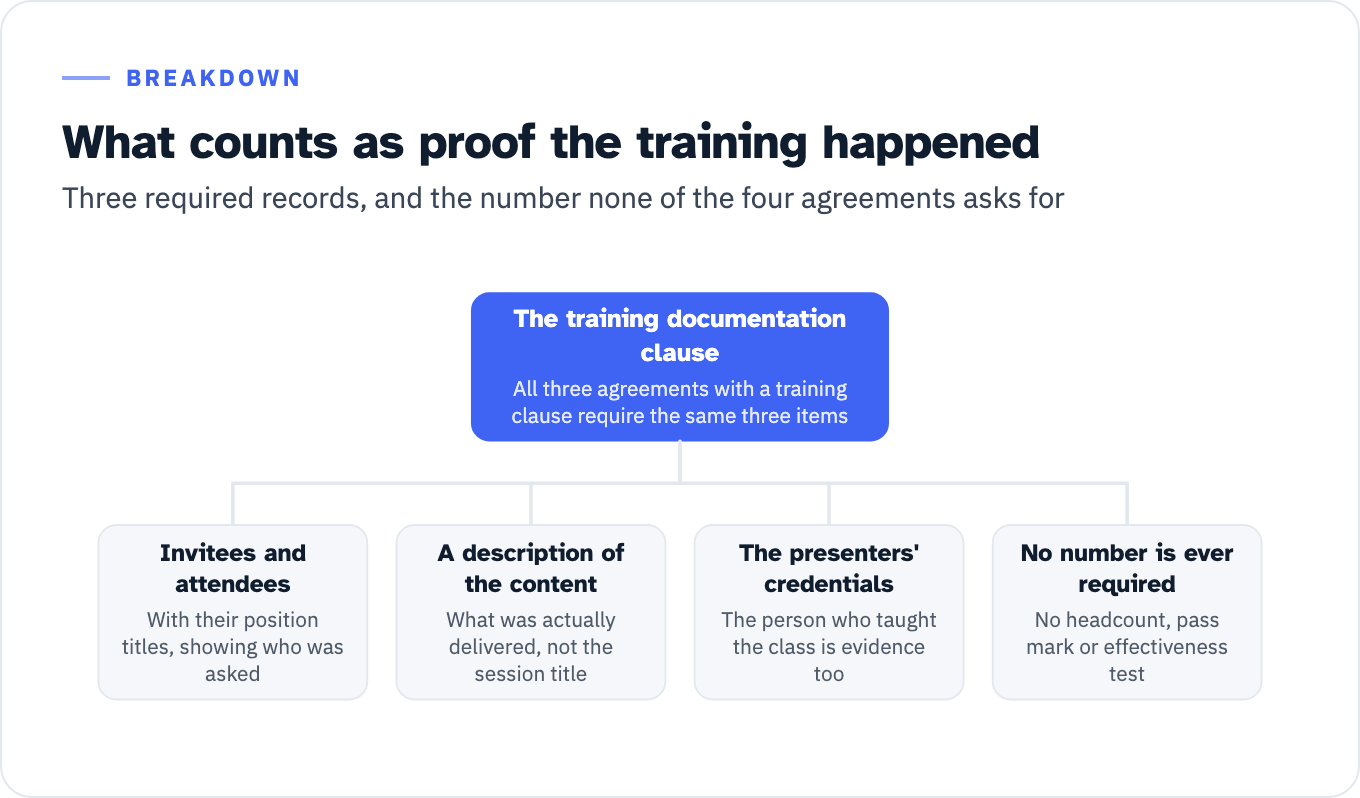
View the data as a list
The training documentation clause: All three agreements with a training clause require the same three items
- Invitees and attendees: With their position titles, showing who was asked
- A description of the content: What was actually delivered, not the session title
- The presenters’ credentials: The person who taught the class is evidence too
- No number is ever required: No headcount, pass mark or effectiveness test
The standard: three named it, one delegated it, and the rule has moved past it
Three of the four agreements open with the same benchmark section, near enough word for word. Santa Clara’s version:
For the purposes of this Agreement, the accessibility of online content and functionality will be measured according to the World Wide Web Consortium’s (W3C’s) Web Content Accessibility Guidelines (WCAG) 2.0 Level AA and the Web Accessibility Initiative Accessible Rich Internet Applications Suite (WAI-ARIA) 1.0 techniques for web content, which are incorporated by reference.
Nevada-Reno carries that sentence with “World Wide Web Consortium’s (W3C’s)” shortened to “W3C’s”. Heartland differs in one word, in the place where a single word does the most work. Santa Clara and Nevada-Reno incorporate “WAI-ARIA 1.0 techniques for web content”; Heartland incorporates “WAI-ARIA 1.0 for web content”, dropping “techniques” from a clause that incorporates by reference. The techniques are a separate W3C artifact from the specification itself. WCAG 2.0 has been a W3C Recommendation since 11 December 2008 and WAI-ARIA 1.0 since 20 March 2014, so all three agreements incorporated stable, finished documents by reference.
Penn did not name a standard at all. Its agreement requires the institution to pick one: “The Recipient’s strategy will designate the standard that Recipient will use to determine the accessibility of online content and functionality (e.g., WCAG 2.0 level AA or a similar standard).” That is the difference between a contract that can be tested and a contract that defines the test later.
The version has since moved. 28 C.F.R. 35.200(b)(1), added by the Department of Justice’s Title II web rule (89 FR 31320, published April 24, 2024), provides that “Beginning April 26, 2027, a public entity, other than a special district government, with a total population of 50,000 or more shall ensure that the web content and mobile apps that the public entity provides or makes available, directly or through contractual, licensing, or other arrangements, comply with Level A and Level AA success criteria and conformance requirements specified in WCAG 2.1,” with April 26, 2028 for smaller entities and special district governments. That is one version above what these agreements incorporated, and the Title II web rule reaches only public entities. WCAG 2.1 is what the rule incorporates, not what W3C currently publishes: WCAG 2.2 has been a Recommendation since 12 December 2024, and WAI-ARIA 1.2 has superseded the 1.0 version these agreements named.
Which matters here more than it first appears. Of the four signatories, two are public: Nevada-Reno and Heartland. Santa Clara and Penn are private and were reached under Section 504 alone. And 34 C.F.R. Part 104, the Department of Education’s Section 504 regulation, contains 38 sections and no web or ICT technical standard anywhere in them. Its operative prohibition, at 104.4(a), is a nondiscrimination sentence: “No qualified handicapped person shall, on the basis of handicap, be excluded from participation in, be denied the benefits of, or otherwise be subjected to discrimination under any program or activity which receives Federal financial assistance.” The 1980-era vocabulary is still the text in force. For a private recipient of federal financial assistance, the specific technical requirement in these documents came from the agreement, not from a rule. The contract supplied the number the regulation does not have.
The whole obligation set, side by side
Read together, three of the four agreements have the same spine, set out clause by clause near the end of this article. The clocks differ. Corrective actions are due 18 months from OCR approval at Santa Clara and Heartland and 24 months at Nevada-Reno, with reporting every six months in all three. The audit report is due 90 calendar days from the most recent audit at Santa Clara, 180 calendar days from OCR’s approval of the Auditor at Nevada-Reno, and 120 days at Heartland.
The fourth agreement does not have that spine, and pretending otherwise would be the easy mistake here. Penn’s two pages contain no training clause, no audit clause, no auditor, no corrective action plan, no named standard, and no named roles. What it has is one strategy obligation with an outer limit: the institution agreed that it will, “in a reasonably timely manner, and in no case longer than 12 months, develop and take substantial steps in the implementation of a strategy” to make online content and functionality accessible, “or, if necessary, providing equally effective alternate access.” It has a priority list the strategy may follow, starting with “site navigation and templates” and running through registration, records and grievance procedures. It has one channel obligation, at paragraph 2: “in no case longer than 20 business days, implement and maintain an accessible process for users to alert Recipient to pages that have accessibility problems.” That channel carries no link to a formal grievance procedure, which the other three notices all require. And it has one reporting obligation, at paragraph 5: a single report due by August 20, 2020, discussing the strategy developed, the benchmarks used to measure progress, ongoing efforts, and the alert process. Not a recurring report until monitoring closes. One report, on one date, twelve months after the strategy deadline. The remaining provision, paragraph 4, offers OCR technical assistance on request and adds that the duty to comply “is not altered by the availability of technical assistance.” That is the whole document.
It would be tidy to call that a shift in how OCR drafted between 2017 and 2019, and four documents cannot establish it. Nothing read for this article says why Penn’s is shorter. What is observable is stated above: it is the only directed investigation of the four, and the shortest by a factor of two to three. Where the comparison below reaches an obligation Penn’s agreement does not contain, that cell is recorded as absent, and nothing is averaged across four.
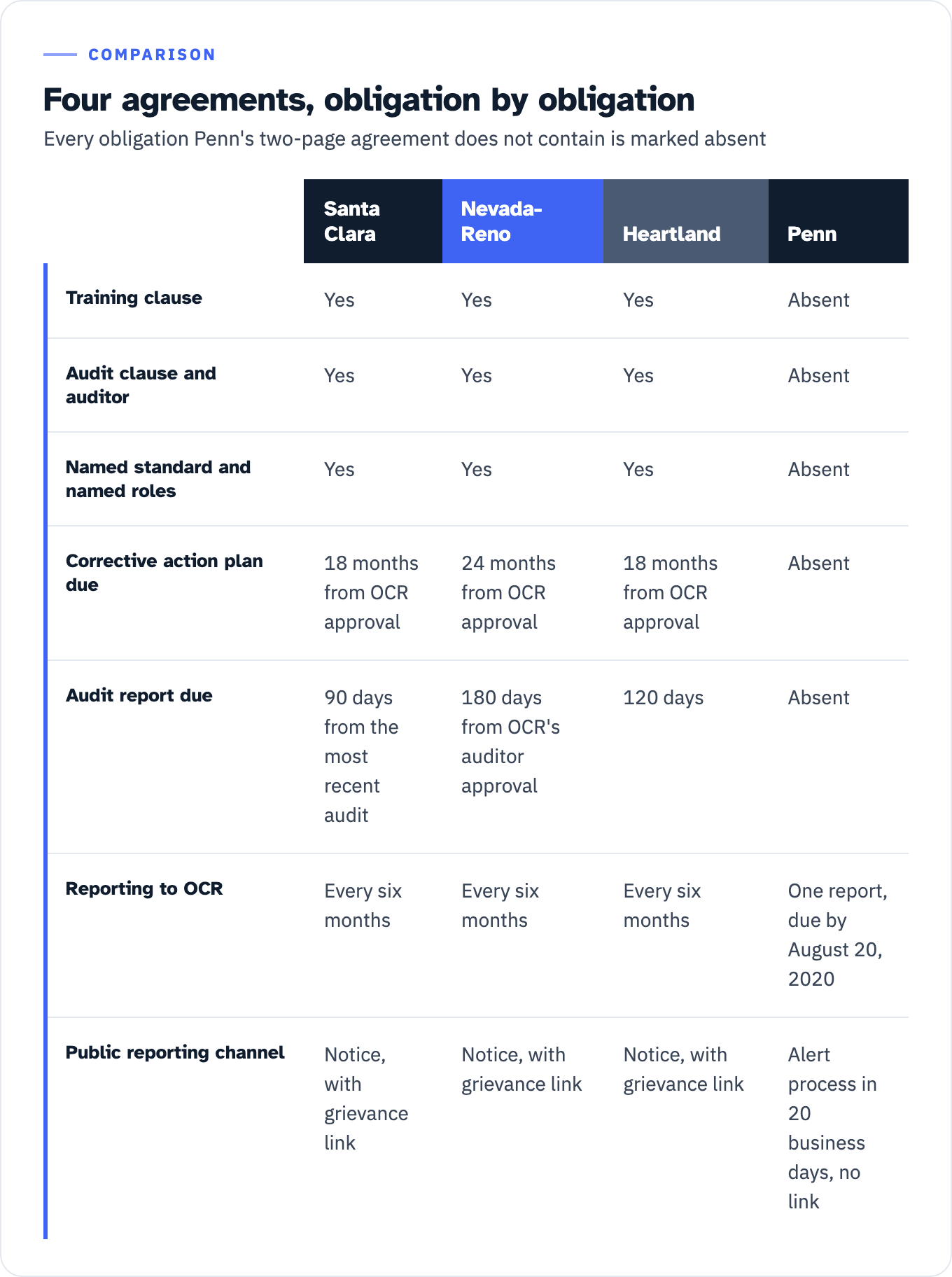
View the data as a table
| Santa Clara | Nevada-Reno | Heartland | Penn | |
|---|---|---|---|---|
| Training clause | Yes | Yes | Yes | Absent |
| Audit clause and auditor | Yes | Yes | Yes | Absent |
| Named standard and named roles | Yes | Yes | Yes | Absent |
| Corrective action plan due | 18 months from OCR approval | 24 months from OCR approval | 18 months from OCR approval | Absent |
| Audit report due | 90 days from the most recent audit | 180 days from OCR’s auditor approval | 120 days | Absent |
| Reporting to OCR | Every six months | Every six months | Every six months | One report, due by August 20, 2020 |
| Public reporting channel | Notice, with grievance link | Notice, with grievance link | Notice, with grievance link | Alert process in 20 business days, no link |
Who is allowed to assert undue burden under these agreements
Every one of the four preserves an undue burden or fundamental alteration defense, and three of them do something the regulation does not: they attach it to a specific office. Santa Clara’s paragraph 2:
For any technology-related requirement in this Agreement for which the Recipient asserts an undue burden or fundamental alteration defense, such assertion may only be made by the University President (President) or by an individual designated by the President and who has budgetary authority after considering all resources available for use in the funding and operation of the service, program, or activity, and must be accompanied by a written statement of the reasons for reaching that conclusion, including the cost of meeting the requirement and the available funding and other resources.
Nevada-Reno names the university president. Heartland names the Executive Director. The device is borrowed from 28 C.F.R. 35.164, which requires that the decision “must be made by the head of the public entity or his or her designee after considering all resources available for use in the funding and operation of the service, program, or activity and must be accompanied by a written statement of the reasons for reaching that conclusion.” The regulation says head of the entity. The agreements say who that is, in this institution, by title, and add budgetary authority as a qualification for the designee. That is the pattern worth taking away from the whole set: the agreement is the more specific document, and the specificity runs to job titles.
Penn’s version keeps the defense and names nobody: its paragraph 3 says the agreement does not require action that the institution “demonstrates in writing, in OCR’s reasonable determination, would result in a fundamental alteration.” All four require equally effective alternate access somewhere, but only in Penn’s is it detached from the defense: it sits in the strategy clause at paragraph 1 rather than in paragraph 3. In the other three the alternate-access duty is written into the undue burden clause itself.
How the file closes, and what happens if it does not
Three of the four agreements make closure conditional on more than finishing the tasks. Nevada-Reno’s paragraph 8:
The university understands that OCR will not close the monitoring of this agreement until OCR determines that the university has fulfilled the terms of this agreement and is in compliance with the regulations implementing Section 504 at 34 C.F.R. 104.4 and the regulations implementing Title II at 28 C.F.R. 35.130 and 35.160(a), which were at issue in this case.
Santa Clara’s version ends at Part 104 with no Title II clause. Heartland’s names both. Penn has no compliance test at all: “Upon Recipient’s satisfaction of the commitments made under this agreement, OCR will close the case.” The Case Processing Manual states the general rule the same way, at Section 504: OCR concludes monitoring “when it determines that the recipient has fully and effectively implemented the terms and obligations of the resolution agreement, including any subsequent approved modifications to the agreement.”
All four carry the same enforcement clause and the same two citations, 34 C.F.R. 100.9 and 100.10, and all four give the recipient sixty calendar days of written notice to cure before OCR moves. The wording varies only in house style. Penn has “OCR will give” and “sixty (60)”; Santa Clara and Nevada-Reno have “OCR shall give” and a bare “60”; Heartland has “shall give” and “sixty (60)”. Penn and Heartland write the sections as “34 C.F.R. §§ 100.9, 100.10”, Santa Clara and Nevada-Reno as “34 C.F.R. 100.9 and 100.10”. Penn alone says “to enforce the agreement” where the other three say “this agreement”. Penn’s paragraph 5: “Before initiating administrative enforcement (34 C.F.R. §§ 100.9, 100.10) or judicial proceedings to enforce the agreement, OCR will give Recipient written notice of the alleged breach, and sixty (60) calendar days to cure the alleged breach.”
Two asymmetries are visible in all four and are worth knowing before you sign anything shaped like this. Every deadline runs against the recipient, and several of them start from an event the recipient does not control: the day OCR approves the auditor, the day OCR approves the corrective action plan. No provision in any of the four sets a time limit for OCR to review or approve a submission. And nothing in the published record fetched for this article says whether OCR has closed monitoring on any of the four cases, so this article does not claim any of them is open, closed or ongoing.
Three drafting facts you would not expect in a federal agreement
These are small, and they are the kind of thing that only shows up when you read the signed document rather than a summary of it.
Heartland’s first deadline is a date that does not exist. Paragraph 1 reads: “By February 31, 2017, the Consortium will submit to OCR for its review and approval proposed policies and procedures (‘the Plan for New Content’).” February 31 is not a date. It is in the agreement as published, in bold, and no corrected version is published. What the parties treated it as is not in the record, and this article will not guess.
Heartland’s audit reporting clock keys to an approval the agreement never creates. Paragraph 3 appoints the Consortium’s own webmaster as Auditor, directly, with no provision requiring the Consortium to propose an Auditor for OCR’s review. Yet paragraph 3(a) starts the reporting clock “Within one hundred twenty (120) days of receiving OCR’s approval of the proposed Auditor.” Nevada-Reno does have that approval step, expressly: “the university will propose for OCR’s review and approval the identity and bona fides of an Auditor (corporation or individual).” Santa Clara has neither, requiring only “A trained and qualified Auditor selected by the University.” Three agreements, three different mechanisms for the same role, and one of them starts a clock at an event its own text never produces.
Every W3C address written into Heartland’s agreement now redirects away from the page it names. The training clause requires training “through online sources such as the W3C’s Web Accessibility Tutorials and Presentations at https://www.w3.org/WAI/train.html, the W3C’s Accessibility Evaluation Resources at https://www.w3.org/WAI/eval/Overview.html, and through other online or in-person trainings as they become available.” Both named addresses now redirect: the first to a page titled “Teach and Advocate Overview,” the second to “Evaluating Web Accessibility Overview.” So does the tools list cited in the audit clause below, which now lands on “Web Accessibility Evaluation Tools List.” The obligation was pinned to addresses rather than to content, and nothing in the record says how that was handled. If you write a training source into a contract, write the requirement, and treat the link as an example.
Heartland is also the only one of the four to name automated tools, and it names them with a limit built in. Its audit runs “using available online accessibility checkers (obtained from the W3C’s list of Web Accessibility Evaluation Tools at https://www.w3.org/WAI/ER/tools/), as a tool to be used in conjunction with individual review.” Checkers appear in the case history too: the Nevada-Reno letter records that the complainant “used website accessibility checkers (PowerMapper and WAVE)” and sent OCR a list of errors copied from one, after which OCR conducted its own preliminary examination of the pages named.
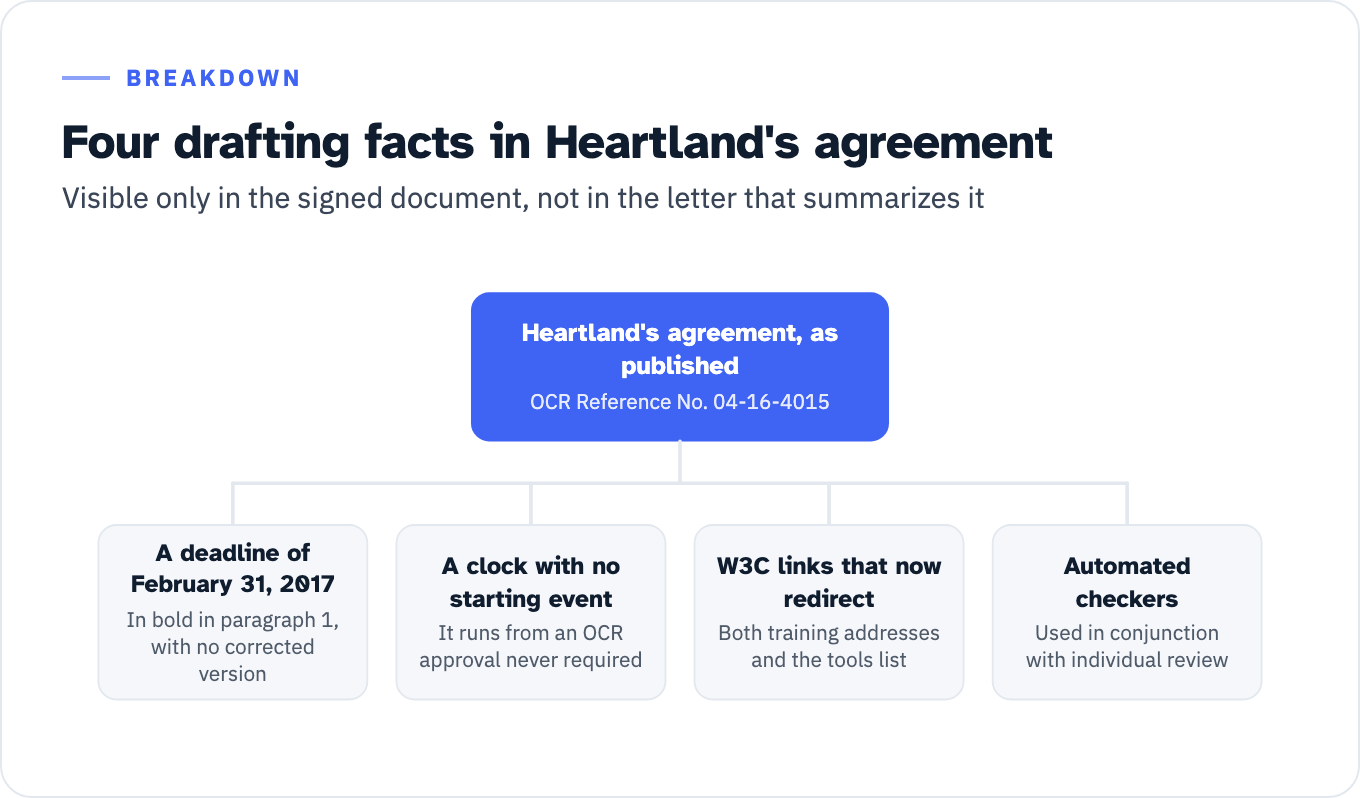
View the data as a list
Heartland’s agreement, as published: OCR Reference No. 04-16-4015
- A deadline of February 31, 2017: In bold in paragraph 1, with no corrected version
- A clock with no starting event: It runs from an OCR approval never required
- W3C links that now redirect: Both training addresses and the tools list
- Automated checkers: Used in conjunction with individual review
The file you could build before anyone asks
The best argument for reading these four is in the Heartland resolution letter, which says out loud what OCR would have gone looking for had the case continued:
In order to conclude OCR’s investigation of this complaint, OCR would have had to conduct interviews, review data response documents, and examine a broader range of pages on the Consortium’s website; OCR would have sought to learn, for example, whether the Consortium had received previous complaints of inaccessible website content or functionality, and how those complaints were resolved; and whether its information technology staff members and people responsible for uploading content or maintaining web pages had received training in website accessibility.
Complaint history, complaint resolution, and training records for the people who touch the pages. Those are files, and an institution either has them or does not. Here is the whole obligation set of the four agreements turned into artifacts, each traced to the clauses that require it, with the count stated as a count and not as a rate. SCU is Santa Clara, UNR is Nevada-Reno.
- A written conformance standard rather than an assumed one (3 of 4 name it in the opening Benchmarks section: SCU, UNR, Heartland. Penn instead requires the recipient to designate one, at Penn paragraph 1).
- A published policy governing new, newly added and modified content, including vendor and open-source content, with quality assurance procedures behind it (3 of 4: SCU paragraph 1, UNR paragraph 2, Heartland paragraph 1).
- A public notice explaining how to report an inaccessible page, carrying information or an accessible link on how to file a formal grievance (3 of 4: SCU paragraph 5, UNR paragraph 6, Heartland paragraph 6. Penn paragraph 2 requires an alert process with no grievance link).
- An audit of all existing content that reaches subordinate pages and third-party content and takes input from people with disabilities (3 of 4: SCU paragraph 3, UNR paragraph 4, Heartland paragraph 3).
- An auditor whose identity and bona fides go to OCR for review and approval (1 of 4: UNR paragraph 3. SCU paragraph 3 requires only “A trained and qualified Auditor selected by the University”, and Heartland paragraph 3 appoints its own webmaster with no OCR review step at all).
- A corrective action plan with a completion deadline (3 of 4: SCU paragraph 4 and Heartland paragraph 4 at 18 months from OCR approval, UNR paragraph 5 at 24 months).
- Role-based training on at least an annual cadence for the named roles (3 of 4: SCU paragraph 6, UNR paragraph 7, Heartland paragraph 7).
- Training records carrying invitees and attendees with position titles, a description of the delivered content, and the presenters’ credentials (3 of 4: SCU paragraph 6(a), UNR paragraph 7(a), Heartland paragraph 7(a)).
- A named officer with budgetary authority who is the only person permitted to assert undue burden, in writing (3 of 4: SCU paragraph 2 names the University President, UNR paragraph 1 names the university president, Heartland paragraph 2 names the Executive Director).
One item on that list is one document’s drafting rather than a shared practice: only Nevada-Reno makes the auditor’s bona fides OCR’s business. Everything else is a web accessibility policy question, an audit question, or a training question, and none of it takes an agreement to justify. That list is derived from four agreements. It is not a compliance standard, not a safe harbor, and not a prediction of what any future agreement would require of anyone.
Where this article stops
All four documents are voluntary contracts. Each disclaims any admission, and each letter says on its face that it is not a policy statement. No court decision construing any of the four turned up in the research for this article, so every mechanic above should be read as text on the page rather than as construed law. Whether these four are representative of OCR’s digital access docket is not answerable from the published record.
Reading four public contracts is not legal advice and does not become legal advice by being specific.
Your next step
Pick the one clause that recurs and answer it first. Three of these four agreements require role-based training for content developers, webmasters and procurement officials on an annual cadence, with a record showing who was invited, who attended with their position titles, what was delivered, and who was qualified to deliver it. That is a curriculum question and a records question, and it is the same question whether or not anyone has complained about your site. If you want it built to that shape, that is what role-based accessibility training delivers.
The other recurring obligation is the audit: all existing content, subordinate pages and third-party content included, with a defect list a corrective action plan can be written against and a named evaluator behind it. A WCAG audit and retest engagement produces that file. For schools, districts and universities working the Title II clock at the same time, our education sector page sets out how the two fit together.