

A contracting officer, a grant manager or a prospective federal customer says the website has to be “508 compliant,” and the team has to work out what the 508 compliance requirements are before anyone can quote, build or test. What is Section 508 compliance? It is conformance with the Revised 508 Standards that the U.S. Access Board publishes at 36 CFR part 1194, and for a website it comes down to one dated version of one guideline: WCAG 2.0 at Level A and AA.
This guide sets out the Section 508 requirements in the order a reader needs them: who the statute binds and how a vendor comes under it, what the standards require of web content and of internal content, where the functional performance criteria and the exceptions fit, and how Section 508 differs from the ADA. How conformance is tested is covered in the companion guide to Section 508 compliance testing.
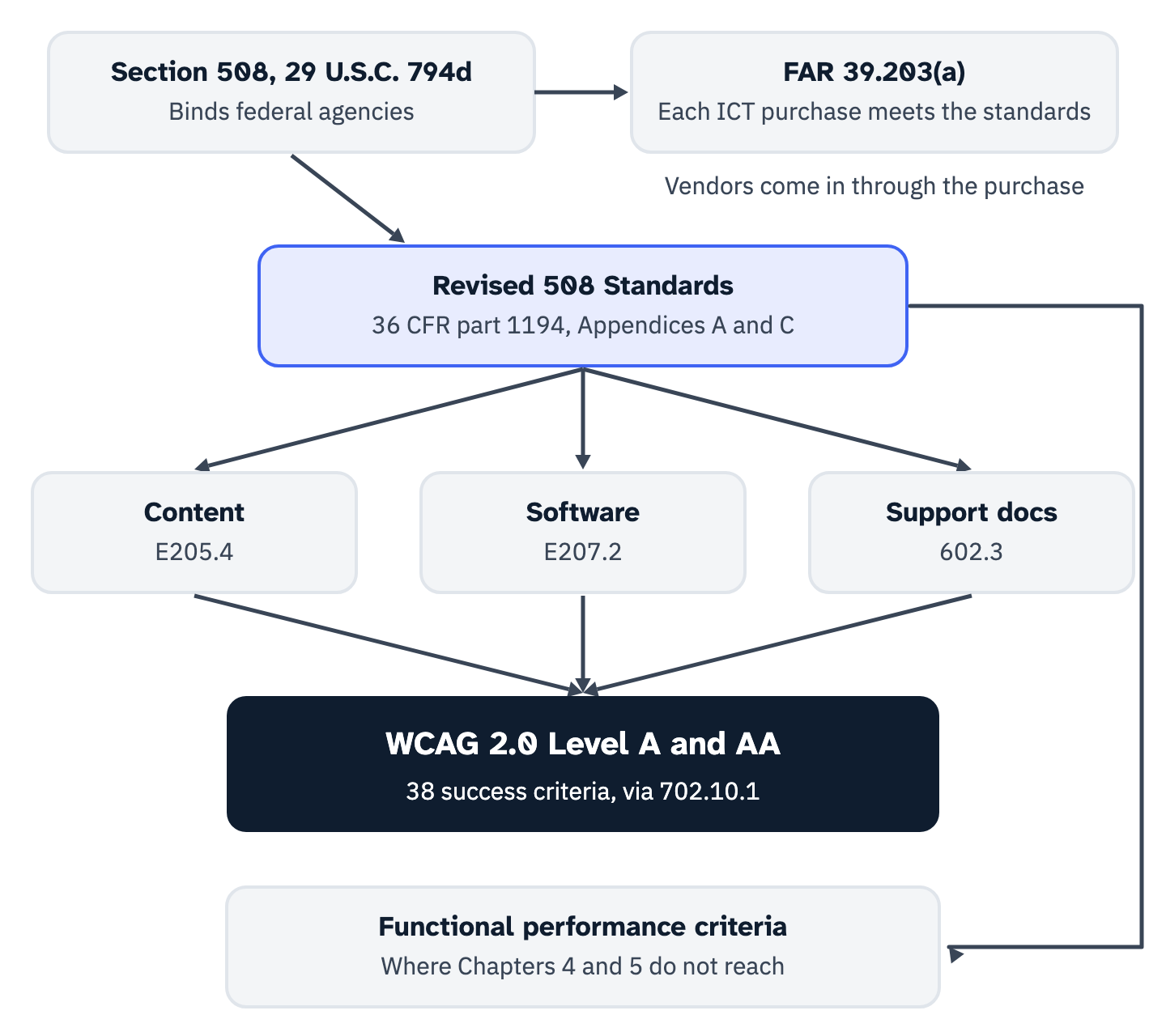
Section 508 binds federal agencies and reaches vendors through the purchase
The statute is short on this point. 29 U.S.C. 794d(a)(1)(A) applies “when developing, procuring, maintaining, or using electronic and information technology,” and it places the duty on “each Federal department or agency, including the United States Postal Service.” The agency must give employees and members of the public with disabilities access to information and data that is “comparable” to the access others have. Where full conformance would be an undue burden, the agency still has to provide the information “by an alternative means of access.”
Enforcement runs against the agency too: under 794d(f), an individual with a disability may file a complaint alleging that an agency fails to comply, and it is filed “with the Federal department or agency alleged to be in noncompliance.”
A vendor comes under the law through the acquisition. The Federal Acquisition Regulation states at 48 CFR 39.203(a) that, unless an exception or exemption applies, “acquisitions for ICT supplies and services shall meet the applicable ICT accessibility standards at 36 CFR 1194.1.” The requirement travels in the requirements documents: under FAR 11.002(f) they must identify the applicable ICT accessibility standards.
For indefinite-quantity contracts, 39.203(b) adds that the contract “must identify which supplies and services the contractor indicates as compliant and show where full details of compliance can be found,” and for commercial products 39.203(d) asks for the standards “that can be met with supplies or services that are available in the commercial marketplace.” Section508.gov’s page for vendors puts the result plainly: “To do business with the Federal government, you need to demonstrate that your ICT product or service is accessible and conforms to the Section 508 Standards.”
There is no standard FAR clause for it; the 2021 FAR rule says it “does not create new solicitation provisions or contract clauses.” How agencies write that requirement into a contract is set out in this guide to Section 508 contract clauses.
The FAR numbering is moving. The overhaul’s Part 39 deviation text, issued on June 12, 2025 and adopted by 32 agencies as of October 2026, carries the same requirement at 39.104-3(a), and a proposed rule of June 2026 would codify it. The published FAR still prints Subpart 39.2. A solicitation may cite either number for the same duty.
Federal money is a different question. Section 504 of the same Act governs programs “receiving Federal financial assistance” as well as the agencies’ own programs, and a grant does not by itself make a recipient a Section 508 entity. Section 508 reaches a recipient only where a statute, a regulation or the award terms attach it, as 42 CFR 433.112(b)(12) does for Medicaid claims and eligibility systems that seek enhanced federal funding. The details are in Section 508 and federal grants and in who needs to follow Section 508.
Before anything is scoped, find the sentence in the solicitation or the grant terms that names the accessibility standard, and copy it into the project brief word for word. That sentence, not a sales conversation, sets the obligation. The same test answers a vendor’s question about its own website: Section 508 attaches to technology the agency develops, procures, maintains or uses, so the answer turns on whether the contract delivers that site or the agency uses it to do business.
The Revised 508 Standards are the rule, and compliance began on January 18, 2018
The standards sit in 36 CFR part 1194. Section 1194.1 places them in Appendices A, C and D, and Appendix A states that “compliance with these standards is mandatory for Federal agencies subject to Section 508.” Appendix A holds the scoping rules, numbered with an E (E205, E207 and so on); Appendix C holds the functional performance criteria and the technical requirements; Appendix D republishes the 2000 standards.
The Access Board’s 2017 final rule dates the change precisely: “This final rule is effective March 20, 2017. However, compliance with the section 508-based standards is not required until January 18, 2018.” The same rule created a safe harbor for existing ICT. Under E202.2, a component that complies with the 2000 standards “and that has not been altered on or after January 18, 2018, shall not be required to be modified,” and the 2017 rule’s preamble applies that test “on an element-by-element basis.”
Older 508 accessibility standards checklists still circulate, and they are easy to spot. The 2000 standards set out web requirements as sixteen paragraphs, “(a)” through “(p)”, in section 1194.22, and the Access Board mapped most of them to WCAG 1.0. Appendix D keeps them only for legacy ICT.
Use one test on any checklist, vendor page or internal policy before relying on it. If it cites “1194.22” or WCAG 1.0, it describes the pre-2018 rule. If it cites E205.4 and WCAG 2.0, it describes the Revised 508 Standards in force today.
For a website, the 508 compliance standards mean WCAG 2.0 Level A and AA
The operative sentence is E205.4:
Electronic content shall conform to Level A and Level AA Success Criteria and Conformance Requirements in WCAG 2.0 (incorporated by reference, see 702.10.1).
Section 702.10.1 fixes the version: “WCAG 2.0, Web Content Accessibility Guidelines, W3C Recommendation, December 11, 2008.” WCAG 2.0 has 25 success criteria at Level A and 13 at Level AA, and Section508.gov’s conformance page counts the same “38 applicable WCAG success criteria.” A 508 compliant website, then, is one whose pages meet those 38 criteria; its linked documents meet them too, less the four that E205.4 excuses for non-web documents. Conformance also covers complete processes: in Section508.gov’s ticket purchase example, the set of pages “does not conform if any of those steps fails to conform fully.”
View the data as a list
- Section 508, 29 U.S.C. 794d: binds federal departments and agencies.
- FAR 39.203(a): ICT acquisitions must meet the standards at 36 CFR 1194.1, which is how vendors come in.
- Revised 508 Standards, 36 CFR part 1194: scoping in Appendix A, requirements in Appendix C.
- Content (E205.4), software (E207.2), support documentation (602.3): each conforms to WCAG 2.0 Level A and AA.
- WCAG 2.0 Level A and AA: 38 success criteria, incorporated by reference in 702.10.1.
- Functional performance criteria (Chapter 3): apply where Chapters 4 and 5 do not address a function (E204.1).
The same standard covers more than web pages. Under E205.4 it applies to non-web documents, which are excused from 2.4.1 Bypass Blocks, 2.4.5 Multiple Ways, 3.2.3 Consistent Navigation and 3.2.4 Consistent Identification. Under E207.2 user interface components and the content of applications meet the same Level A and AA criteria, and electronic support documentation, “including Web-based self-service support,” meets them under 602.3.
A web application is software as well, so E207.1 adds Chapter 5. Under the 501.1 Exception, a web application without access to platform accessibility services is excused from 502 and 503 when it conforms to WCAG 2.0, but not from 504: an application that lets users create content for others, such as a content management system, also meets 504 Authoring Tools. Where support documentation is supplied, 602.2 requires it to “list and explain how to use the accessibility and compatibility features.”
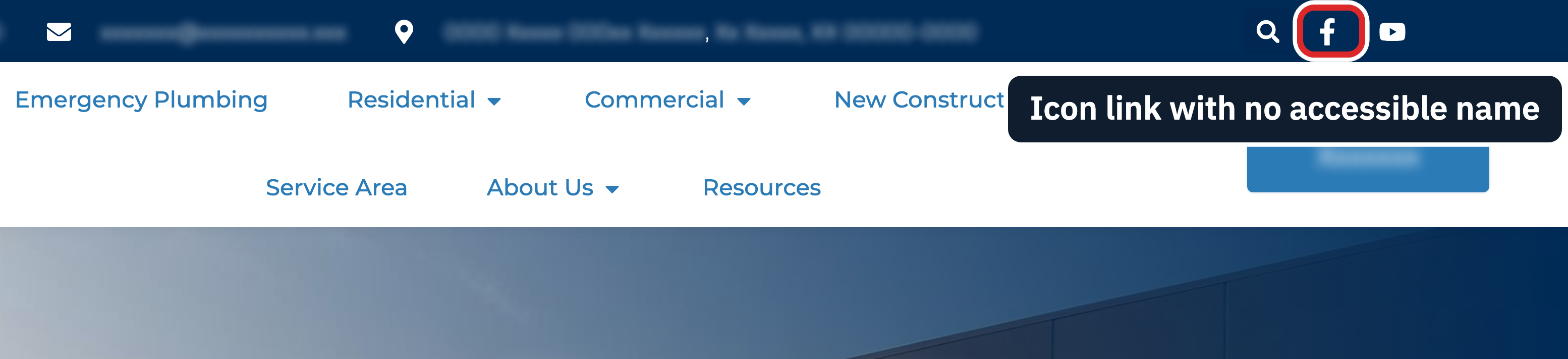
The failures this standard catches on a website are concrete. The header of a home-services company’s website, captured for this guide, links its social media icons without any text a screen reader can announce. The same markup on an agency page would fail WCAG 2.0 success criteria 2.4.4 Link Purpose (In Context) and 4.1.2 Name, Role, Value, both of them Level A.
The standard is 2.0 rather than 2.1 or 2.2 for a historical reason, and the Department of Justice stated it in its 2024 Title II rule: “In 2017, when the … Access Board … adopted WCAG 2.0 as the technical standard for the Federal Government’s web content under section 508, WCAG 2.1 had not been finalized.” 702.10.1 still names the 2008 Recommendation, and a Federal Register search of Access Board documents from January 2025 through November 3, 2026 finds none that changes these standards.
Building to a later version is allowed and practical: WCAG 2.2 states that “content that conforms to WCAG 2.2 also conforms to WCAG 2.0 and WCAG 2.1,” and warns that authors bound to 2.0 “may need to continue to test and report 4.1.1,” the Parsing criterion 2.2 removed. When a solicitation itself names WCAG 2.1 or 2.2, that version is the build target, and 4.1.1 is still tested for the Section 508 report.
Write the target into the statement of work in one sentence: “Conformance to WCAG 2.0 Level A and AA under 36 CFR 1194, E205.4 and, for a web application, E207.2 and Chapter 5 as applicable, tested and reported per success criterion, including 4.1.1.” How the other US rules map to WCAG versions is in which WCAG version each US rule requires.
Public pages count, and nine kinds of internal content count too
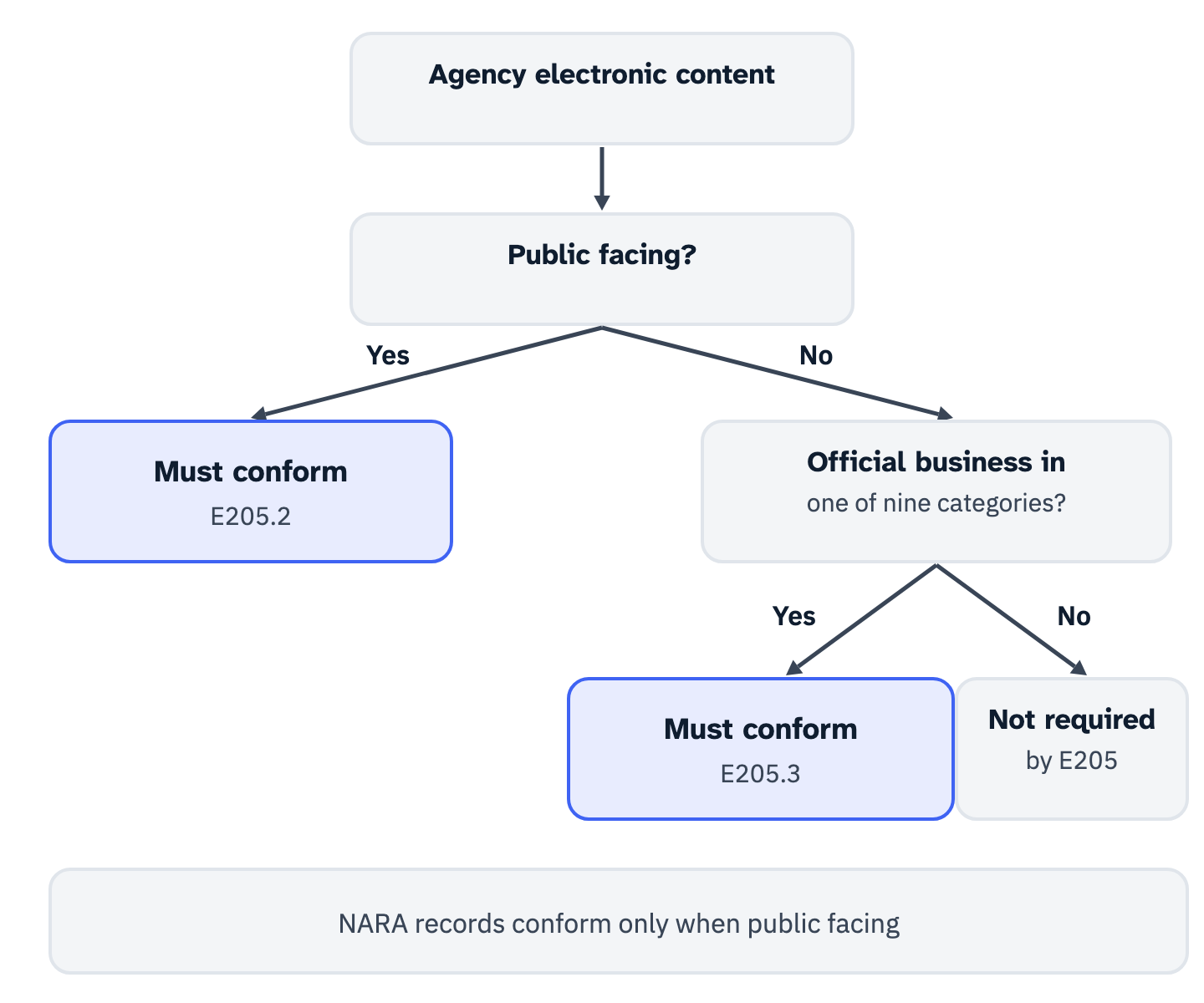
Scope starts with who sees the content. E205.2 requires that “electronic content that is public facing shall conform,” and the standards define public facing as “content made available by an agency to members of the general public,” naming “an agency Web site, blog post, or social media pages” as examples.
Content that is not public facing has to conform when it is official business communicated through one of nine channels listed in E205.3. The 2017 rule’s preamble counts them the same way: “nine categories of non-public-facing content that communicate agency official business.”
View the data as a list
- Public facing: must conform (E205.2).
- Not public facing, official business in one of the nine categories: must conform (E205.3).
- Not public facing, none of the nine categories: not required to conform by E205.
- Records maintained by NARA: required to conform only when public facing (E205.3 Exception).
The nine categories, as E205.3 lists them:
| Letter | Category |
|---|---|
| A | An emergency notification |
| B | An initial or final decision adjudicating an administrative claim or proceeding |
| C | An internal or external program or policy announcement |
| D | A notice of benefits, program eligibility, employment opportunity, or personnel action |
| E | A formal acknowledgement of receipt |
| F | A survey questionnaire |
| G | A template or form |
| H | Educational or training materials |
| I | Intranet content designed as a Web page |
Category H brings agency training into scope even when only staff see it, which is why the guide to Section 508 compliant eLearning applies inside an agency as well as outside it. One exception sits under E205.3: records maintained by the National Archives “pursuant to Federal recordkeeping statutes” are not required to conform “unless public facing.”
Run the content inventory against this table. Mark each item public facing or internal; for internal items, record the letter that brings it into scope, or “none.” An item with no letter and no public audience falls outside E205, and the inventory shows why.
Functional performance criteria cover what the technical rules leave out
WCAG 2.0 does not describe every function of every product. For that gap, E204.1 states that “where the requirements in Chapters 4 and 5 do not address one or more functions of ICT, the functions not addressed shall conform to the Functional Performance Criteria specified in Chapter 3.” The 2017 rule calls them “outcome-based provisions that apply when applicable technical requirements … do not address one or more features of ICT.”
Chapter 3 of Appendix C sets nine criteria, 302.1 to 302.9: use without vision, with limited vision, without perception of color, without hearing, with limited hearing, without speech, with limited manipulation, with limited reach and strength, and with limited language, cognitive and learning abilities. The same criteria judge equivalent facilitation under E101.2, when a design meets the intent of a requirement by another route.
For web content, WCAG 2.0 carries the test through E205.4. The criteria matter for the functions that Chapters 4 and 5 do not address. A 508-edition ACR has a row for each of the nine, and functional performance criteria as ACR rows explains how to complete them. When a function has no WCAG criterion, name the Chapter 3 criterion it is tested against in the test plan.
The exceptions belong to the agency, not to the vendor
Appendix A lists six general exceptions, E202.2 to E202.7:
- Legacy ICT. Existing ICT that met the 2000 standards and has not been altered since January 18, 2018 (E202.2).
- National security systems. ICT operated as part of a national security system (E202.3).
- Federal contracts. “ICT acquired by a contractor incidental to a contract” (E202.4).
- Maintenance spaces. Status indicators and operable parts in spaces used only by service personnel (E202.5).
- Undue burden or fundamental alteration. Conformance is required only to the extent it imposes neither (E202.6).
- Best meets. Where conforming ICT “is not commercially available,” the agency buys what best meets the standards (E202.7).
Two features of these exceptions follow from the text. The determination is the agency’s: “The responsible agency official shall document in writing the basis for determining” an undue burden or fundamental alteration, and the agency must still provide access “by an alternative means that meets identified needs.” The contract exception is narrow: the FAR explains it at 39.204(a)(2) as ICT “for in-house use by the contractor to perform the contract,” which covers the vendor’s own tools and not the product it delivers.
A vendor cannot grant itself an exception in an ACR. When a requirement cannot be met, report the gap honestly and leave the determination to the agency, as this guide to Section 508 exceptions explains.
Section 508, the ADA and WCAG answer three different questions
Section 508 is section 508 of the Rehabilitation Act of 1973, added in 1986 and rewritten in 1998, and it governs the federal government’s own technology. The ADA is a separate law: the Department of Justice’s web guidance explains that it “applies to state and local governments (Title II) and businesses that are open to the public (Title III).” WCAG is the technical standard these rules point to: Section 508 to WCAG 2.0, the Title II rule to WCAG 2.1, and Title III to no version at all.
| Rule | Who it binds | Web standard | Date |
|---|---|---|---|
| Section 508 (36 CFR 1194) | Federal agencies; vendors through the acquisition | WCAG 2.0 Level A and AA | Compliance since January 18, 2018 |
| ADA Title II (28 CFR 35.200) | State and local governments | WCAG 2.1 Level A and AA | April 26, 2027 (population 50,000 or more); April 26, 2028 (smaller entities, special districts) |
| ADA Title III | Businesses open to the public | The ADA’s general requirements; DOJ’s 2022 guidance names WCAG and the 508 Standards | None in the guidance |
The Title II row is current as of November 3, 2026. 28 CFR 35.200 sets those dates after an interim final rule of April 20, 2026 moved them from April 24, 2026 and April 26, 2027, and the Department said it plans “future rulemaking processes related to the substantive requirements.” In the 2024 rule, it declined to adopt “the Access Board’s section 508 standards, which are harmonized with WCAG 2.0.” For businesses, the DOJ guidance names “the Web Content Accessibility Guidelines (WCAG) and the Section 508 Standards” as existing standards that “provide helpful guidance.”
When someone asks whether a site is “ADA and 508 compliant,” answer with the row of the table that applies, and say which version of WCAG each row measures against. A site that conforms to WCAG 2.2 Level AA, with 4.1.1 still tested, meets the WCAG requirement of both the Section 508 row and the Title II row; whether it meets the obligation is the agency’s, the contract’s or counsel’s question.
Your next step
Put the solicitation’s accessibility sentence into the project brief. Inventory the site’s content as public facing or one of the nine internal categories. Then test against WCAG 2.0 Level A and AA under E205.4, with 4.1.1 included, and record each result per success criterion; the accessibility testing tools guide shows which checks a tool can make and which need a person.
Two questions belong to others. An exception, an undue burden or a “best meets” purchase is the agency’s determination, made in writing. Whether a federal grant, a state contract or a Title II obligation applies on top of Section 508 is a question for counsel, and the ACR that answers a buyer is described in VPAT and ACR for Section 508 and in the notes on the VPAT 2.5 template. The consequences of skipping the work are covered in what happens if you ignore Section 508.
ADA Compliance Pros confirms which framework applies before recommending any work, then tests websites, web applications, documents and other ICT against WCAG 2.0 Level A and AA, the standard Section 508 is measured on. The testing pairs an automated baseline with manual passes by keyboard, with JAWS, NVDA and VoiceOver, and with screen magnification, follows the federal test procedures in the ICT Testing Baseline for Web, and ties every finding to its WCAG 2.0 criterion with its location and evidence.
The team also helps interpret the accessibility requirements in an RFP and prepares the VPAT or ACR in the correct 508 edition. Bring the solicitation to a call, and the work will be scoped with you as part of Section 508 compliance services.