
Medicaid systems: the Section 508 condition on enhanced FFP
Section 508 does not bind a state agency. The Medicaid match does.
A solicitation for a state Medicaid eligibility and enrollment replacement says “must be Section 508 compliant,” and someone on the bid team who has read the statute points out that Section 508 reaches federal agencies. They are right. 29 U.S.C. 794d(a)(1)(A) opens with “each Federal department or agency, including the United States Postal Service,” and never adds a state. GSA puts it plainly on section508.gov: “Since Section 508 of the Rehabilitation Act of 1973 only applies to federal agencies, the short answer is no.”
That is a correct answer to a different question. The state agency is not covered through the Rehabilitation Act. It is covered because CMS wrote the standard into the price of the federal match, at 42 CFR 433.112(b)(12): one clause of one of twenty-two conditions a state must meet before CMS will approve a Medicaid eligibility, enrollment or claims system for enhanced federal financial participation. The string “508” appears exactly once in all of 42 CFR part 433, and this is where.
The sentence, and where it actually stops
Quoted from 42 CFR 433.112, with the elision marked:
The agency meets accessibility standards established under section 508 of the Rehabilitation Act, or standards that provide greater accessibility for individuals with disabilities, and compliance with Federal civil rights laws[.]
The bracket matters. In the regulation the sentence runs on through a semicolon list covering standards adopted under section 1561 of the Affordable Care Act and Core Set reporting protocols, and paragraph (b)(12) is otherwise about health IT standards and the HIPAA rules. The accessibility language is a clause, not a freestanding condition, and its neighbors are what CMS discusses when it returns to (b)(12).
CMS explained the accessibility clause once, in the April 2011 final rule that created it. Answering a comment on the standards and conditions, CMS wrote, at 76 FR 21961:
Our final rules will require that systems include usability features or functions that accommodate the needs of persons with disabilities, including those who use assistive technology. … The Department also encouraged States to follow either the 508 guidelines or guidelines that provider greater accessibility to individuals with disabilities, and noted that States could consult the latest Section 508 guidelines issued by the US Access Board or W3C’s Web Content Accessibility Guidelines (WCAG) 2.0
That passage is fifteen years old, “provider” is CMS’s typo for “provide”, and its verb is “encouraged”. It is also the only place CMS has named a technical standard for this clause.
Other federal routes push the Access Board’s standards onto a state, and they are softer or narrower. The Assistive Technology Act assurance at 29 U.S.C. 3003(d)(5)(G) reaches only activities “supported by Federal funds received under this chapter.” The Labor Department’s WIOA title I rule, 29 CFR 38.15(a)(5), asks a recipient for technologies “consistent with modern accessibility standards, such as Section 508 Standards (36 CFR part 1194) and W3C’s Web Content Accessibility Guidelines (WCAG) 2.0 AA,” where the words “such as” do the work. The Medicaid clause names the standards without that hedge, and it reaches a whole eligibility or claims system, through the money rather than through a civil rights duty.
The condition is tested at three separate moments
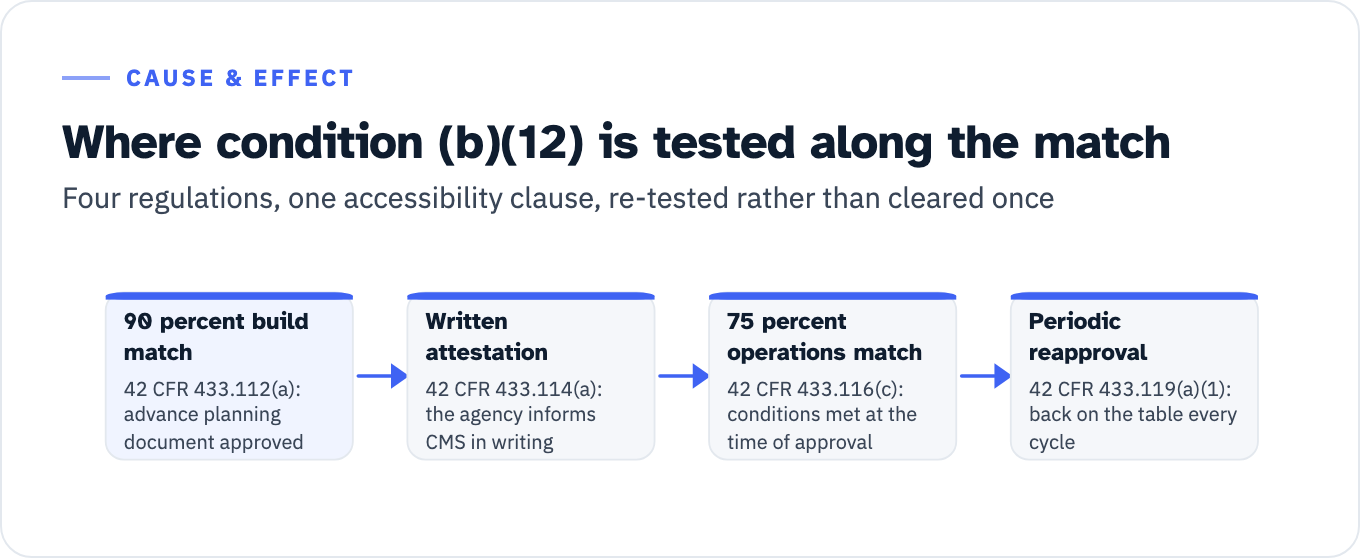
42 CFR 433.112(a) conditions the 90 percent design, development and installation match on CMS approving the advance planning document, and paragraph (b) opens the list of conditions. Condition twelve is on it.
42 CFR 433.114(a) requires that “the Medicaid agency must inform CMS in writing that the system meets the conditions specified in § 433.116(c) through (i).” That is an affirmative written statement by the agency, not a silence CMS has to disprove.
42 CFR 433.116, which governs the 75 percent operations match, catches condition twelve twice: paragraph (c) requires that “The conditions of § 433.112(b)(1) through (22) must be met at the time of approval,” and paragraph (i) separately requires (b)(10) through (b)(16). Then 42 CFR 433.119(a)(1) puts it back on the table at every periodic reapproval, granted where “The system meets the requirements of § 433.112(b)(1), (3), (4), and (7) through (22).”
So the accessibility clause is not a gate cleared once at go-live. It is re-tested for as long as the state claims the operations match.
View the data as a list
- 90 percent build match: 42 CFR 433.112(a): advance planning document approved
- Written attestation: 42 CFR 433.114(a): the agency informs CMS in writing
- 75 percent operations match: 42 CFR 433.116(c): conditions met at the time of approval
- Periodic reapproval: 42 CFR 433.119(a)(1): back on the table every cycle
What disapproval costs, and what has never been shown to happen
The regulation states the consequence in numbers, which is rare in accessibility law. 42 CFR 433.119(c) provides that a disapproval notice carries CMS’s decision “to reduce FFP for system operations from 75 percent to 50 percent of expenditures, beginning with the first day of the first calendar quarter after CMS issues the written notice to the State,” and that the disallowance “will be appealable to the Departmental Appeals Board.” The cut is surgical: under 42 CFR 433.120(b) CMS may reduce the rate “for expenditures related to the operations of non-compliant functionality or system components.”
CMS has said in the Federal Register that a failure of paragraph (b)(12) runs through that machinery. Writing about the Core Set reporting protocols it added to the same paragraph in 2023, CMS said that “in accordance with regulations at §§ 433.117 and 433.119, we may not approve replacement State systems or may not reapprove existing State systems if the State does not meet Core Set reporting requirements that are now described in § 433.112(b)(12) and cross-referenced in § 433.116(c), which means that we would not approve or reapprove a Federal matching percentage of 75 percent” (88 FR 60303). The subject of that sentence is Core Set reporting, not accessibility. The paragraph and the cross-reference are the ones the accessibility clause sits in.
Now the honest part. No instance of that path being walked over accessibility turned up in the research for this article. What was searched: the full text of CMS’s reapproval bulletin of May 24, 2023, eight pages on the reapproval process for systems claimed at 75 percent, which holds no occurrence of “accessib” or of “508”; the full text of State Medicaid Director Letter #22-001, same result; and searches for Departmental Appeals Board decisions combining MMIS reapproval, disallowance and section 508, which returned reapproval decisions on other grounds. Treat the consequence as documented mechanism, not as demonstrated practice.
In 2011 a commenter put the enforcement question directly, asking how CMS would measure compliance with (b)(12) and whether a state short in one area, such as part of the ICD-10 conversion, would risk all enhanced FFP. CMS answered that it has “the authority to withhold enhanced FFP (or potentially all FFP) for issues of noncompliance with the conditions listed in Title XIX of the Act,” and that it would give states “the opportunity to correct any failures that might endanger FFP” (76 FR 21962). Read the limit as well as the threat: the conditions “listed in Title XIX of the Act” are statutory, and the accessibility clause is not in the statute.
From “section 508” to WCAG 2.0, and where that chain stops
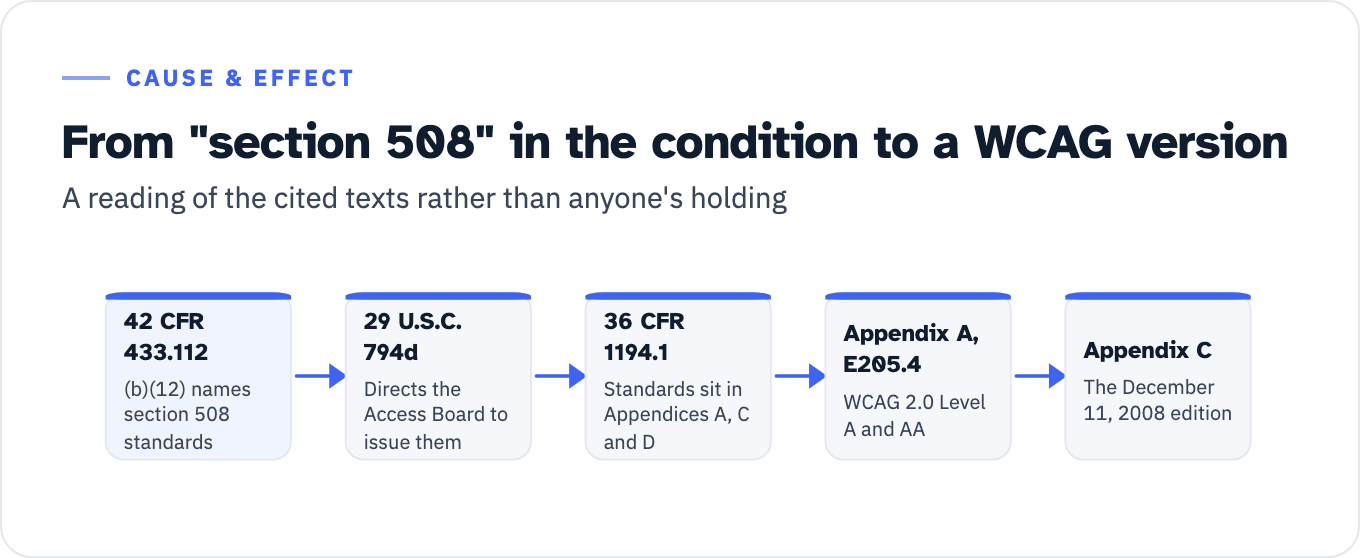
The condition names a statute, not a version, and no single CMS or DOJ document sets out the steps between them. What follows is a reading of the cited texts rather than anyone’s holding.
Condition (b)(12) points at standards “established under section 508 of the Rehabilitation Act.” Section 508 is 29 U.S.C. 794d, which directs the Access Board to issue them. 36 CFR 1194.1 says those standards “are set forth in Appendices A, C and D to this part.” Appendix A, provision E205.4: “Electronic content shall conform to Level A and Level AA Success Criteria and Conformance Requirements in WCAG 2.0 (incorporated by reference, see 702.10.1).” Provision E207.2 says the same of user interface components and of the content of platforms and applications, and Appendix C fixes the edition as the “W3C Recommendation, December 11, 2008.”
That is also where the chain stops being about WCAG, and a bid drafted from those links alone will under-scope. Appendix A reaches past content. E206.1 sends hardware components to Chapter 4. E207.1 sends software components to Chapter 5, which carries 502 Interoperability with Assistive Technology and 503 Applications. Chapter 6 governs support documentation and services, and Chapter 3 sets Functional Performance Criteria. None of that is WCAG, so a clean WCAG report says nothing about 502.2, 503.2 or 602.2.
Two more limits deserve stating rather than smoothing over. The word “WCAG” appears nowhere in 42 CFR part 433, so the version arrives only by following that chain. And the alternative is undefined: “standards that provide greater accessibility for individuals with disabilities” names no benchmark, no version and no decision maker. DOJ records that “WCAG 2.1 is built on and is backwards compatible with WCAG 2.0” (89 FR 31346), so the sensible reading is that conforming to 2.1 satisfies a clause written around 2.0. No CMS document says that a WCAG 2.1 report discharges (b)(12), and the only version CMS has ever named for this clause is WCAG 2.0, in 2011. Treat it as open, and keep the map of which WCAG version each US rule requires beside you when drafting the clause. The condition also carries no date at all, which is why it goes missing from calendars built around 2027.
View the data as a list
- 42 CFR 433.112: (b)(12) names section 508 standards
- 29 U.S.C. 794d: Directs the Access Board to issue them
- 36 CFR 1194.1: Standards sit in Appendices A, C and D
- Appendix A, E205.4: WCAG 2.0 Level A and AA
- Appendix C: The December 11, 2008 edition
The same portal is standing under five rules at once
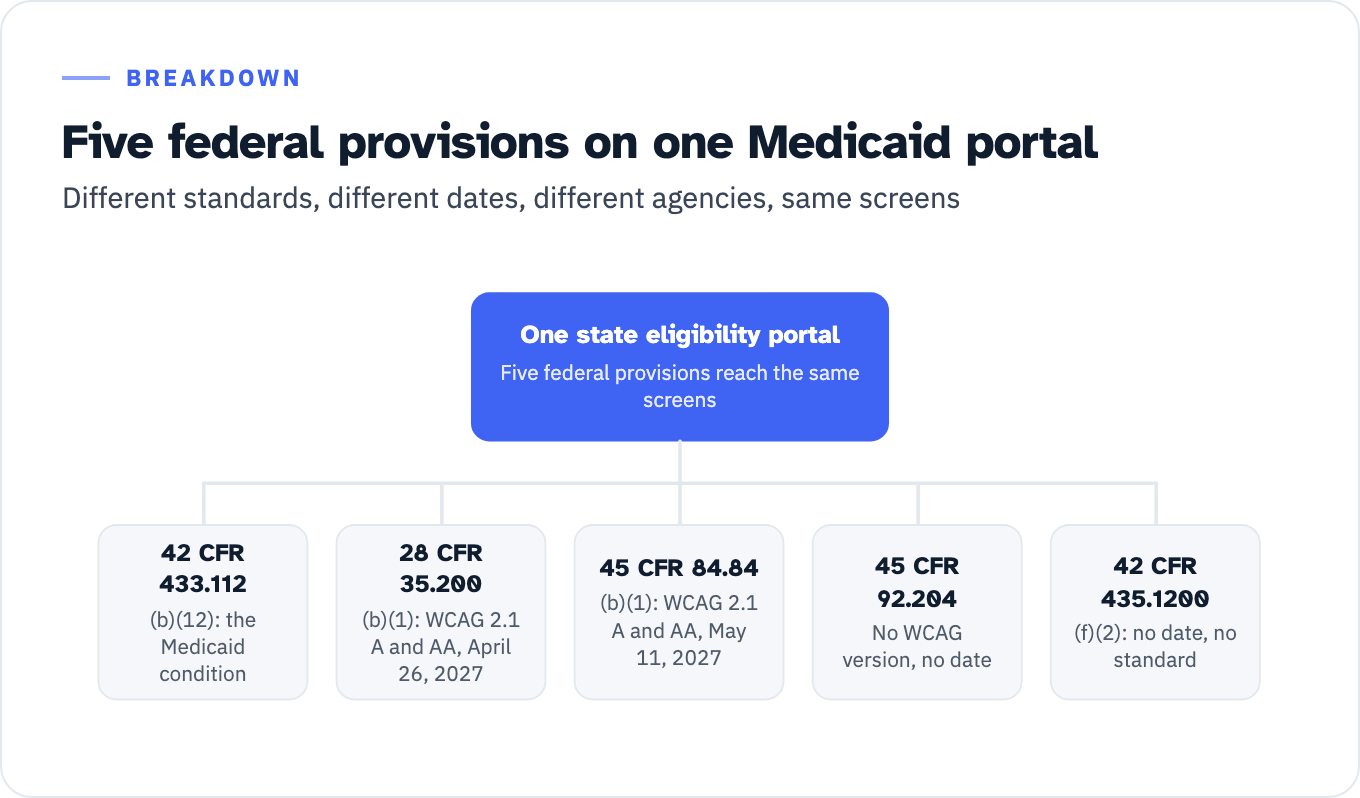
The Medicaid condition is the first of at least five federal provisions reaching a state eligibility portal, and they point at different standards, dates and agencies.
The second is the ADA Title II web rule. 28 CFR 35.200(b)(1) requires a public entity with a total population of 50,000 or more, other than a special district government, to ensure that the web content and mobile apps it “provides or makes available, directly or through contractual, licensing, or other arrangements,” comply with WCAG 2.1 Level A and AA, “Beginning April 26, 2027.” That date is new: an interim final rule published April 20, 2026 at 91 FR 20902 moved both Title II dates back a year, so a calendar still treating April 26, 2027 as the small entity date was built from the 2024 rule and is wrong.
The third is the HHS Section 504 rule at 45 CFR 84.84(b)(1), requiring WCAG 2.1 Level A and AA of a recipient with fifteen or more employees “Beginning May 11, 2027.” A state Medicaid agency is a recipient, and HHS said so by name at 89 FR 40074: “State Medicaid programs receive Federal funds and are therefore covered by section 504.” That date also moved, by an HHS interim final rule published May 11, 2026 at 91 FR 25496.
The fourth is the ACA section 1557 rule. 45 CFR 92.204 requires a covered entity to ensure that its health programs and activities “provided through information and communication technology are accessible to individuals with disabilities,” unless that would mean “undue financial and administrative burdens or a fundamental alteration,” and paragraph (b) requires a recipient’s websites and mobile apps to “comply with the requirements of section 504 of the Rehabilitation Act, as interpreted consistent with title II of the ADA.” Part 92 applies to every health program or activity any part of which receives federal financial assistance from HHS, directly or indirectly (45 CFR 92.2(a)(1)). It names no WCAG version and sets no date, so it does not change the technical answer. It changes who can act on it: 45 CFR 92.301 carries over the enforcement mechanisms of title VI, title IX, section 504 and the Age Discrimination Act, a route running through the HHS Office for Civil Rights rather than through the match.
The fifth is Medicaid’s own, and it is the one nobody writes about. 42 CFR 435.1200(f)(2) requires the state’s Medicaid website, “any interactive kiosks and other information systems established by the State to support Medicaid information and enrollment activities,” to be accessible to individuals with disabilities, consistent with 42 CFR 435.905(b) and its duty to provide “auxiliary aids and services at no cost to the individual.” No date. No technical standard. In force the whole time.
The section 504 rule declined to adopt the Section 508 standards, and said so in terms: HHS “declines to adopt the Access Board’s section 508 standards, which are harmonized with WCAG 2.0” (89 FR 40131). So one portal is asked for WCAG 2.0 by the money condition and WCAG 2.1 by the two dated civil rights rules, on the same screens. Both of those dates rest on interim final rules whose comment periods have closed, DOJ’s on June 22 and HHS’s on July 6, 2026, and DOJ says it “will consider issuing an NPRM providing members of the public with an opportunity to comment on the substance of the 2024 final rule” during the extension period, adding that “Regardless of the compliance dates, covered entities have an ongoing obligation” to keep web content and mobile apps accessible under Title II (91 FR 20908). Our read of what the 2026 extensions did and did not move covers the rest.
View the data as a list
One state eligibility portal: Five federal provisions reach the same screens
- 42 CFR 433.112: (b)(12): the Medicaid condition
- 28 CFR 35.200: (b)(1): WCAG 2.1 A and AA, April 26, 2027
- 45 CFR 84.84: (b)(1): WCAG 2.1 A and AA, May 11, 2027
- 45 CFR 92.204: No WCAG version, no date
- 42 CFR 435.1200: (f)(2): no date, no standard
Does a Section 508 test report satisfy the Medicaid condition?
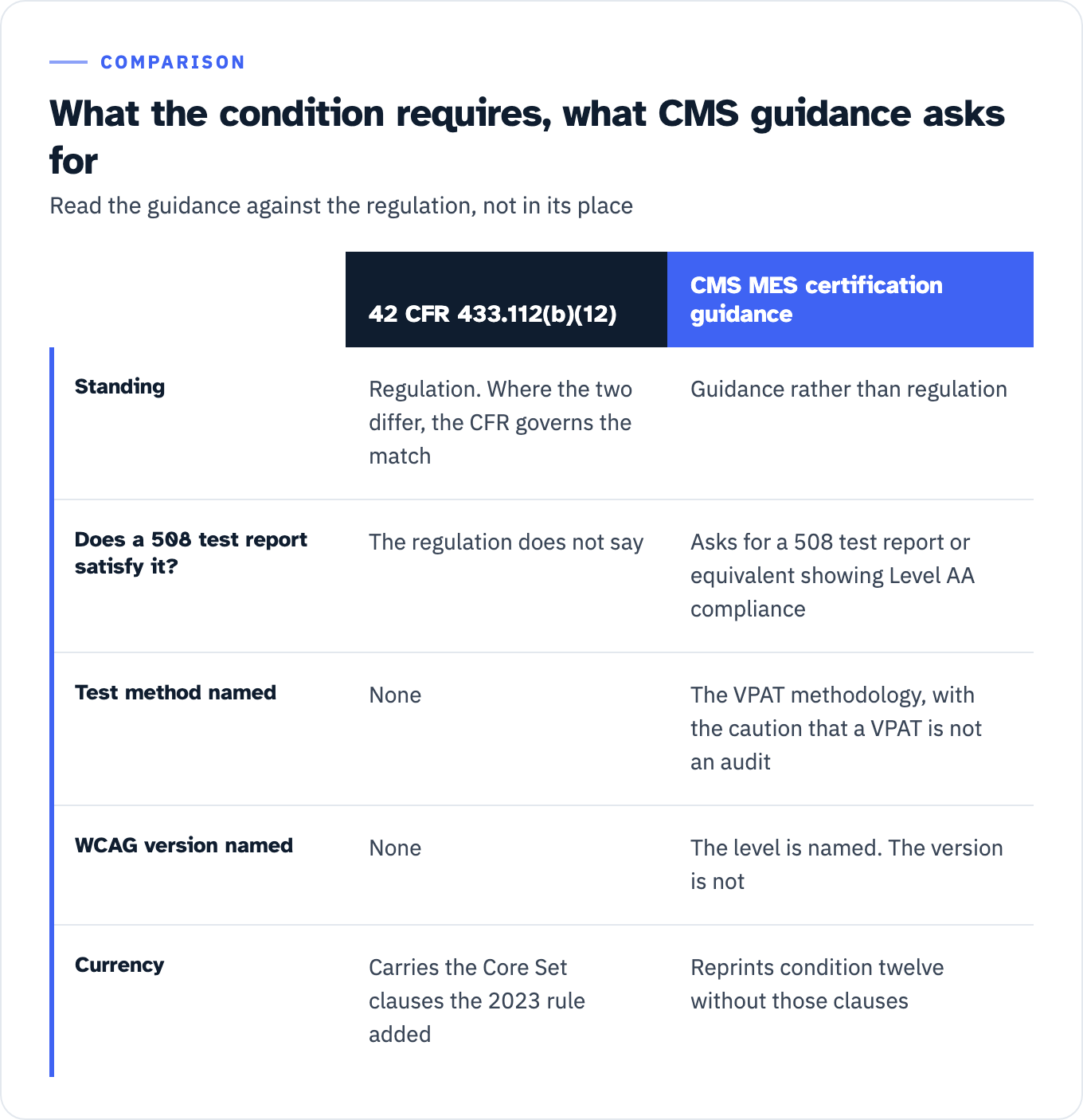
The regulation does not say. CMS’s guidance does, and it should be read as guidance rather than as regulation.
CMS publishes a MES Certification Repository through the CMCS Data and Systems Group, which states that “states must attest that the system complies with all of the applicable 22 conditions for enhanced funding (CEF) as provided in 42 CFR § 433.112.” Its example evidence for condition twelve is a list headed “Required:”, whose last item is the one to write into a bid: “508 test report or equivalent showing Level AA compliance.” The level is named. The version is not.
The repository’s Security and Privacy page resolves the tension this article opened with, in CMS’s own words:
Section 508 of the Rehabilitation Act applies directly to federal agencies; however, its testing standards and the Voluntary Product Accessibility Template (VPAT) methodology are widely accepted by CMS as the practical means for SMAs to demonstrate accessibility compliance for MES modules.
The same page recommends the VPAT, accepts alternative formats where testing was performed and reports are provided, and cautions that “a VPAT is not an audit (an audit goes into much greater detail).” It asks states still testing against the older standard for “written plans to achieve WCAG 2.1 Level AA conformance by their applicable IFR-extended compliance date.” If you are handing a state a conformance report, how a reviewer scores it decides whether it lands.
Read that guidance against the regulation, not in its place. The repository’s own reference note still describes compliance as due “2 or 3 years from published date of April 24, 2024,” which the 2026 extension superseded, and the Streamlined Modular Certification Guidance version 2.0 reprints condition twelve without the Core Set clauses the 2023 rule added. Where the two differ, the CFR governs the match.
View the data as a table
| 42 CFR 433.112(b)(12) | CMS MES certification guidance | |
|---|---|---|
| Standing | Regulation. Where the two differ, the CFR governs the match | Guidance rather than regulation |
| Does a 508 test report satisfy it? | The regulation does not say | Asks for a 508 test report or equivalent showing Level AA compliance |
| Test method named | None | The VPAT methodology, with the caution that a VPAT is not an audit |
| WCAG version named | None | The level is named. The version is not |
| Currency | Carries the Core Set clauses the 2023 rule added | Reprints condition twelve without those clauses |
The gap: internal systems
The sharpest unresolved point sits inside CMS’s own guidance. The Security and Privacy page states flatly that the Title II web rule “does not apply to the internal, non-public systems.” The DOJ passage it relies on, at 89 FR 31344, does not say that. Answering commenters who asked about applications used solely by employees, DOJ said subpart H “includes requirements for the web content and mobile apps provided or made available by public entities within the scope of title II,” then noted that compliance with subpart H will not relieve entities of their distinct employment-related obligations under Title I. CMS’s rendering substitutes “this rule” for DOJ’s “subpart H of this part,” and DOJ never states the exclusion.
Then ask the separate question of what the Medicaid condition reaches, because the standards it incorporates do draw a public and internal line, for content. E205.2 scopes electronic content “that is public facing.” E205.3 scopes content that is not public facing only where it is official business communicated through one of nine listed forms, among them “An initial or final decision adjudicating an administrative claim or proceeding,” “A notice of benefits, program eligibility, employment opportunity, or personnel action” and “Intranet content designed as a Web page.” A hostile reviewer opens there first, and the concession is real.
The line disappears one provision later. E207.1 carries no public facing qualifier: “Where components of ICT are software and transmit information or have a user interface, such components shall conform to E207 and the requirements in Chapter 5.” A caseworker eligibility portal and a claims adjudication workbench are software with a user interface, and their costs are part of the system being matched. A bid that scopes testing to the citizen-facing portal has scoped to the civil rights rules, not to the condition that pays for the build.
What this means before the RFP goes out
Accessibility language in a Medicaid systems procurement passes a federal desk earlier than a bidder might assume. Under 45 CFR 95.611(b)(2)(iii), a state seeking enhanced FFP needs prior approval from HHS, which for Medicaid means CMS, of the acquisition solicitation documents and the contract, “unless specifically exempted by the Department,” when the contract “is anticipated to or will exceed $500,000.” The operations match also follows the contractor’s work: 42 U.S.C. 1396b(a)(3)(B) pays 75 percent for these systems “whether such systems are operated directly by the State or by another person under a contract with the State.”
Four things belong in the accessibility section of such a bid or contract, and none of them is the phrase “ADA compliant”:
- The citation in full: 42 CFR 433.112(b)(12), with 433.116(c) and (i) and 433.119(a)(1) named, so reapproval sits inside the obligation.
- A version, a level, and the parts of the 508 standards that WCAG does not cover. WCAG 2.1 Level A and AA satisfies the Title II and Section 504 rules on their face and is the safer reading of “standards that provide greater accessibility.” Add the non-WCAG chapters of the Revised 508 Standards, which the 508 columns of a full VPAT already report.
- Scope that names internal modules, not only the public portal.
- A deliverable matching CMS’s phrasing: a test report or equivalent showing Level AA conformance, with test method and tools named, refreshed on the reapproval cycle.
What is not known
No state has been publicly shown to lose or have reduced enhanced FFP over accessibility. The mechanism is written down; the instance was searched for and not found.
CMS has explained the clause once. The April 2011 preamble quoted above is the whole of it: the 2015 rule that carried the language forward reprints it without discussion, and the 2023 rule that gave the sentence its current shape discusses the Core Set clauses only. Congress never wrote accessibility into the Medicaid systems statute either. 42 U.S.C. 1396b contains no reference to the Rehabilitation Act or to any ICT accessibility term, so the condition is CMS’s regulatory choice, which a rule can change without legislation.
And there is no published count of anything here: not of states conforming, not of 508 test reports CMS has accepted or rejected, not of corrective action plans, not of the cost of remediating a Medicaid system. Anyone quoting you such a number should be asked for the source.
One boundary. Whether a particular agency is a public entity with a total population of 50,000 or more, whether a fundamental alteration or undue burden defense is available to it, and how to answer a disallowance are questions for the agency’s counsel. What sits on our side of the line is the standard, the test, the evidence and the report, which is what our Section 508 testing work covers for state government programs and the healthcare systems beside them.
Next step
Open the accessibility requirement in the Medicaid solicitation or contract in front of you and check three lines. Does it cite 42 CFR 433.112(b)(12), or only “Section 508”? Does it name a WCAG version and level, or an adjective? Does its scope reach the worker-facing modules, or stop at the public portal? If any of the three comes back short, that is the gap between a document that satisfies a reviewer and one that satisfies a condition attached to a federal match the state will claim for as long as the system runs.