
ADA demand letter: four state statutes and the 90-day record
What the four statutes actually give you
A demand letter arrives naming your website, one or two barriers, a statute, and a number. Whatever response deadline the letter sets for itself, you have to decide whether to pay it, contest it, quietly fix the site and hope, or fix the site on a documented clock. If your state is one of the four with an abusive-litigation statute, you may also have been told that you now have a 30-day or 90-day window to cure the problem before anyone can sue you.
That reading is wrong, and it is wrong in a flattering direction. Four states have enacted statutes aimed at abusive website access litigation: Kansas, Utah, Missouri and Georgia. None of them creates immunity. None of them bars, stays or dismisses a federal claim under Title III of the ADA. What three of the four create is a rebuttable presumption, available only in a separate action brought after the fact against the party who sued you. The fourth, Georgia, has no notice requirement and no cure window at all.
The commercially useful half is the operational one: what the cure record has to contain before that presumption is worth anything, who has to sign it, and what has to be dated. That part is fully sourceable, and it is the part you can buy this week.
One boundary before the detail. Legal strategy on the demand letter itself belongs to your counsel, not to your accessibility vendor. What follows is the statutory mechanics and the evidence file, which is the part that sits on your side of the line.
All four are built the same way, and the shape is not what the word “cure” suggests. The statute hands you nothing to raise inside the accessibility case. It hands you a separate cause of action against the party who filed against you, and in each of the three notice states the Attorney General can bring or intervene in that action as well.
Missouri says so in plain words. Any resident of Missouri subject to website access litigation, or the Attorney General on behalf of a class of such residents, “may file a civil action in any court of competent jurisdiction within this state against the party, attorney, or law firm that initiated such litigation for a determination as to whether such litigation alleging a website or web content access violation is abusive litigation” (RSMo section 537.1250; the text as truly agreed to is in the enrolled bill PDF).
Kansas reads almost identically, down to the phrase “may file a civil action in any court of competent jurisdiction within this state” (K.S.A. 60-5005(b)(1)). Utah is built the same way but names no forum at all: “A defending party has a right of action against a filing party who initiated a website access lawsuit against the defending party if the website access lawsuit is abusive,” and the Attorney General may bring that action on the defending party’s behalf (Utah Code 78B-3-1302). If you have read that all three route you into state court, read the Utah text again. It confers a right of action and stops there.
Georgia’s version is a separate tort action too, but it fires on a different trigger entirely, which is covered below.
So the sequence in the three notice states is: you receive notice, you work the clock, and the accessibility case proceeds on its own schedule. What these statutes freeze is the abusiveness finding, not the underlying case. Kansas 60-5005(b)(3), RSMo 537.1250.2(3) and Utah 78B-3-1302(4) each bar the trier of fact from deciding whether the filing was abusive until the cure period expires or the court determines the violation is corrected, whichever happens first. Kansas and Missouri separately require the court, at the conclusion of the underlying litigation, to review the reasonableness of any fee award before entering judgment. In Kansas the Attorney General can issue a written determination that the suit is not abusive, and if that determination is attached to the petition it raises a rebuttable presumption running the other way.
No published decision applying any of these four statutes turned up in the research for this article. Treat every mechanic below as text on the page rather than as construed law.
The comparison matrix
Read the last row of this matrix first. Whatever else a statute does, the answer in that row is the same in all four states, and it is the answer that determines what you do on Monday.
Kansas has had K.S.A. 60-5005 since 2023, so this is not a 2026 development, and the three 2026 statutes are not copies of it.
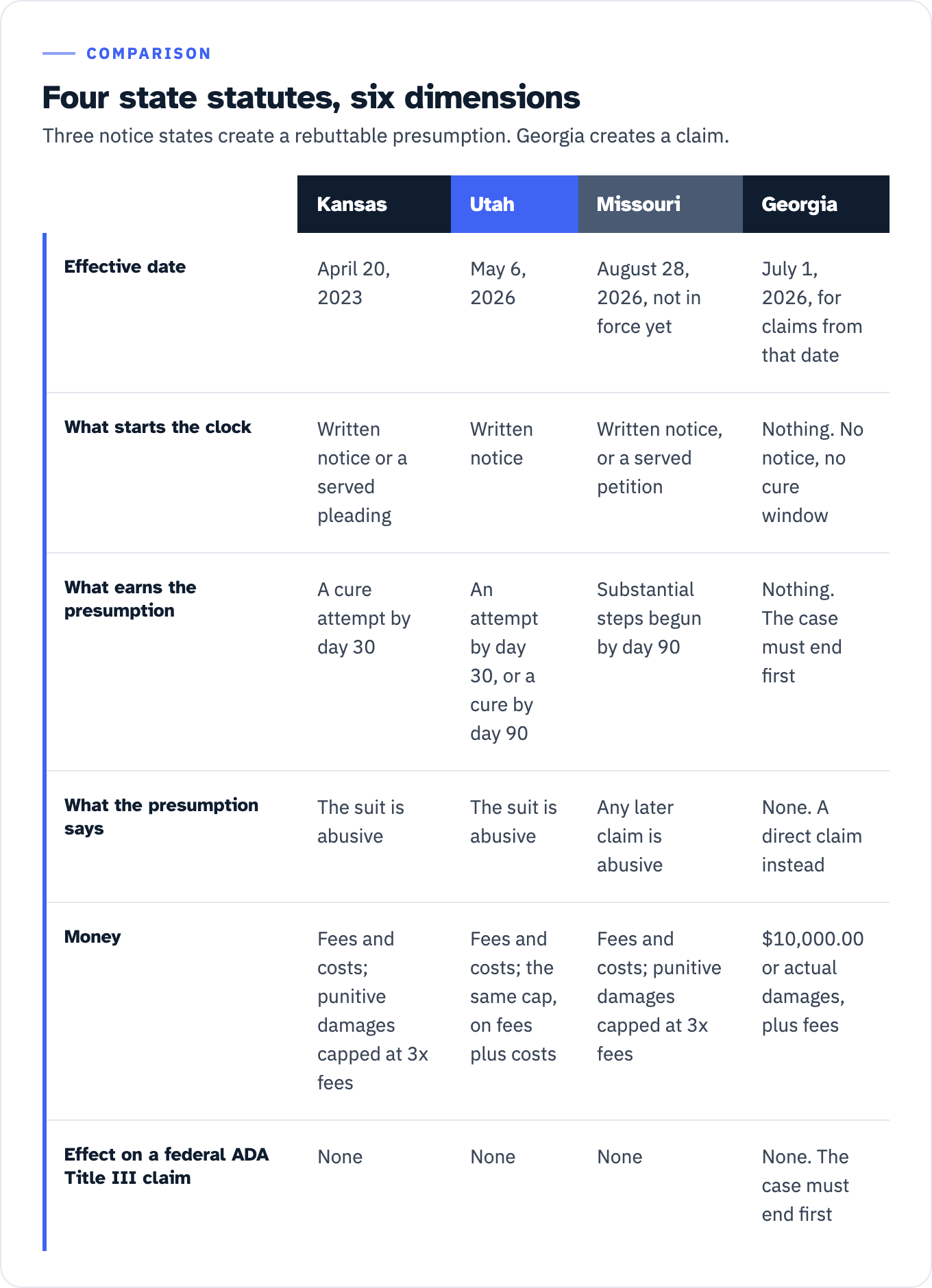
View the data as a table
| Kansas | Utah | Missouri | Georgia | |
|---|---|---|---|---|
| Effective date | April 20, 2023 | May 6, 2026 | August 28, 2026, not in force yet | July 1, 2026, for claims from that date |
| What starts the clock | Written notice or a served pleading | Written notice | Written notice, or a served petition | Nothing. No notice, no cure window |
| What earns the presumption | A cure attempt by day 30 | An attempt by day 30, or a cure by day 90 | Substantial steps begun by day 90 | Nothing. The case must end first |
| What the presumption says | The suit is abusive | The suit is abusive | Any later claim is abusive | None. A direct claim instead |
| Money | Fees and costs; punitive damages capped at 3x fees | Fees and costs; the same cap, on fees plus costs | Fees and costs; punitive damages capped at 3x fees | $10,000.00 or actual damages, plus fees |
| Effect on a federal ADA Title III claim | None | None | None | None. The case must end first |
| Kansas | Utah | Missouri | Georgia | |
|---|---|---|---|---|
| Citation | K.S.A. 60-5005 (HB 2016, 2023 ch. 27) | Utah Code 78B-3-1301, 78B-3-1302 (S.B. 68, 2026) | RSMo 537.1250 (HCS/SS/SCS/SBs 907, 1154 and 1272) | O.C.G.A. 51-1-58 (HB 1470, Act 458) |
| Effective date | April 20, 2023, on publication in the Kansas Register | May 6, 2026 | August 28, 2026. Not yet in force as of July 27, 2026 | July 1, 2026, for causes of action accruing on or after that date |
| What starts the clock | Written notice, or service of a pleading, “with sufficient detail to identify and correct the alleged violation” | Written notice “with sufficient detail to identify and cure the website access violation” | Written notice, for the presumption. Written notice or service of a petition or complaint, for the 90-day correction test | Nothing. No notice requirement and no cure window |
| Trigger for the presumption or claim | Good-faith cure attempt within 30 days | Good-faith cure attempt within 30 days, or actual cure within 90 days | Good-faith initiation of substantial steps within 90 days | The underlying ADA action is adjudicated on the merits against the claimant, involuntarily dismissed at any stage, or dismissed for lack of standing |
| What is lost, and when | Presumption gone if the violation is not corrected, as determined by the court, within 90 days | Neither door met, no presumption | Presumption gone if the violation is not corrected, as determined by the court, within 90 days | Not applicable |
| What you get | Rebuttable presumption that initiating or continuing the suit is abusive litigation | Rebuttable presumption that the lawsuit is abusive, decided on a preponderance standard | Rebuttable presumption that any subsequent claim is abusive | A cause of action against the claimant and the claimant’s attorney |
| Money | Fees and costs; punitive damages or sanctions capped at 3x the attorney fees awarded | Fees and costs for bringing the action and for the underlying matter; punitive damages; Rules-based sanctions. Punitive damages plus monetary sanctions capped at 3x the fee-and-cost award | Fees and costs for the abusive-litigation action and the underlying matter; punitive damages or sanctions capped at 3x the attorney fees awarded | Actual damages for business disruption and lost opportunity cost, or $10,000.00 statutory damages, whichever is greater; fees for both actions; treble damages on written notice of the Code section plus refusal to dismiss |
| Distinctive feature | Attorney General can issue a written “not abusive” determination that creates the opposite presumption | Two independent doors at 30 and 90 days; explicit preponderance standard | Applies to litigation already pending on August 28, 2026; protects the state and its political subdivisions by name | Two-year limitation from entry of judgment; text says it “shall be narrowly construed” |
| Sunset | Expires when DOJ issues Title III website standards and the AG’s certification is published in the Kansas Register | Part 13 repealed July 1, 2031 by Utah Code 63I-1-278(3) | Contingent on DOJ Title III standards, and then only as to registered entities and the state and its political subdivisions | None stated in the enacted text |
| Effect on a federal ADA Title III claim | None | None | None | None. The claim has to end first |
Two of those sunsets need a word, because they are not dates. Kansas and Missouri expire when the Department of Justice issues website accessibility standards under Title III of the ADA and the state attorney general certifies or notifies that it has happened. It has not happened. The DOJ web accessibility rule sits under Title II and reaches state and local government entities: the April 2026 interim final rule amends 28 CFR part 35, the Title II regulation, and extends those compliance dates to April 26, 2027 for public entities serving 50,000 or more people and April 26, 2028 for smaller entities and special district governments. None of that is a Title III standard, and the Department said so in February 2026 at footnote 4 of its Alcazar filing: “The United States does not endorse WCAG as the appropriate or necessary standard for the provision of auxiliary aids and services under Title III of the ADA.” Kansas wrote the same premise into its own 2023 purpose clause: “The lack of standards issued by the federal department of justice concerning website accessibility under title III of the federal Americans with disabilities act has resulted in the need for this process.”
Kansas: the original, and the only one with a counter-presumption
Kansas passed HB 2016 in 2023. The session law says the act “shall take effect and be in force from and after its publication in the Kansas register,” and records that it was approved April 17, 2023 and published in the Kansas Register April 20, 2023. The revisor’s history line for K.S.A. 60-5005 reads “L. 2023, ch. 27, § 1; April 20.” Seyfarth’s ADA Title III blog reported in May 2023 that the law would begin “starting on July 1, 2023”. If you are calendaring a Kansas matter, use the revisor’s date.
The Kansas mechanic is a 30-day door and a 90-day trapdoor in one sentence pair. A good-faith attempt to cure within 30 days of written notice, or of service of a pleading with sufficient detail, creates the rebuttable presumption. Failure to correct within 90 days, “as determined by the court,” destroys it.
Two Kansas features have no equivalent in the enacted text of the others. The first is the counter-presumption at subsection (c): a written Attorney General determination that the litigation is not abusive, attached to the petition in the accessibility case, creates a rebuttable presumption that it is not. The second is that Kansas is the only one of the four whose factor list names your headcount. It weighs “the number of full-time employees employed by the defendant and the resources available to the defendant to engage in the litigation,” and separately “the resources available to the defendant to correct the alleged website access violation.” Utah reaches similar ground through two softer factors, the defending party’s “ability to engage in the website access lawsuit” and its “ability to cure the website access violation.” Missouri’s five factors do not ask about the defendant’s size at all. A small operator and a national retailer are not standing in the same place under the Kansas statute.
Kansas also wrote its own limit into the purpose clause: the process “shall not be used to preclude a person with a disability from asserting their right to equal access to a public accommodation under the law” either as an individual or as a class, where the litigation is brought in good faith. And when the Kansas court reviews the fee award at the conclusion of the case, “the results obtained in the litigation alleging a website access violation shall be weighed heavily, particularly if the litigation was resolved in favor of the plaintiff.” If the plaintiff wins the accessibility case, the fee side of this statute gets much harder to use.
Utah: two doors, 30 days or 90
Utah S.B. 68 (2026), titled Disability Litigation Amendments, enacted a new Title 78B, Chapter 3, Part 13, Abusive Website Access Litigation, and took effect May 6, 2026 (enrolled bill). The Senate passed it 20-6-3 on February 17, 2026, the House 58-15-2 on February 26, and the Governor signed on March 23 (bill status and votes).
Utah is the cleanest of the four to plan against, because it gives you two independent ways in. There is a rebuttable presumption if the defending party either “attempted, in good faith, to cure the website access violation within 30 days after the day on which the defending party received written notice with sufficient detail to identify and cure the website access violation,” or “cured the website access violation within 90 days” of that same notice. Either one is enough. That matters operationally: a documented attempt inside 30 days is worth something on its own, even if the full cure takes the whole 90.
Utah also states the standard and the question, which the others leave looser. The trier of fact finds the suit abusive if it determines “by a preponderance of evidence that the filing party’s primary purpose of the website access lawsuit is to obtain monetary payment from the defending party rather than to remedy a website access violation.” The eight-factor list includes the number of substantially similar actions filed by the same filer, whether that filer has previously brought a frivolous or abusive suit, your ability to engage in the litigation, your ability to cure, and whether the venue chosen makes defending unreasonably difficult.
On money, read the cap precisely. Utah lets the court award reasonable attorney fees and costs both for bringing the abuse action and for defending the underlying lawsuit, award punitive damages, and impose sanctions under the Utah Rules of Civil Procedure. Then: “[a]ny punitive damages or monetary sanctions imposed by the court … may not exceed three times the amount awarded under Subsection (5)(a)(i).” Subsection (5)(a)(i) is the fee and cost award, so Utah’s ceiling is measured against fees plus costs, where Kansas and Missouri measure theirs against attorney fees alone. In none of the three is the fee award itself capped.
One trap sits outside the new part. Utah’s sunset lives in a general repeal-dates section, not in 78B-3-1302, so a reader checking only the operative sections will miss it. Section 1 of the enrolled bill amends Utah Code 63I-1-278 to add: “Title 78B, Chapter 3, Part 13, Abusive Website Access Litigation, is repealed July 1, 2031.”
Missouri: real law, not yet operative
Missouri’s is the one to be careful about right now. RSMo section 537.1250 is on the revisor’s site, and the page carries the banner “end of effective 28 Aug 2026.” As of July 27, 2026 it is enacted and not operative. The Senate bill page states the effective date of August 28, 2026 and a current status of “Letter of approval from the Governor,” and the complete legislative action history records that the bill was truly agreed to and finally passed on April 21, 2026, delivered to the Governor on April 23, signed on May 6, with the letter of approval dated May 7. The enacted vehicle is HCS/SS/SCS/SBs 907, 1154 and 1272; cite the code section and put the bill in parentheses. The statute names itself the “Act Against Abusive Website or Web Content Access Litigation.”
The Missouri clock is a single 90-day period that both halves have to fit inside. Good-faith initiation of substantial steps within 90 days of written notice creates the presumption. Then: “There shall not be a rebuttable presumption that such litigation is abusive litigation if the alleged website or web content access violation is not corrected, as determined by the court, within ninety days after being provided written notice or being served a petition or complaint with sufficient detail to identify and correct the alleged access violation.” Starting work is not the finish line. The court decides whether it was corrected.
The asymmetry inside that subdivision is worth noting for anyone drafting a calendar. The sentence that creates the presumption reaches only “a defendant who receives written notice.” The sentence that withdraws it also counts service of a petition or complaint. Kansas puts both triggers in the presumption-creating sentence. Missouri does not.
Missouri labels the relevant subdivision the “Safe Harbor Provision,” and the revisor’s section heading repeats the phrase. Quote it as the statute’s own label and then say what it does, because what it produces is a rebuttable presumption in a separate action you have to bring, not a harbor from anything. The trier of fact “shall not determine whether such litigation is abusive litigation until after such ninety-day period expires or the alleged access violation is corrected, as determined by the court, whichever occurs first.”
The test is totality of the circumstances aimed at one question: whether “the primary purpose of the litigation … is obtaining a payment from a defendant due to the costs of defending the action in court.” Five factors are named, including whether the plaintiff gave “reasonable notice and an opportunity to correct the alleged barrier prior to filing suit,” and whether Missouri Supreme Court Rule 55.03(b) factors are present and Rule 55.03(c) sanctions appropriate.
Three Missouri specifics worth calendaring. The section applies to litigation already pending on August 28, 2026, and the safe harbor subdivision reaches a defendant in pending litigation who complied before that date or who is inside the 90-day correction period after it. The protected class of defendants expressly includes “the state of Missouri or any political subdivision thereof, including all boards, commissions, agencies, institutions, authorities, and bodies politic and corporate of the state created by or in accordance with state law or regulations,” so Missouri public entities are covered by name. And the sunset is partial: if DOJ issues Title III website standards and the Attorney General notifies the revisor, the section expires only as to entities registered with the Secretary of State and as to the state and its political subdivisions. Individual Missouri residents appear in the definition of “resident of this state” but not in the expiration clause.
Georgia: the cure window was in the bill, not in the law
If you have read that Georgia gives you a 30-day cure window and a rebuttable presumption, that describes House Bill 1470 as introduced. It is not what passed, and the paper trail is unusually easy to check.
The introduced bill, drafting number 26 LC 63 0114, ran six pages and amended Chapter 7 of Title 51, the chapter on false arrest, false imprisonment, malicious prosecution and abusive litigation. It created a new Code Section 51-7-101 with an eight-factor test, damages, and authority for the Attorney General to intervene and to make investigative demands. It also carried the cure window: a resident who “attempts in good faith to correct the alleged violation within 30 days of receiving written notice or being served with a petition or complaint that contains sufficient detail to identify and correct the alleged violation, whichever occurs first” got a rebuttable presumption that continuing the suit was abusive, forfeited if the court found the violation uncorrected within 90 days. That is the Kansas design, almost clause for clause.
The House Committee on Judiciary replaced it. Its substitute, drafting number 26 LC 63 0140S, opens “The House Committee on Judiciary offers the following substitute to HB 1470,” runs two pages instead of six, moves the new section into Chapter 1 of Title 51, general provisions relative to torts, and drops the notice requirement, the cure window, the presumption, the factor list and the Attorney General powers. The House adopted the substitute in committee on March 4, 2026, and passed the bill by substitute on March 6 by 144 to 22. The Senate Judiciary Committee reported it favorably on March 25 with no substitute of its own, the bill was tabled on March 31 and taken from the table on April 2, and the Senate passed it that day 50 to 0. The enacted text is printed under the header “House Bill 1470 (AS PASSED HOUSE AND SENATE)” and carries drafting number LC 63 0140S/AP, the House substitute’s number.
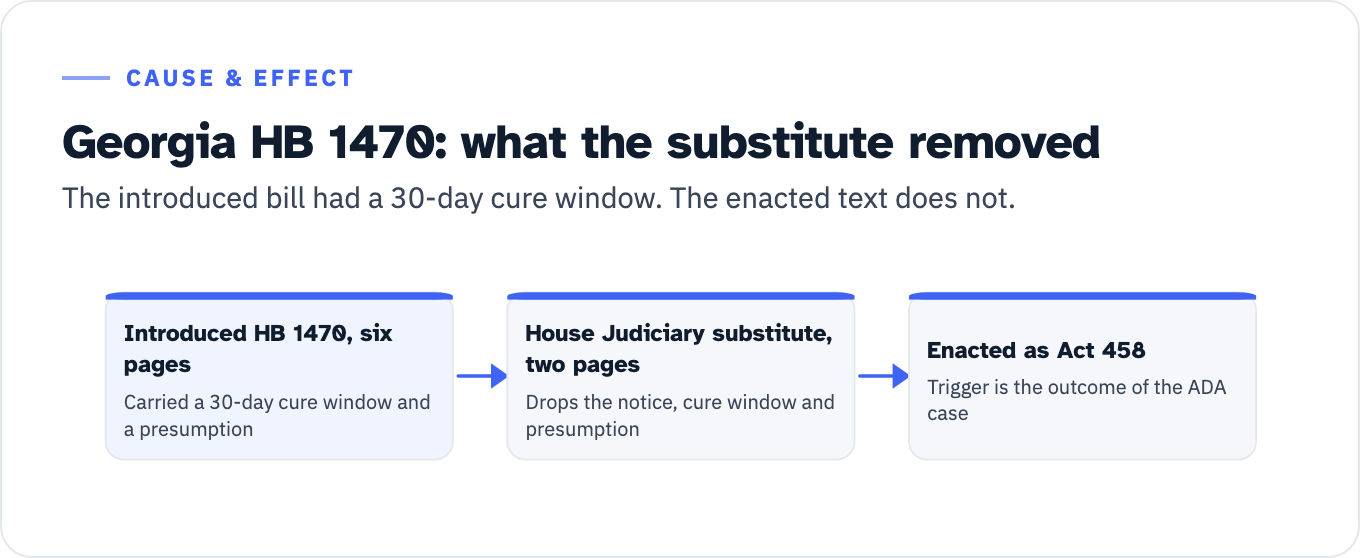
View the data as a list
- Introduced HB 1470, six pages: Carried a 30-day cure window and a presumption
- House Judiciary substitute, two pages: Drops the notice, cure window and presumption
- Enacted as Act 458: Trigger is the outcome of the ADA case
Two artifacts still carry the introduced bill’s language and are the likeliest source of the confusion: the General Assembly’s First Reader Summary, which still promises “a rebuttable presumption when corrective action is taken after receiving notice,” and the caption printed beside HB 1470 on the Governor’s 2026 signed legislation list, which is still the introduced bill’s: “Torts; abusive litigation based on alleged website access violations under federal and state law; create a cause of action.” Neither is the enacted text.
The trigger in what passed is the outcome of the ADA case, not a notice you receive:
When a civil action brought by a claimant against a person or entity of this state alleging that such person or entity operates a website that violates the federal Americans with Disabilities Act … is adjudicated on the merits against such claimant, involuntarily dismissed at any stage of the civil proceedings, or dismissed based on the claimant’s lack of standing, such person or entity shall be entitled to recover the following from the claimant and the claimant’s attorney
The recovery is actual damages for disruption of the business or other lost opportunity costs, or statutory damages of $10,000.00, whichever is greater, plus reasonable attorney fees “related to the defense of the unsuccessful action and to the prosecution of an action under this Code section.” Treble damages are available only where, before entry of judgment in the underlying action, the claimant “was given written notice of the provisions of this Code section but refused or otherwise failed to voluntarily dismiss such action.” Note what that notice is about: the Georgia Code section, not the accessibility barrier. The action must be brought within two years after entry of judgment in the underlying case, and the statute instructs that it “shall be narrowly construed and shall not be construed to alter or amend any other provision of law.”
The bill went to the Governor on April 10, 2026 and was signed on May 11 as Act 458. It took effect July 1, 2026 and applies only to causes of action accruing on or after that date.
For a Georgia business holding a demand letter today, the practical consequence is blunt. There is no 30-day window to hit and no cure record that triggers anything. You get nothing under 51-1-58 unless the claimant loses, withdraws into an involuntary dismissal, or is thrown out for lack of standing, and then you have to sue.
Does the statute reach you at all
Every one of the four is gated on where the defendant sits, not on where the website is served or where the plaintiff shops.
- Utah: a “defending party” must be a “resident,” which Utah Code 78B-3-1301(10) defines either by cross-reference to Section 53-3-102 or as “a business organization with a principal place of business or registered office located in this state.”
- Missouri: any individual residing in Missouri, any entity registered with the Missouri Secretary of State, or the state and its political subdivisions.
- Kansas: any person residing in Kansas and any entity that has filed with the Kansas Secretary of State’s office under chapter 17 of the Kansas Statutes Annotated.
- Georgia: “a person or entity of this state.”
A Delaware holding company with no Missouri registration gets nothing from RSMo 537.1250. Before you spend a dollar on the cure clock in the hope of a statutory payoff, confirm with counsel which entity is actually named in the demand letter and where that entity is registered. That single check decides whether the statutory half of this exercise applies to you at all. The evidence half applies regardless, for the reasons in the next two sections.
The federal claim runs on its own track
Title III’s private remedy comes by cross-reference from 42 U.S.C. 12188, which imports the remedies and procedures of 42 U.S.C. 2000a-3(a). There is no pre-suit notice requirement in that section, no cure period, and an express instruction the other way: “Nothing in this section shall require a person with a disability to engage in a futile gesture if such person has actual notice that a person or organization covered by this subchapter does not intend to comply with its provisions.”
The one place the statute makes good-faith effort relevant is the size of a civil penalty in a Department of Justice enforcement action under 12188(b)(1)(B), which the Attorney General may bring on a pattern or practice of discrimination or where discrimination “raises an issue of general public importance.” In such an action, “the court, when considering what amount of civil penalty, if any, is appropriate, shall give consideration to any good faith effort or attempt to comply with this chapter by the entity.” That is the Department suing. Nothing in 12188 gives a private plaintiff’s case a pause button because you started remediating.
This is the misreading that costs money. If a decision maker believes the state statute is a shield, the natural next move is to slow-walk the federal matter while the cure clock runs. The result is neither a cure nor a record, and the federal case does not move an inch.
What “sufficient detail to identify and cure” means for your file
Three of the four statutes use nearly the same phrase for what starts the clock: written notice, or a served pleading, with sufficient detail to identify and correct or cure the alleged violation. That phrase does two jobs, and both are operational.
Going in, it sets a bar on the letter you received. A notice asserting only that the site is not accessible to screen reader users, without naming pages, elements or barriers, is a different document from one that lists URLs and success criteria. Date-stamp the letter on arrival, record the exact receipt date, and have counsel write down a dated assessment of whether the notice met the statutory detail standard. That assessment is itself an artifact, and it is cheap to produce on day one and impossible to reconstruct on day 85.
Coming out, the same phrase tells you what your own record has to be able to show: that a specific, identified barrier was attempted inside 30 days or corrected inside 90, on a date, by someone with a name. A dashboard score does not do that. The published methodology says so directly. WCAG-EM 2.0, the W3C Group Note published July 23, 2026, states that “there is currently no single metric that is known to address the required reliability, accuracy, and practicality,” and that “aggregated scores can be misleading and do not provide sufficient context and information to understand the actual accessibility of a digital product.”
WCAG-EM 2.0 is the right source for the contents of the file because it says out loud why the file exists. Its Methodology Requirement 5.2 is optional, which is exactly why you have to ask for it in the engagement letter: it covers archiving the samples evaluated and recording the tools, browsers and assistive technologies used, and it gives the reason. “Evaluators may need to keep a record of the evaluation specifics to support conflict resolution in the case of dispute.” That is the exact use case a cure record serves. The Note adds that this recording “is typically kept internal and not shared by the evaluator unless otherwise agreed on” in the scoping step, which is a second reason to settle it on day 7 rather than day 85.
Requirement 5.1, which is not optional, sets the minimum contents of the evaluation record: name of the evaluator, name of the evaluation commissioner, date of the evaluation, scope of the digital product, conformance target, accessibility support baseline, technologies relied upon, the structured and random sample sets and the selection method used, the complete processes selected, and the evaluation outcomes for each. Reports “should include at least one example for each conformance requirement and WCAG 2 Success Criterion not met,” and the Note recommends clear issue descriptions, steps to reproduce, severity of the findings, and screenshots or videos. Requirement 5.2 adds “names and versions of the evaluation tools, web browsers and add-ons, assistive technology, and other software used,” along with the settings, input and actions needed to reproduce a finding and any test credentials required to reach a workflow. Requirement 5.3 defines what a public evaluation statement carries: the date it was issued, the guidelines title, version and URI, the conformance level evaluated, the definition of the digital product, the technologies relied upon, and the accessibility support baseline.
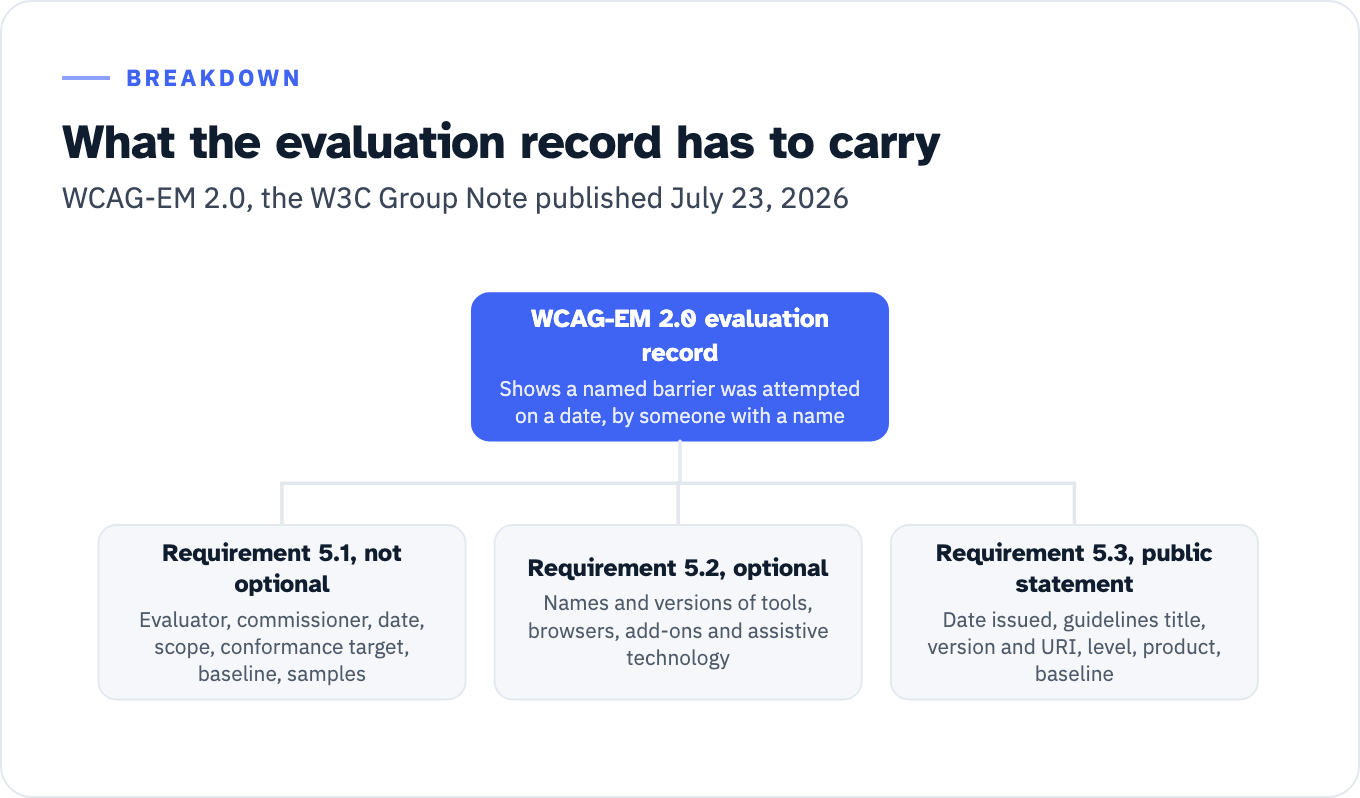
View the data as a list
WCAG-EM 2.0 evaluation record: Shows a named barrier was attempted on a date, by someone with a name
- Requirement 5.1, not optional: Evaluator, commissioner, date, scope, conformance target, baseline, samples
- Requirement 5.2, optional: Names and versions of tools, browsers, add-ons and assistive technology
- Requirement 5.3, public statement: Date issued, guidelines title, version and URI, level, product, baseline
Two of those fields answer the question of who signs. The record names the evaluator, and it names the commissioner. If your file has neither, it is a document about your website rather than evidence about a date.
Two decisions have to be made before the evaluation starts, not after: which WCAG version and level you are measuring against, and which assistive technology and versions the evaluation uses. Get the version question settled against the rule that actually binds you and the assistive technology targets named before testing begins, because both fields are part of the record under 5.1 and 5.3 and cannot be backfilled honestly.
The evidence file, day 0 to day 90
Only two dates in this calendar are statutory: day 30 and day 90. Everything between them is scheduling you choose. The calendar below produces both artifacts, so it satisfies the 30-day door in Utah and Kansas and the 90-day correction requirement in all three notice states with one run of work.
Four lanes: counsel, engineering, an independent evaluator, and the evidence file itself. The file is the deliverable; the other three lanes exist to feed it.
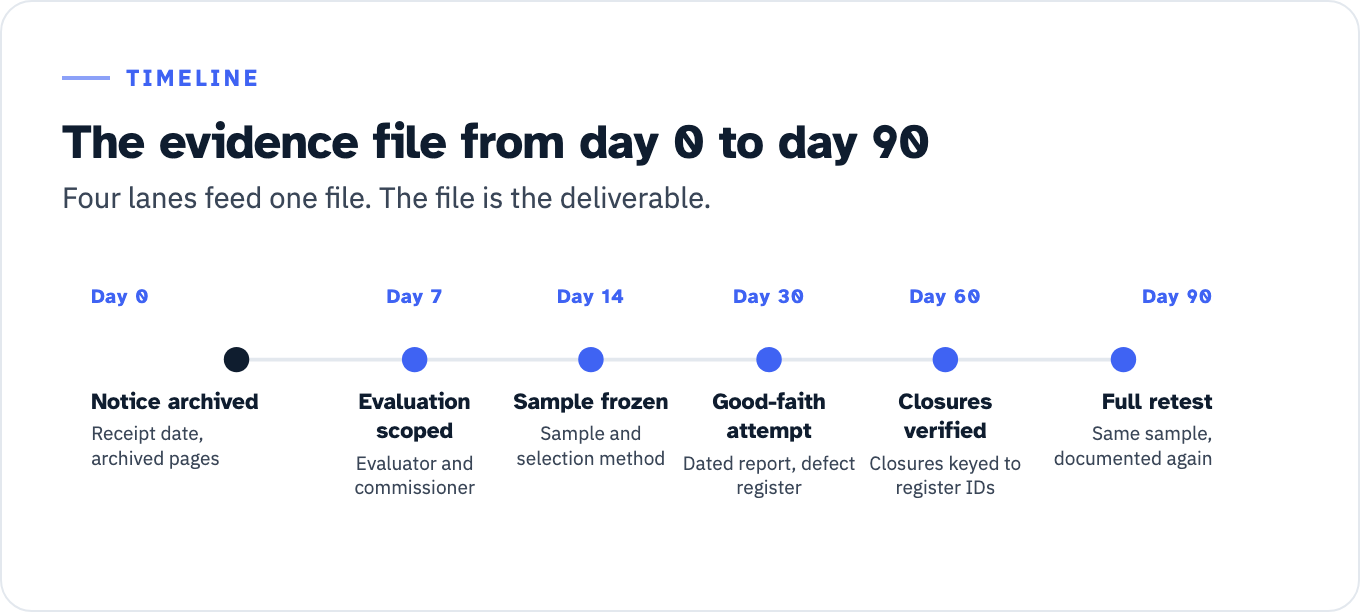
View the data as a table
| Time | Milestone | Detail |
|---|---|---|
| Day 0 | Notice archived | Receipt date, archived pages |
| Day 7 | Evaluation scoped | Evaluator and commissioner |
| Day 14 | Sample frozen | Sample and selection method |
| Day 30 | Good-faith attempt | Dated report, defect register |
| Day 60 | Closures verified | Closures keyed to register IDs |
| Day 90 | Full retest | Same sample, documented again |
| Day | Counsel | Engineering | Independent evaluator | Evidence file gains |
|---|---|---|---|---|
| 0 | Record exact receipt date of the notice and preserve the transmittal | Archive the pages named in the letter, with the build or commit identifier | Not engaged | The notice, the receipt date, an archived copy of the site as it stood |
| 7 | Dated written assessment of whether the notice carries sufficient detail to identify and cure | Confirm scope: URLs, templates, and complete processes named | Engaged; evaluator and commissioner named in writing, Requirement 5.2 recording agreed in the engagement letter | Signed engagement, named evaluator, named commissioner, conformance target and level, accessibility support baseline, technologies relied upon |
| 14 | Hold | Freeze scope changes for the sampled pages | Sample selection: structured sample, random sample and the selection method, complete processes | The sample list plus archived copies of every sampled page |
| 30 | Written response to the sender describing the steps initiated, with dates | First remediation batch merged; change log with commit identifiers and dates | Dated evaluation report: per-criterion outcomes, at least one example per failed success criterion, severity, steps to reproduce, screenshots, names and versions of browsers and assistive technologies | The day-30 artifact set: dated report, defect register with severity, change log. This is the good-faith attempt |
| 60 | Track what the court will be asked to find corrected | Second batch; defects closed against register IDs | Verification of closed items only | Per-defect closure evidence keyed to register IDs, each with a verification date and the assistive technology and version used |
| 90 | Hold | Remaining defects closed, or documented as open with a written reason | Full retest of the same sample, documented to Requirement 5.1 again, with its own completion date | Two dated evaluations of the same sample, a register showing which criteria moved, archived before and after samples, and an evaluation statement under Requirement 5.3 if you publish one |
Missouri collapses both gates onto day 90, since it wants substantial steps initiated and the violation corrected inside the same period. Utah and Kansas are the states that pay for the day-30 artifact. The day-30 artifact needs no work the day-90 retest does not already need, provided the evaluation is scoped on day 7.
A note on what the day-30 artifact is not. It is not a scan report, and it is not a vendor dashboard export. The reason is not stylistic. Requirement 5.1 asks for a named evaluator, a named evaluation commissioner, a date, a conformance target, an accessibility support baseline and the technologies relied upon; Requirement 5.2 asks for the names and versions of the assistive technologies used. A file that cannot produce those fields cannot show that a named barrier was attempted on a date, whatever else it shows. Before accepting any third-party output into this file, run it against the test-evidence acceptance questions a reviewer will ask. If the current plan is a widget subscription, understand first what an overlay vendor’s conformance claim can and cannot support.
What a record that does not exist looks like
There is a public document that shows the failure mode better than any hypothetical, and it involves no client data.
On February 2, 2026 the United States filed a Statement of Interest in Alcazar v. Fashion Nova, Inc., No. 4:20-cv-01434-JST (N.D. Cal.), docket entry 214 (filing; DOJ case page). The authority is 28 U.S.C. 517 plus the Class Action Fairness Act notice scheme at 28 U.S.C. 1715, and the objection is framed against the Rule 23(e)(2) fairness inquiry as applied in Briseño v. Henderson, 998 F.3d 1014, 1022 (9th Cir. 2021). This is an objection in a filing. It is not a holding, and the settlement is still under submission.
Read the numbers carefully, because the press release compresses them. Fashion Nova agreed to pay $5.15 million into a non-reversionary common fund for the California Class. From it, class counsel sought 25 percent, or $1,287,500, in fees, and separately $1,235,259.03 in costs. The settlement administrator’s compensation was set at $200,000 and the named plaintiff sought a $1,000 service award. Approximately $2.43 million remained to be divided among California Class members filing timely valid claims, which DOJ described as less than half of Fashion Nova’s payment. The DOJ press release of February 2, 2026 compresses the two into “over $2.52 million in attorneys’ fees and costs.” That $2.52 million figure is fees and costs together, not fees.
The part that matters for your file is the injunctive relief. The entire nationwide-class remediation commitment was one sentence, quoted in the United States’ filing: “To the extent it has not already done so, Fashion Nova shall modify Fashion Nova’s [w]ebsite as needed to achieve substantial conformance with WCAG 2.1 (“Injunctive Measures”).” The United States objected on the basis that this relief “is not meaningful”, being in its words “a mere recitation of the obligation to make visually delivered materials available to individuals who are blind or low vision with no confirmation or enforcement mechanism”.
The specifics of what was missing are the negative template for the swimlane above. Per the United States’ description of the agreement: Fashion Nova had to adopt a Website Accessibility Policy, but there was no mechanism for the class to review it and the agreement expressly stated that the plaintiff’s or class counsel’s approval of the policy was not required. The plaintiff made no commitment to confirm or monitor compliance, and the defendant was not required to engage third-party or user testing. Class counsel’s compliance audit was optional and at their own expense; if performed, they were required only to give Fashion Nova a copy and to meet and confer in good faith; and the option to perform it appears to have expired on December 14, 2025, the audit being due at least 60 days before the final approval hearing then set for February 12, 2026. A remediation promise with an optional, unexercised audit, no independent testing and no enforcement mechanism is exactly the shape of a cure record that was never built. Every one of those gaps corresponds to a field in Requirement 5.1: a named evaluator, a named commissioner, a date, a defined sample.
The filing also forecloses a misreading of itself. The United States wrote that it “does not endorse WCAG as the appropriate or necessary standard for the provision of auxiliary aids and services under Title III of the ADA,” and applied WCAG only because the plaintiff had elected that standard in the proposed settlement. This filing is not DOJ adopting WCAG for Title III.
Procedurally: Judge Tigar held an evidentiary hearing on March 30, 2026, recorded in the minute entry as two hours and nine minutes, and took the matter under submission. No order granting or denying final approval appears on the public docket as of July 27, 2026.
Colorado and California: two laws that answer a different question
Colorado HB24-1454 is not a business grace period. It gave state agencies and public entities a conditional one-year extension, to July 1, 2025, of immunity from liability for failure to comply with Colorado’s own digital accessibility standards, available to an agency demonstrating good-faith efforts and conditioned on posting quarterly progress reports and creating a redress process (enacted bill summary). Colorado’s own Office of Information Technology states that it “is not an automatic extension” (OIT FAQ). It expired on July 1, 2025, it never applied to a private business, and it never touched a federal ADA claim.
California’s high-frequency litigant rules do not reach a website-only claim. Code of Civil Procedure section 425.55 defines a high-frequency litigant by reference to “alleged construction-related access violations.” The California provision that does matter to a website demand letter is on the money side: Civil Code section 52(a) sets Unruh Act damages at up to three times actual damages “but in no case less than four thousand dollars ($4,000)” per offense, plus fees. That statutory minimum is state-law damages, not ADA damages. Title III reserves money to the government: 12188(b)(2)(B) lets a court award “monetary damages to persons aggrieved when requested by the Attorney General,” in the enforcement action described above, and 12188(b)(4) excludes punitive damages from it. A California website matter therefore carries a damages floor that a federal-only matter does not.
None of the four abusive-litigation statutes mentions California or the Unruh Act. The only one of them that states a motive on the face of the statute is Kansas, and it names something else: the legislature found that in a small minority of cases litigation is being abused “for the primary purpose of obtaining an award of attorney fees for the plaintiff instead of remedying the alleged access violation,” in suits that “are almost always filed in another state’s court system against smaller Kansas businesses.”
Your next step
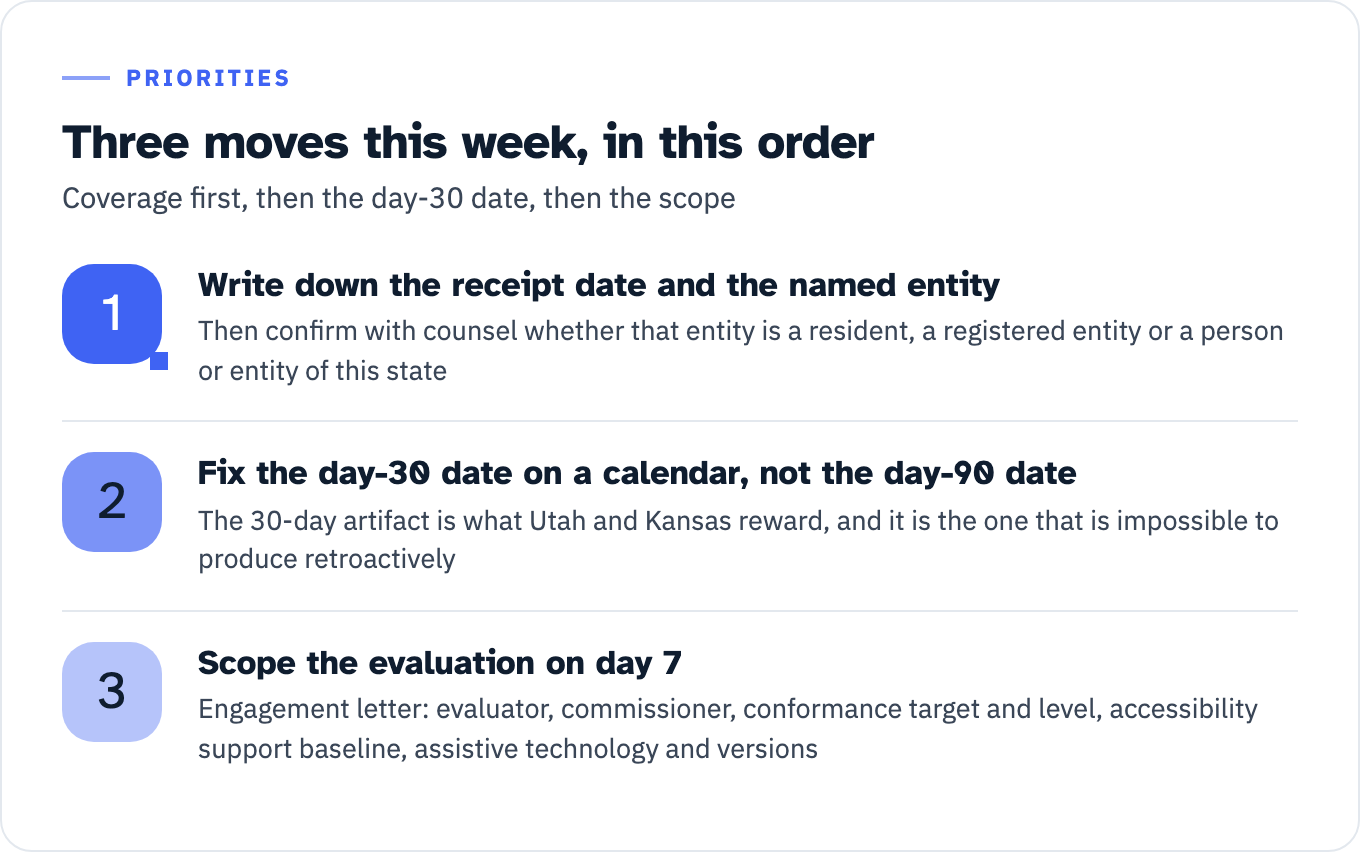
Do three things before the end of the week, in this order.
- Write down the receipt date of the notice and the exact legal entity named in it, then confirm with counsel whether that entity is a resident, a registered entity or a “person or entity of this state” in Kansas, Utah, Missouri or Georgia. If it is none of those, the statutory payoff is off the table and the evidence file becomes a purely commercial decision about the federal matter.
- Fix the day-30 date on a calendar, not the day-90 date. The 30-day artifact is what Utah and Kansas reward, and it is the one that is impossible to produce retroactively.
- Scope the evaluation on day 7 and put five fields in the engagement letter: the evaluator, the commissioner, the conformance target and level, the accessibility support baseline, and the assistive technologies and versions. Add the Requirement 5.2 recording as a deliverable rather than an option. Those are what turn a report into evidence.
View the data as a list
- Write down the receipt date and the named entity: Then confirm with counsel whether that entity is a resident, a registered entity or a person or entity of this state
- Fix the day-30 date on a calendar, not the day-90 date: The 30-day artifact is what Utah and Kansas reward, and it is the one that is impossible to produce retroactively
- Scope the evaluation on day 7: Engagement letter: evaluator, commissioner, conformance target and level, accessibility support baseline, assistive technology and versions
If you want the day-30 and day-90 artifacts produced to Requirement 5.1 and 5.2, with a defect register carrying severity and steps to reproduce and a dated retest of the same sample, that is what a WCAG audit and retest engagement delivers. Send the demand letter and the list of URLs it names, and we will scope the sample and the calendar against your day 30.
For the wider question of who is being sued and on what basis, see the reconciliation of the 2025 and 2026 web accessibility filing datasets.